Entries by Candace Wolmarans

The Slow Month Isn’t a Tactic Problem — It’s a Diagnosis Problem

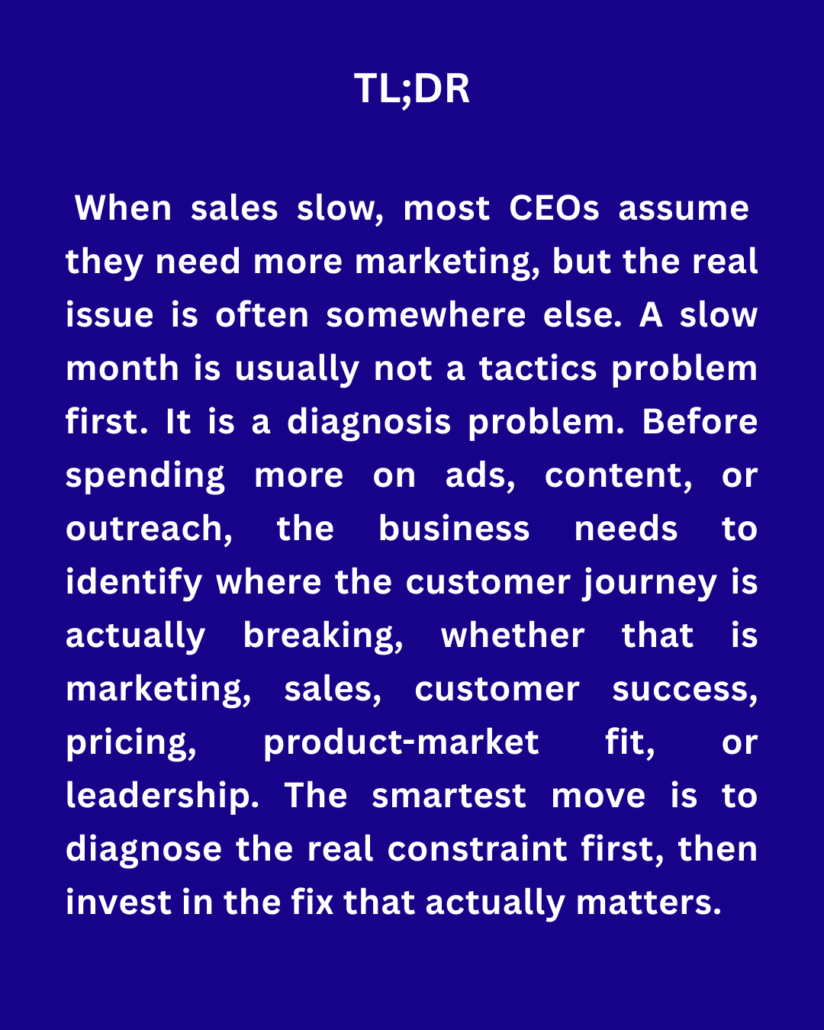
A marketing diagnostic maps the full customer journey from initial awareness through closed sale and post-sale expansion to identify where revenue is actually breaking down. Most stalled sales are not a marketing problem. They are a sales conversion failure, a customer success gap, or a product that has drifted from what the market wants. The diagnostic tells you which one before you spend another dollar trying to fix the wrong thing.

When business slows, something has to change. A CEO feels it immediately. Sales flatten or dip. The pipeline looks wrong. Revenue stalls. And suddenly, every assumption about what’s working gets questioned.

Most CEOs respond the same way. They ask the wrong question.

They ask, “What should we do more of.”

That question almost always leads to the same answers. More ads. More content. More cold calls. More networking. More outreach. More, more, more. The assumption is that the problem is visibility. Not enough people know about us. So we need to do more marketing.

Sometimes that’s right. Most of the time, it’s not.

The better question is the one nobody wants to ask. “What is actually broken.”

That’s a harder question. It requires thinking. It requires data. It requires honesty. But it’s the only question that leads to a real answer.

Let me give you the context. I work with a lot of CEOs in the 5 to 50 million dollar range. And I see a pattern. When a CEO comes to me and says their sales have stalled, the first thing I do is not recommend more marketing. The first thing I do is get curious.

Because most of the time, the problem isn’t marketing.

Sometimes it is. Sometimes the market has shifted and nobody knows about them. Sometimes their positioning is broken. Sometimes they’ve stopped reaching out. Sometimes their content is old.

But a lot of the time, it’s something else entirely. It’s a sales process that got sloppy. It’s a product that drifted from the market. It’s a team that’s burnt out and stopped selling. It’s a pricing structure that doesn’t fit the market anymore. It’s a customer success team that’s not creating advocates. It’s the CEO that stopped talking to customers.

All of those look like a marketing problem from the outside. But they’re not. And if a company invests in more marketing, they’re treating the symptom, not the disease.

That’s expensive.

The fog that felt manageable during growth becomes a real cost when the number goes flat. And most CEOs at this stage have never had a structured way to see where the wall is.

Here’s how this works in practice.

When sales slow, there are three things that could be happening. One: your marketing isn’t working. Two: your sales process isn’t converting. Three: your customer success is falling apart and you’re not getting referrals or expansion revenue.

Most CEOs assume it’s one. They start throwing money at marketing. But if it’s two or three, that money is wasted. And now they’re frustrated because they’re spending and nothing is moving.

That’s where the diagnostic comes in.

The diagnostic is simple. You map the entire customer journey. You understand how awareness happens. You understand how a lead gets qualified. You understand how a sale gets closed. You understand how customers get activated. You understand how expansion happens. You understand where it breaks.

Once you see where it breaks, you know what to fix. You don’t guess. You don’t assume. You know.

I worked with a company that was convinced their problem was awareness. Sales had stalled. They weren’t getting enough leads. So they wanted to increase marketing spend. The diagnostic revealed something different. They were getting plenty of leads. But their sales team wasn’t converting them. The sales process was broken. Awareness wasn’t the problem. Sales leadership was.

They would have wasted hundreds of thousands of dollars on more marketing if they’d made that assumption.

That’s the cost of bad diagnosis.

The reason most CEOs skip the diagnosis is that it feels slow. You’re not doing marketing. You’re not running ads. You’re not posting. You’re asking questions and looking at data. It feels passive.

It’s not. It’s the most important work you can do

Here’s what the diagnostic tells you. It tells you where the wall is. It tells you whether marketing is the constraint or whether something else is. It tells you what to invest in next. It tells you what you can ignore. It tells you where the CEO’s attention needs to go.

And here’s the thing. The cost of getting the diagnosis wrong is exponential. The cost of the diagnostic is nothing.

So if your sales have stalled or plateaued, before you do anything else, ask the right question. Not “What should we do more of.” Ask “What is actually broken.”

Then do the work to find out. Map the system. Look at the data. Talk to your team. Talk to your customers. Understand the feedback. Understand where the signal is going wrong.

You might find that you need more marketing. Or you might find that you need a sales overhaul. Or you might find that your product doesn’t fit the market anymore. Or you might find that your CEO is holding the plate and nobody else can see the strategy.

But you’ll know. And that knowledge is worth way more than another ad spend.

FAQ  

Q1: What does a marketing diagnostic actually look for?

A marketing diagnostic maps five stages of the customer journey: awareness, lead qualification, sales conversion, customer activation, and expansion revenue. It identifies which stage is breaking down and whether the cause is a marketing issue, a sales process issue, or a customer success issue.

Q2: How is a marketing diagnostic different from a marketing audit?

A marketing audit reviews what marketing tactics are in place and how well they are performing. A marketing diagnostic goes upstream and asks whether marketing is even the right place to invest, or whether the constraint is in sales, product, or customer success.

Q3: When should a CEO run a marketing diagnostic?

The best time is before making any new marketing investment after a plateau or revenue dip. It can also be run proactively as an annual strategic review to catch drift before it becomes a problem.

Q4: What are the most common reasons B2B sales stall?

The most common non-marketing causes include a sloppy sales process, product drift from the market, team burnout, misaligned pricing, weak customer success, and a CEO who has stopped talking to customers directly.

Q5: How do I know if my sales process is the problem versus my marketing?

If you are generating leads but not converting them, the sales process is the constraint. If leads are not entering the pipeline at all, marketing is the problem. The diagnostic makes this measurable.

Q6: What is the cost of skipping a diagnostic?

A company that misidentifies the constraint and invests in more marketing when the sales process is broken can waste hundreds of thousands of dollars without moving the needle. The diagnostic eliminates that risk.

Q7: How much does a B2B marketing diagnostic cost?

A structured 30-day marketing diagnostic from a fractional CMO practice typically costs between $3,000 and $5,000 and covers the full customer journey across all four evaluation dimensions.

Q8: Do I need a full-time CMO to run a marketing diagnostic?

No. A fractional CMO can run a complete diagnostic in 30 days without the cost or commitment of a full-time hire. The diagnostic itself often determines whether a full-time CMO investment is warranted.

Q9: Marketing diagnostic vs. sales audit. What is the difference?

A sales audit focuses exclusively on the sales team, process, and pipeline. A marketing diagnostic covers the entire revenue system, including how leads are generated, how they are converted, and how customers are retained and expanded.

Q10: What happens after the diagnostic is complete?

The diagnostic produces a prioritized roadmap that identifies the highest-leverage fixes, the sequence to address them, and whether marketing, sales, or customer success requires the most urgent investment.

Mark Toney is a fractional CMO with 20+ years of experience working with CEOs in the $5M to $50M range. He is the founder of Luce Media and the creator of the Executive Marketing Readiness Review. This diagnostic framework comes from running 30-day marketing reviews with founder-led B2B companies.

Why Your Marketing Problem Is Actually a Leadership Problem – And How to Fix It

The Marketing Problem Isn’t a Marketing Problem – It’s a Leadership Problem

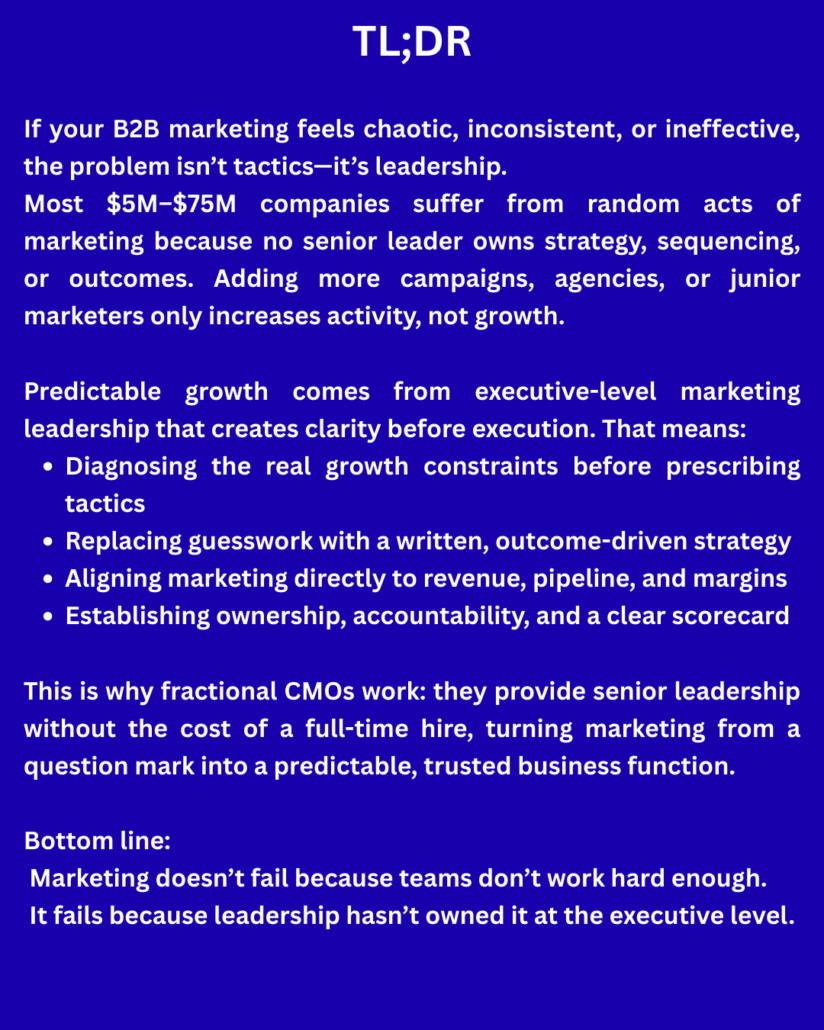
For CEOs leading B2B companies in the $5 million to $75 million range, the feeling is all too familiar. Growth has stalled or feels inconsistent. Your marketing efforts are fragmented into a series of disconnected “random acts of marketing.” You find your team relying on instinct instead of a documented strategy, and as a result, the entire function feels like a constant question mark. You know something needs to change, but the path forward is unclear.

When faced with this uncertainty, the common impulse is to look for tactical fixes: a new social media campaign, a different ad vendor, or perhaps hiring a more junior person to “do more marketing.” This approach rarely delivers the predictable growth you need, and the cycle of guesswork continues.

But what if the solution isn’t more marketing, but a completely different way of thinking about it? What if the root of the problem isn’t in your tactics at all?

The solution lies in four fundamental shifts in perspective that move a business from strategic ambiguity to predictable growth. These shifts aren’t just theoretical—they’re backed by research and proven results from companies that have successfully transformed their marketing function from chaos to certainty.

Marketing Isn’t a Tactical Problem, It’s a Leadership Problem

When growth stalls, leaders often misdiagnose the cause. According to research on CEO-CMO alignment, less than 40% of CEOs grade their marketing leaders as an “A” for driving growth, indicating a fundamental disconnect between expectations and results. The typical response is to seek tactical solutions, assuming the business needs more tactics, more junior execution, or a new set of disconnected vendors.

Here’s what those “random acts of marketing” actually look like in practice:

Sporadic social posts with no content strategy or measurable connection to pipeline development. One-off email blasts that go to undefined audiences with no nurture sequence. Vanity SEO spending on keywords that don’t align with your ideal customer profile. Expensive trade show appearances with no follow-up process or ROI measurement.

These patterns usually emerge from habit (“we’ve always done this directory ad”), reactive decisions (“the CEO saw a trend on LinkedIn”), or pressure (“sales wants more collateral now”), rather than a strategy anchored to clear outcomes. Research from B2B marketing consultancies shows these scattershot tactics burn budget and attention while creating misleading activity metrics that look busy but mask the fact that revenue, win rates, and sales cycle times are not improving.

The breakthrough moment for any CEO is the realization that this chaos is a symptom of a leadership gap, not a tactical deficiency. The root cause is almost always a lack of senior ownership. Your marketing isn’t just a set of activities; it’s a multi-level ecosystem, and without executive-level guidance, that ecosystem becomes fragmented.

McKinsey’s research on CEO-CMO partnerships reveals that companies where the CMO is deeply involved in strategy are 1.4 to 2 times more likely to achieve annual revenue growth of more than 5%. This underscores that senior-level marketing ownership is a structural advantage, not a luxury.

To resolve the chaos, marketing must be reframed as a predictable, executive-level function, not a series of tasks delegated downward. The CEO realizes that marketing cannot be delegated downward or outsourced tactically; it requires senior leadership, sequencing, and ownership.

The Real Goal Is Clarity, Not Just More Activity

Once you accept that marketing is a leadership function, the next logical question is: what does that leadership produce? Most leaders believe marketing’s job is to produce campaigns and content. They’re wrong.

The actual product of a high-functioning marketing leader is freedom from strategic ambiguity—or what experienced fractional CMOs call “Marketing Certainty.” It’s about moving from uncertainty to a credible, step-by-step path forward that doesn’t rely on guesswork.

This clarity is the force that repairs the fragmented ecosystem. It unlocks a powerful progression that moves the entire organization forward in a structured way:

The path forward: clarity → coherence → confidence → ownership

This progression is so impactful because it replaces instinct with a visible, written strategic marketing plan, often for the first time. Within approximately 45 days, the leadership team can align on a shared understanding of the business’s growth engine and trust that a transparent process is finally in place to drive execution.

CEOs tend to evaluate marketing on revenue growth and margins, while many marketing teams default to softer engagement metrics like likes, shares, or website traffic. This disconnect deepens the sense that marketing is unclear, inconsistent, and hard to trust. Strategic clarity closes this gap by ensuring every marketing activity connects directly to business outcomes.

When there is no documented executive-level marketing strategy, teams default to “doing more” rather than “doing the right few things better,” which is why activity volume goes up while confidence goes down. This is precisely why hiring a junior marketer or adding another agency vendor doesn’t solve the underlying problem.

Why a Junior “Doer” or New Agency Doesn’t Fix the Problem

Many CEOs believe the solution to marketing chaos is hiring a junior marketer or bringing in a new agency. This approach virtually guarantees continued frustration. Here’s why:

Hiring a junior marketer without a strategy effectively delegates complex positioning, segmentation, and revenue architecture to someone who has never done it before. This reinforces reactive, channel-first execution rather than strategic thinking. You’re asking someone to build the plane while flying it, and they’ve never built a plane before.

Agencies are optimized to sell execution: Tactics like ads, content, SEO, and campaigns. Agencies excel at “doing,” but they typically cannot provide the senior leadership required to determine what should be done, why, and in what sequence.

In mid-market B2B firms, the gap is often that marketing is either under-leveled (owned by a junior generalist) or outsourced piecemeal to agencies with no one accountable for the integrated plan. This creates a scenario in which everyone is busy, but no one owns the strategy.

This is the context in which a fractional CMO becomes valuable: not as “another vendor,” but as the missing owner of the overall growth narrative, trade-offs, and scorecard. A fractional CMO brings senior leadership, strategic frameworks, and decision-making at a fraction of the cost of a full-time executive, typically the right solution for companies that are too complex for ad hoc marketing but not yet ready for a full-time CMO.

You Must Diagnose Before You Prescribe

Achieving clarity isn’t a matter of opinion or brainstorming. It can only be built on an honest, unflinching diagnosis of the business. Jumping into solutions without this diagnostic phase is the very definition of “random acts of marketing.” A structured approach begins by helping leadership clearly see why their current approach cannot deliver predictable growth. The diagnosis itself is what reframes the problem, shifting the focus from tactics to leadership.

In my experience working with mid-market B2B companies, a successful diagnosis is marked by a series of powerful epiphanies. A CEO should find themselves saying:

  • “This explains why what we’re doing feels scattered.”
  • “I finally understand what’s missing.”
  • “I can see why tactics alone won’t solve this.”
  • “This makes the next step obvious.”

This diagnostic clarity, often facilitated by an experienced executive resource like a fractional CMO, allows a business to understand precisely where growth is breaking down, what to fix first, why it matters, and how all the pieces fit together.

What a proper diagnostic phase includes:

Research-backed fractional CMO frameworks typically spend the first 30 days almost entirely on discovery. This includes 8 to 10 stakeholder interviews with founders and key customers, pipeline and win-loss analysis to understand what’s actually converting, marketing asset inventory to assess what exists, website and conversion review to identify funnel leaks, and mapping of current tech stack and agency relationships to understand resource allocation.

The main deliverable for this phase is an executive-level diagnostic: a baseline KPI scorecard that shows where you actually stand, a map of the current funnel with conversion rates at each stage, and a gap analysis that calls out what’s broken or missing and the cost of those gaps.

Many effective frameworks also emphasize identifying “quick wins” in this phase, patching obvious funnel leaks such as broken calls-to-action, slow demo scheduling, or poor lead routing. These quick wins demonstrate early lift and build confidence without pretending a complete strategy is already in place.

Before this diagnosis, the CEO typically believed the marketing strategy was either non-existent, something they’d never actually done, or an expensive exercise that hadn’t felt practical or worth the effort. After this phase, they understand exactly where growth is breaking down, why it’s happening, and how a structured, strategic marketing process resolves it.

You’re Investing in a Leadership Shift, Not Just a Process

Perhaps the most profound takeaway is that transforming marketing from a chaotic function to a predictable one is more than just implementing a new plan. It represents a fundamental change in the organization’s identity and leadership.

This is not a process. This is an identity and leadership shift.

This means reframing marketing as a core executive responsibility, integrated at the highest level of the company. It’s a shift that allows the entire multi-level ecosystem—from strategy to execution—to work without the fragmentation that plagues so many businesses.

When this transformation occurs, the CEO no longer has to decide whether they’re doing the proper marketing, enough marketing, or any marketing at all—because there is a visible, documented strategy and a transparent process driving execution. Marketing becomes a well-managed, predictable, and strategic function that the entire leadership team can trust.

This is the crucial final step that enables long-term, predictable growth because the responsibility for that growth is no longer siloed or delegated; it is owned and managed at the executive level.

From Question Mark to Predictable Function

Replacing marketing chaos with predictable growth requires a fundamental change in perspective. It demands a move away from tactical guesswork and toward a strategy-led approach owned by senior leadership. It’s about achieving clarity, diagnosing problems correctly, and understanding that this is ultimately a shift in leadership, not just a change in activities.

The research is detailed: companies with senior-level marketing leadership deeply involved in strategy significantly outperform those that delegate marketing downward or treat it as a tactical function. The difference isn’t in the tactics themselves; it’s in the strategic clarity, ownership, and accountability that senior leadership provides.

When this transformation occurs, marketing ceases to be a source of frustration and uncertainty. It becomes a well-managed, predictable, and strategic function that the entire leadership team can trust.

Ultimately, you must ask yourself:

Is marketing something you are delegating, or is it a predictable, executive-level function you are prepared to own?

If you’re ready to replace strategic ambiguity with Marketing Certainty, the first step is gaining clarity on where your marketing ecosystem is actually breaking down—and what it will take to fix it. That clarity begins with an honest diagnostic assessment that shows you exactly what’s missing and provides a credible path forward.

eco-friendly print options?

Fractional CMO + Creative Team: Healthcare Growth Model

Why High-Growth Healthcare Companies Are Abandoning Agencies for an All-in-One Strategic Engine

Your practice is growing. Maybe you’ve got multiple locations or you’re planning to expand. Patient volume is decent.

But here’s the problem that keeps you up at night: your marketing feels like herding cats in a thunderstorm.

You’ve got a web designer who takes three weeks to update a landing page. A social media person posting random content. An SEO consultant sending reports you don’t understand. Maybe a videographer you found on Facebook who ghosted you after shooting one patient testimonial.

Nobody’s talking to each other. Nothing connects. And you—the CEO or owner—are stuck in the middle, trying to translate between all these vendors while also running your actual business.

Oh, and let’s not forget:

  • Patient acquisition costs keep climbing
  • The DSO down the street just opened with a massive marketing budget
  • Your online reviews need constant attention
  • Every marketing piece needs HIPAA review before it goes live
  • Insurance reimbursements keep shrinking while your marketing spend grows

Sound familiar?

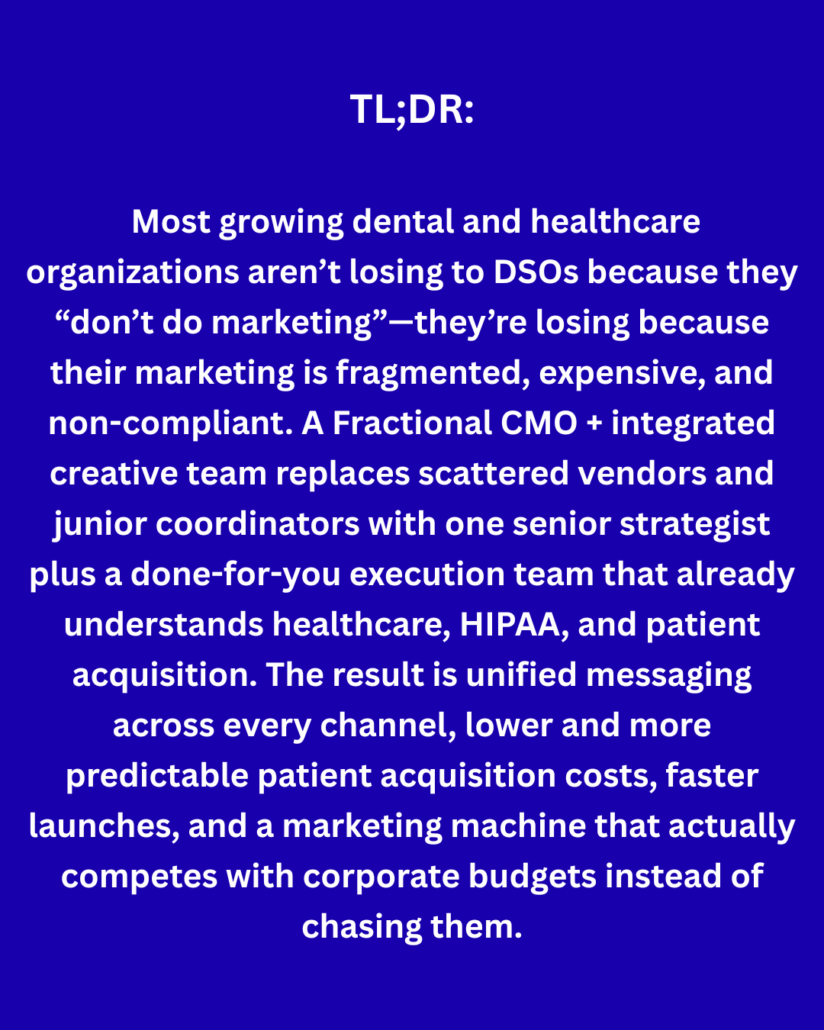
Most healthcare and dental organizations don’t fail because they’re not doing marketing. They fail because their marketing is completely fragmented.

It’s not a system. It’s a scavenger hunt with a Black Card.

And it’s exactly why smart healthcare CEOs are shifting to a completely different model: the Fractional CMO + Creative Team.

Let me show you why this model is quietly becoming the unfair advantage for practices and health organizations serious about predictable growth—especially in a market where DSOs and corporate healthcare are outspending independent practices 10-to-1.

What Is the Fractional CMO + Creative Team Model?

Before we dive into why this works, let’s get clear on what this actually is.

A Fractional CMO is a senior marketing executive who works with your organization part-time. Think C-suite level strategic thinking without the $250K salary, benefits, equity package, and six-month ramp-up period.

But here’s where it gets interesting.

Most fractional CMOs work alone. They give you strategy, hand you a beautiful roadmap, and say “good luck finding people to execute this while maintaining HIPAA compliance.”

The Fractional CMO + Creative Team model is different.

You get the strategic brain—the CMO who builds your roadmap, owns your positioning, and knows how to compete against well-funded DSOs—plus an integrated creative team that can actually execute everything under healthcare compliance requirements.

Same ecosystem. Same vision. One unified force.

It’s like having a full marketing department that understands HIPAA, patient acquisition, and reputation management, minus the office politics, hiring headaches, and massive overhead.

  1. You Finally Get Real Strategy (From Someone Who Actually Knows How to Build One)

Here’s what typically happens when a dental practice or healthcare organization hires a marketing agency:

They start with tactics.

“Let’s run some Google Ads!”
“You need more social media!”
“Let’s redesign your website!”

But nobody asks the important questions first:

  • Who exactly are we targeting, and why should they choose us over the DSO with the billboard on the highway?
  • What makes us different when every practice says “caring, compassionate, state-of-the-art”?
  • Which marketing channels will actually drive new patients without blowing our acquisition costs through the roof?
  • How do we compete when corporate practices have 10x our marketing budget?
  • How do we build trust online when one bad review can tank our reputation?
  • What should we build first, second, and third—and how does this all tie to revenue goals?

know your customer

A Fractional CMO starts with alignment, forecasting, positioning, audience design, and channel strategy.

Before a single ad runs or a single post goes live, you get:

  • A 12-18 month marketing roadmap that ties directly to revenue targets and patient acquisition goals
  • Competitive positioning that differentiates you from DSOs and corporate practices
  • Priority sequencing (what to tackle first and why—not just what’s trendy on LinkedIn)
  • A measurable, revenue-focused plan built on realistic patient acquisition costs, not vanity metrics
  • Messaging that actually sets you apart from every other practice in your market
  • A reputation management strategy that turns reviews into your competitive advantage

This is the strategic layer that freelancers, junior marketing coordinators, and most agencies simply aren’t equipped to build—especially in healthcare where compliance and reputation are everything.

Real-world example: A multi-location dental group was watching patient acquisition costs climb to $400+ per new patient while a nearby DSO was dominating local search. Their fragmented marketing approach led to different messaging at each location, an inconsistent online presence, and no clear positioning against corporate competitors. After bringing in strategic leadership through a Fractional CMO + Creative Team model, they repositioned around a specific patient demographic (families who value personalized care over corporate convenience), unified their brand across locations, and built a reputation management system that showcased their difference. Patient acquisition costs dropped to $240 within six months, and they started winning the “mom research” battle against the DSO.

  1. Then You Get Instant Execution—Without Hiring a 6-Person Internal Team

Here’s where this model moves from “interesting” to “game-changing.”

Strategy without execution is just a fancy PDF that sits in your Google Drive while your competitors keep stealing your patients.

Most fractional CMOs leave you to figure out the execution part. You’re back to hiring freelancers, begging your niece who “knows Canva,” or trying to train someone internally who’s never done healthcare marketing before.

And here’s what makes healthcare execution even harder:

  • Every piece of content needs HIPAA review
  • Patient testimonials require proper consent and releases
  • Before-and-after photos have specific regulations
  • Claims about procedures need to be carefully worded
  • Online reputation requires constant monitoring
  • Video content needs to feel authentic, not corporate

With the Fractional CMO + Creative Team model, you get both strategy and execution under one roof:

  • Graphic designers (who understand healthcare branding, HIPAA compliance, and how to compete visually against DSO marketing)
  • Copywriters (who can write patient-facing content that converts without making illegal claims)
  • SEO specialists (who know local search for healthcare and how to outrank corporate practices)
  • Video producers (because video is no longer optional—it’s how patients research you)
  • Content strategists (who plan months ahead with compliance built in)
  • Social media + distribution experts (who understand healthcare advertising restrictions)
  • Reputation management specialists (who monitor and respond to reviews strategically)

No more chasing vendors.
No more training junior staff on HIPAA.
No more duct-taping deliverables together and hoping they’re compliant.

The Fractional CMO leads the strategy.
The creative team executes the strategy.
You get speed plus accuracy plus compliance without the payroll burden.

Think about what this means practically:

  • Need a HIPAA-compliant patient education video series? Done in two weeks, not two months.
  • Need your website rewritten with clear positioning against DSOs? Handled with proper compliance review.
  • Need a 6-month content calendar for SEO and social? Mapped, created, and scheduled.
  • Need reputation management protocols for responding to reviews? Built and monitored.
  • Need email campaigns for patient reactivation? Created and deployed with proper opt-in management.

All from people who already understand your strategy, your compliance requirements, and your competitive landscape.

  1. Every Marketing Channel Finally Pulls in the Same Direction

Let’s talk about what happens when your marketing is fragmented—especially when you’re competing against well-funded DSOs.

Your website says you’re “comprehensive and caring.”
Your Google Ads say you’re “affordable and convenient.”
You’re posting generic dental memes on social media.
Your SEO blog is keyword-stuffed articles written by someone who’s never set foot in a dental office.
Your video content looks like it’s from a completely different practice.
Your reviews are all over the place because no one is managing your reputation strategically.

Meanwhile, the DSO down the street has consistent branding everywhere, a unified message, and they’re outspending you 10-to-1.

When your brand, SEO, video, social, website, messaging, and reputation management come from different people who’ve never talked to each other, you end up with:

  • Inconsistent tone (sounds professional here, casual there, corporate over there)
  • Misaligned visuals (your brand doesn’t look like a brand—it looks like a DIY project)
  • Conflicting priorities (everyone’s pushing their own agenda instead of patient acquisition)
  • Weak positioning against DSOs (you can’t compete on budget, so you need to compete on message—but what IS your message?)
  • Lost revenue (because confused patients book with the DSO that seems more “together”)

When everything comes from one strategic brain with one unified creative team, you get:

  • Messaging that compounds (every touchpoint reinforces the same positioning against corporate competition)
  • Content that reinforces your brand story (not random posts about National Smile Day)
  • Videos that match your visual identity and message (cohesive, professional, authentic)
  • SEO content built on the same strategy as your social content and your reputation management (everything works together)
  • A website that actually converts because the message is crystal clear: “Here’s why we’re different from the corporate place”
  • Reputation management that turns reviews into a competitive weapon (responding strategically, showcasing your difference)

It feels like someone finally turned all the lights on.

Patients start saying things like, “Your practice really stands out,” or “I can tell you’re not like those chain dentists,” or “Your online reviews made me feel like I’d be cared for as a person, not a number.”

That doesn’t happen by accident. It happens when strategy, execution, and reputation management are unified.

  1. It Removes 90% of Your Marketing Risk (Especially the Compliance Kind)

Let’s be honest: hiring for marketing in healthcare is a gamble with really expensive stakes.

You hire a marketing coordinator. Six months in, you realize they’re in over their head—and they just posted something on Instagram that might be a HIPAA violation.

You hire an agency. They create gorgeous content. Then you find out they’ve been making claims about procedures that aren’t FDA-approved language.

You hire a CMO full-time. They don’t understand healthcare compliance. Eighteen months and $300K later, they’re gone and you’re starting over.

The Fractional CMO + Creative Team model reduces risk in four specific ways:

Risk #1: Compliance Failures

Healthcare marketing has landmines everywhere. HIPAA violations. Improper patient testimonials. Misleading procedure claims. A unified team with healthcare experience knows these rules inside and out. Your content gets created right the first time.

Risk #2: Underperformance

If a campaign or channel underperforms, the same team diagnoses it and fixes it. No fingerpointing between your SEO person, your web developer, and your ad manager. No “well, the design was fine—your copy must be the problem.” One team owns the entire patient acquisition funnel.

Risk #3: Onboarding Churn

Every time you hire a new vendor or employee, there’s a 30-90 day learning curve. They need to understand your brand, your patients, your clinical capabilities, HIPAA requirements, your competitors, and your goals. With an integrated team, that learning curve happens once. Every project after that builds on existing knowledge.

Risk #4: The Vendor Blame Game

When your SEO consultant blames your web developer, who blames your content writer, who blames your designer, who blames your social media manager—you lose time and money. With one unified team, there’s no blame game. One team owns everything from strategy to execution to results.

Execution becomes consistent.
Compliance is baked in.
Results become predictable.
Your marketing stops feeling like a high-stakes gamble.

  1. You Scale Faster—With Way Less Chaos (And You Can Actually Compete with DSOs)

Here’s what happens when strategy and execution live in the same ecosystem:

Your company can move fast without breaking things or breaking compliance.

  • Launch campaigns 3-5x faster (no waiting for vendor schedules or compliance reviews from five different people)
  • Spin up video content at scale (patient testimonials with proper releases, procedure explainers, doctor intros, office tours)
  • Dominate your local market with unified content (SEO blogs that support your social posts that support your ads that support your reputation strategy)
  • Create a recognizable brand that competes with DSO marketing (because everything compounds instead of contradicting)
  • Build an actual marketing machine instead of reinventing the wheel every quarter and playing catch-up

This is how mid-market healthcare companies and multi-location dental groups go from “stalling at $5M while DSOs eat our lunch” to “predictably hitting $10M, then $20M while maintaining our independence.”

The marketing isn’t the bottleneck anymore. It’s the accelerant. It’s the competitive advantage.

Example: A regional dental group wanted to open three new locations in 18 months to compete with DSO expansion in their market. Their old agency model couldn’t keep up—every new location meant re-onboarding, re-explaining, restarting the whole process. With a Fractional CMO + Creative Team model, they built a replicable playbook. Each new location launched with a complete marketing system from day one: brand-consistent website pages, local SEO optimized for each market, patient-acquisition campaigns targeting families who value personalized care, reputation management protocols, and video content featuring each location’s team to humanize the brand against corporate competitors. They hit their growth targets six months early and successfully defended against DSO market share gains.

The Bottom Line: This Is How Smart Healthcare CEOs Are Winning Against Corporate Competition

If you want faster growth without the bloat of a marketing department—and without the chaos of juggling five different agencies and freelancers who don’t understand HIPAA or how to compete with DSOs—the Fractional CMO + Creative Team model is the most efficient, highest-leverage option available today.

It gives you:

The strategy of a C-suite marketing executive who understands healthcare
The horsepower of a full creative agency with compliance expertise
The alignment of a single unified team
Positioning that helps you compete with corporate healthcare marketing budgets
Reputation management that turns reviews into a competitive weapon

When these forces combine, marketing stops feeling like throwing money at a wall and hoping something sticks while the DSO steals your patients.

It becomes a predictable growth engine—even when you’re competing against practices with 10x your budget.

Key Takeaways

  • Fragmented marketing kills growth, especially against DSOs. Multiple vendors who don’t communicate create inconsistent messaging, compliance risks, wasted budget, and lost opportunities to well-funded corporate competitors.
  • Strategy without execution is worthless in healthcare. A Fractional CMO gives you the roadmap and competitive positioning, but you need a team to actually execute it while maintaining HIPAA compliance.
  • Integration creates compound growth against corporate competition. When every marketing channel pulls in the same direction with unified messaging, your brand becomes recognizable, and your positioning becomes powerful enough to compete with DSOs.
  • Risk drops dramatically—including compliance risk. One unified team with healthcare experience means no onboarding churn, no vendor blame game, no HIPAA violations, and consistent execution.
  • You scale faster with less chaos. Healthcare organizations using this model can launch campaigns 3-5x faster, open new locations without marketing becoming the bottleneck, and compete effectively against corporate healthcare expansion.
  • Patient acquisition costs become predictable. Instead of watching costs spiral while you juggle vendors, you get strategic focus on the channels and messages that actually drive quality patients at sustainable costs.

Frequently Asked Questions (FAQs)

  1. How is a Fractional CMO different from hiring a marketing agency?

A marketing agency typically focuses on execution (running ads, creating content, managing social media). A Fractional CMO focuses on strategy first—building your roadmap, positioning against competitors like DSOs, and creating a growth plan that addresses patient acquisition costs and reputation management. With the Fractional CMO + Creative Team model, you get both: strategic leadership plus execution, all under one roof with complete alignment and healthcare compliance expertise.

  1. Is this model only for large healthcare organizations?

Not at all. This model works exceptionally well for mid-market healthcare and dental organizations ($3M-$50M in revenue) who’ve outgrown the “DIY marketing” phase but aren’t ready to build a full internal department. It’s perfect for multi-location practices facing DSO competition, specialty clinics needing to differentiate, and regional health service organizations fighting patient acquisition cost increases.

  1. How does this model handle HIPAA compliance and healthcare regulations?

Healthcare compliance is built into the process, not added as an afterthought. The team has experience with HIPAA requirements, patient testimonial releases, proper claims language, and healthcare advertising restrictions. Every piece of content is created with compliance in mind from the start, and review protocols are already established—no more worrying about whether your social media post creates legal exposure.

  1. How quickly can we expect to see results?

Strategy development and competitive analysis typically take 30-45 days. Execution and initial campaign launches happen within 60-90 days. Most organizations see measurable improvements in patient acquisition costs and brand consistency within the first quarter, with compounding growth accelerating in quarters 2-4 as the full system takes effect and reputation management begins to show results.

  1. What if we already have some internal marketing staff?

Perfect. The Fractional CMO can lead and mentor your internal team, filling the strategic leadership gap while the creative team handles specialized execution (video production, advanced design, SEO technical work, reputation management) that your internal staff may not have bandwidth or expertise for. Many organizations use this as a “build and train” model—eventually bringing more capabilities in-house once the system is proven and your team is trained.

Conclusion: It’s Time to Stop Juggling and Start Competing

If you’re reading this, you probably already know your current marketing setup isn’t working the way it should.

Maybe you’re frustrated watching patient acquisition costs climb while the DSO down the street seems to have unlimited budget.

Maybe you’re tired of being the middleman between five different contractors who don’t understand healthcare.

Maybe you’re losing the reputation battle because nobody’s strategically managing your online presence.

Maybe you’ve tried hiring internally and watched good people fail because they didn’t have the right leadership, support, or healthcare marketing expertise.

Here’s the truth: you can’t out-execute a broken strategy, and you can’t wait around for a perfect strategy that never gets implemented while your competitors steal your market share.

You need both. At the same time. Working together. With healthcare compliance baked in.

The Fractional CMO + Creative Team model gives you exactly that.

It’s not flashy. It’s not trendy. But it works.

And in a competitive healthcare market where patients have endless options, DSOs are expanding aggressively, and one compliance mistake can cost you everything, having a unified marketing machine isn’t just nice to have.

It’s how you survive. It’s how you grow. It’s how you win.

Ready to Build Your Marketing Machine with Luce Media?

At Luce Media, we’ve helped healthcare and dental organizations just like yours compete effectively against DSOs, reduce patient acquisition costs, and build predictable growth engines through the Fractional CMO + Creative Team model.

If you’re a healthcare or dental CEO tired of fragmented marketing and ready to build a system that actually works, let’s talk.

Schedule a free 30-minute strategy consultation with Luce Media to see if this model is right for your organization. We’ll audit your current marketing approach, identify your biggest competitive opportunities (especially against DSOs), analyze your patient acquisition costs, and map out exactly what a unified system would look like for you.

No pushy sales pitch. No generic agency promises. Just straight talk about what’s working, what’s not, and what’s actually possible when strategy and execution are unified under one roof.

Because the practices that win aren’t the ones with the biggest budgets.

They’re the ones with the smartest systems.

The Hidden Margin Killers in Your Print Shop — and How Automation Quietly Fixes Them

Let me guess — you’re fighting rising material costs, labor shortages, and clients who want everything yesterday.

But here’s what I’ve learned working with print operations across every segment: the real threat isn’t paper prices.

It’s the hidden waste buried in your workflow—the bottlenecks you’ve normalized, the manual processes you tolerate, and the inefficiencies that compound every single day.

Today, I’m going to show you the five margin killers that sabotage print shops and the automation moves that fix them fast. No theory. No fluff. Just the patterns I’ve seen destroy profitability and the systematic solutions that actually work.

Margin Killer #1: Manual Prepress That Eats Hours

Here’s the scene I see constantly: Your prepress team is drowning in file checks, manual imposition, and endless corrections. Every job requires human intervention. Every mistake requires rework. And every hour your skilled operators spend fixing customer files is an hour they’re not adding strategic value.

The numbers don’t lie. Across wide-format, flexo, offset, and transactional segments, automation adoption is accelerating because manual workflows create cascading delays throughout production. When prepress is your bottleneck, everything downstream suffers.

Let me give you a real example. I worked with VariVerge, a company facing exactly this challenge—no systematic workflow, no visibility into where jobs were stalling, and processes that moved at a crawl. We implemented automation-driven workflows paired with a strategic marketing engine.

The result? 9× traffic increase and a multi-million-dollar growth opportunity unlocked.

The insight here is simple but powerful: When your team stops firefighting prepress tasks, they start finding real growth.

Automated prepress systems handle file validation, imposition, and color management without human babysitting. This doesn’t eliminate jobs—it elevates them. Your people move from reactive firefighting to proactive optimization.

Margin Killer #2: Slow Intake & Approval Loops

“Every job feels like we’re reinventing the wheel.”

I hear this from executives more than any other complaint. And it makes perfect sense—intake friction is the silent killer of print operations.

Think about your current process. A customer submits a job. Someone manually enters specifications. Files go back and forth via email. Approvals get lost in inboxes. Revisions create version control nightmares. By the time the job hits production, you’ve burned hours of labor and frustrated your client.

Here’s what changes with intelligent automation: templated intake forms, automated proofing systems, and smart customer portals eliminate 80% of this friction.

Consider Goelzer’s transformation. They were stuck with outdated systems, no marketing engine, and stalled growth. We brought operational clarity and streamlined their front-end processes.

The outcome? They doubled their client base and unlocked $4.2 million in value.

The critical insight: They didn’t buy a new press—they fixed the front-end friction.

When customers can submit jobs through structured portals with pre-defined specifications, when proofing happens through automated systems with clear approval workflows, when intake doesn’t require your team to be interpreters and project managers simultaneously—everything changes.

Margin Killer #3: Labor Shortages Creating Structural Bottlenecks

Let’s address the elephant in the pressroom: you can’t hire your way out of this problem.

Industry data consistently shows labor shortages as one of the top growth barriers in commercial print. Skilled operators are retiring. Younger workers aren’t entering the trade in sufficient numbers. And the operators you do have are stretched dangerously thin.

But here’s the strategic shift successful shops are making: they’re using automation to fill gaps better than hiring ever could.

Why? Three reasons:

  1. Predictability: Automated systems don’t call in sick, don’t quit, and don’t need months of training
  2. Scalability: You can handle volume spikes without adding headcount
  3. Reduced skill dependence: Less reliance on institutional knowledge trapped in individual employees’ heads

Let me be crystal clear about something: Automation isn’t replacing your people—it’s keeping them from burning out.

When automation handles repetitive tasks, your skilled operators can focus on complex problem-solving, quality control, and continuous improvement. This is how you retain good people—by making their work more meaningful and less exhausting.

Margin Killer #4: Rework Waste Hidden Across Every Run

Color inconsistencies. Missed specifications. Late changes that require reprints.

Every one of these problems feels like a one-off exception. But add them up across a quarter, and you’re looking at significant margin erosion.

The compounding cost of rework is brutal:

  • Wasted materials
  • Lost press time
  • Rushed delivery
  • Damaged client relationships
  • Demoralized production teams

Modern AI-powered quality control systems are changing this equation dramatically. Automated color management ensures consistency across jobs and across time. Intelligent preflighting catches specification mismatches before they reach the press. Real-time monitoring during production identifies problems within seconds, not after thousands of impressions.

This isn’t futuristic technology—it’s available now and being deployed across offset, digital, and flexo operations to reduce makeready time, improve color accuracy, and cut rework to near-zero levels.

Margin Killer #5: Reactive Scheduling & No Real-Time Visibility

Here’s what reactive scheduling looks like in too many shops:

  • Surprise overruns that cascade into delayed jobs
  • Unplanned downtime that throws off the entire day
  • Manual job routing based on whoever shouts loudest
  • No visibility into actual capacity until you’re already overbooked

This isn’t a scheduling problem—it’s a data problem.

Intelligent automation combined with modern scheduling tools gives you something revolutionary: real-time visibility into actual production capacity.

You can see where jobs are in real-time. You can identify bottlenecks before they cause delays. You can make data-driven decisions about which jobs to prioritize. You can increase throughput without buying new equipment simply by optimizing how you use what you already have.

Industry research on workflow automation consistently shows 15-30% throughput improvements when shops move from reactive to intelligent scheduling systems.

The Automation Fix: What Actually Changes in a Print Shop

Let’s break this down into the specific transformations that matter:

  1. Intake & Job Creation

Replace email chaos with templated portals, automated specification capture, and structured customer interfaces. Jobs enter your system complete and correct from day one.

  1. Prepress & Proofing

Implement automated file checks, intelligent imposition, color management, and digital proofing workflows. Eliminate the back-and-forth that kills timeline and morale.

  1. Production & Pressroom

Deploy AI-driven predictive maintenance, intelligent scheduling, and inline quality control. Catch problems before they become expensive mistakes.

  1. Sales & Marketing Automation

This is where many print executives miss the connection, but the principle is identical.

I worked with Elite Health Online to implement automated marketing sequencing and systematic customer acquisition processes. The result: 2.5× customer acquisition improvement using automation to eliminate human bottlenecks.

The insight is universal: Whether it’s customer acquisition or production workflow, eliminate human bottlenecks and growth compounds.

The Real Point: You Don’t Need More Machines — You Need Better Systems

This is the pattern I’ve seen repeatedly across every transformation I’ve guided:

  • VariVerge didn’t need bigger capacity—they needed workflow clarity
  • Goelzer didn’t need more equipment—they needed front-end efficiency
  • Elite Health Online didn’t need more salespeople—they needed systematic processes

Every major leap came from fixing process friction, not buying hardware.

Your next competitive advantage isn’t sitting in an equipment catalog. It’s hiding in the gaps between your current workflow steps, waiting to be optimized.

Quick Diagnostic: 5 Questions Every Print Executive Should Ask This Week

Take five minutes and honestly answer these:

  1. Where do jobs slow down before they hit the press? Map your actual workflow and identify the delays.
  2. How many steps are still manual that don’t need to be? List every touch point that requires human intervention.
  3. What work is your team doing that automation could do better? Be ruthless about this assessment.
  4. Where do clients get frustrated in your current process? Listen to their complaints—they’re showing you your bottlenecks.
  5. Which bottlenecks would disappear with a clearer workflow? Imagine your ideal state and work backward.

Your answers will reveal exactly where automation delivers maximum ROI.

Key Takeaways

  • Manual prepress workflows create cascading delays and prevent your team from focusing on strategic growth
  • Intake friction costs you more than material waste—fix the front-end and watch margins improve
  • Labor shortages require systematic solutions, not just hiring strategies—automation fills gaps predictably
  • Hidden rework costs compound silently; automated QC catches problems before they reach the press
  • Reactive scheduling leaves money on the table; intelligent automation increases throughput without new equipment
  • Process optimization delivers faster ROI than equipment upgrades—fix workflow friction first
  • Systematic automation principles apply across production, sales, and marketing—eliminate bottlenecks everywhere

Frequently Asked Questions

Q: Won’t automation eliminate jobs in my print shop?

A: No. Automation eliminates tedious tasks, not jobs. Your skilled operators shift from firefighting to strategic optimization. Companies that implement automation typically retain employees better because work becomes more meaningful and less exhausting. You’re not replacing people—you’re amplifying their impact.

Q: How quickly can we see ROI from print workflow automation?

A: Most shops see measurable improvements within 90 days—reduced makeready time, fewer customer service issues, and better on-time delivery. Full financial ROI typically manifests within 6-12 months through reduced rework, increased throughput, and improved capacity utilization without additional equipment investment.

Q: What’s the difference between automation and just buying new equipment with digital features?

A: Equipment automation (like inline color control) solves specific production problems. Workflow automation solves systemic process problems across intake, prepress, production, and delivery. The highest ROI comes from fixing workflow friction first—then your equipment investments deliver even better returns.

Q: How do I know which automation investments to prioritize?

A: Start with your biggest bottleneck. Ask: “Where do jobs slow down most?” and “Where does rework happen most frequently?” Fix those first. The diagnostic questions in this article will help you identify priority areas based on actual pain points, not vendor promises.

Q: Can smaller print shops benefit from automation, or is it only for large operations?

A: Smaller shops often see proportionally larger benefits because they’re more resource-constrained. Cloud-based automation tools have made sophisticated workflow management accessible at every scale. The key is selecting solutions that match your volume and complexity—you don’t need enterprise-level systems to eliminate common bottlenecks.

Your Competitive Edge Is Hidden in Your Workflow

In my experience guiding print operations through transformation, I’ve learned this: The shops that grow fastest are the ones that stop tolerating inefficiency.

They don’t wait for perfect conditions. They don’t blame external factors they can’t control. They systematically identify friction, eliminate it, and compound those improvements over time.

Your competitors are making this shift right now. The question isn’t whether automation will reshape commercial print—it’s whether you’ll lead that transformation or react to it.

The margin killers I’ve outlined aren’t hypothetical. They’re operating in your shop today, quietly eroding profitability while you focus on more visible problems. But unlike material costs or market conditions, these are problems you can actually fix.

Start with the diagnostic questions. Be honest about where friction lives in your operation. Identify the one bottleneck that causes the most pain. Then fix it systematically.

That’s how transformation actually happens—not through grand visions, but through relentless elimination of unnecessary friction.

Ready to Find Your Hidden Margin Killers?

I’ve created a comprehensive Print Shop Workflow Efficiency Audit that walks you through a systematic assessment of your operation. It’s the same diagnostic framework I use when evaluating print shops for automation opportunities.

If you’d like to get this audit or talk through your specific situation, schedule a 30-minute strategy call. I’ll help you identify your top three automation priorities and create a practical 90-day implementation roadmap.

Let’s fix what’s broken and unlock the margins hiding in your workflow.

Why Print Executives Need a Fractional CMO: Protecting Margins and Driving Growth

The Reality Print Leaders Face

If you’ve been running a printing operation for any length of time, you know the squeeze is real. Price pressure from online competitors, consolidation from larger national print shops, and the constant challenge of staying top-of-mind with customers who treat print as a commodity—it’s relentless. Your production team runs lean and efficient. Your quality is dialed in. Your SLAs are solid. But here’s the uncomfortable truth: operational excellence alone doesn’t guarantee profitable growth anymore.

Most print executives got where they are by mastering production, not marketing. You can optimize your pressroom down to the last percentage point, but if your message to the market doesn’t differentiate you from a dozen other shops offering similar specs and turnaround, you’re fighting a race to the bottom on price. And that’s where margin goes to die.

This is where a Fractional Chief Marketing Officer becomes your strategic partner—not another overhead line item, but a lever for turning production capacity into profitable orders and protecting the margins your operation works hard to earn.

What Is a Fractional CMO, and Why Should a Print Executive Care?

A Fractional CMO is a senior marketing strategist who works with your business on a part-time or project basis. Think of it as bringing in an experienced marketing leader without the burden of a $150K-$200K+ full-time salary, benefits, and years of ramp-up time. Instead, you get strategic guidance, campaign direction, and market insight focused directly on your growth objectives—delivered on your timeline and your budget.

For print companies specifically, a Fractional CMO understands that your challenge isn’t just marketing—it’s translating operational excellence into market value, positioning your capabilities in a way that attracts higher-margin opportunities, and building the kind of customer relationships that turn one-off orders into accounts with predictable, high-volume throughput.

The Strategic Advantages: Why Now?

1. Protect Your Margins While You Scale

Here’s the math: the cost of hiring a full-time CMO typically ranges from $120K to $250K annually, plus benefits, overhead, and ramp time. A Fractional CMO model delivers comparable senior-level expertise at 30–50% of that cost. More importantly, you’re not paying for internal meetings, politics, or learning curves—you’re paying for strategic output aligned directly to your revenue goals.

For print operations running on typical 8–15% margins, that efficiency matters. A Fractional CMO helps you fill capacity with the right customers (higher-mix, faster-turnaround, premium-service-tolerant accounts) rather than race-to-the-bottom price shoppers. Better order profile = better margin profile.

2. Eliminate the Strategy Vacuum

Most print companies operate without a dedicated marketing strategy. Marketing responsibilities fall to the owner, a sales manager, or a part-time coordinator who’s juggling multiple roles. The result? Inconsistent messaging, missed opportunities to differentiate, and a reactive posture instead of a proactive one. Your competitors who are thinking strategically are slowly winning the accounts with the best order profiles.

A Fractional CMO brings a strategic lens to your market position, identifies the customer segments where you have the strongest competitive advantage, and builds a go-to-market approach that aligns production capabilities with customer demand. This clarity reduces wasted effort in sales and marketing, and it reduces the risk of chasing the wrong business.

3. Reduce SLA Risk and Compliance Exposure Through Smarter Customer Acquisition

When you’re taking on the wrong type of work—overcommitting on specs you can barely meet, or attracting customers with unrealistic turnaround expectations—you’re not just risking missed deadlines. You’re risking quality issues, rushed production, employee stress, and potential compliance or contractual exposure. A Fractional CMO helps you articulate your true service differentiators and attract customers aligned with what your operation can reliably deliver.

Example: Instead of competing on “fastest turnaround,” you might position as “premium quality with predictable, documented SLAs”—which attracts accounts that value compliance and consistency, not just speed. Those customers tend to stick around longer and be less price-sensitive.

4. Scale Without Overheading

Your capacity is your constraint. You can’t add pressroom headcount or equipment on a whim. But you can be smarter about filling that capacity with higher-margin work. A Fractional CMO helps you:

  • Identify underutilized or upcoming capabilities (that new equipment you just installed, that specialty service you added)
  • Communicate those capabilities to the right customer segments
  • Build pipeline momentum so your sales team isn’t constantly starting from zero

This scalability is crucial for print shops in growth mode. You’re not investing in permanent overhead; you’re activating a strategic lever that adjusts to your current business needs.

5. Market Insights That Reduce Guesswork

Print executives live in the details of production. Market trends, customer perception, competitive positioning—these often get missed because you’re focused on keeping the presses running and on-time delivery intact. A Fractional CMO does the market research so you don’t have to. They monitor what competitors are doing, identify emerging opportunities in your vertical, and spot shifts in customer behavior before they impact your order flow.

In a market where waste (missed opportunities, failed bids, inefficient campaigns) directly erodes margin, this clarity is worth its weight in gold.

A Day in the Life: What Your Fractional CMO Actually Does

When a Fractional CMO partners with a print operation, the work is hyper-focused on high-impact activities:

Strategic Planning and Capability Positioning: The Fractional CMO works with you to define what makes your shop unique—faster turnaround, specialty capabilities, compliance expertise, custom finishing, whatever it is—and then crafts a market positioning that attracts the right customers. This involves setting clear KPIs: new customer acquisition, revenue per order, repeat customer percentage, margin on new business, capacity utilization rate.

Competitive and Market Analysis: They analyze who’s winning business in your market, why they’re winning, and what gaps exist. For print, this might mean studying how local competitors are positioning, what services are trending, where customer pain points are being underserved, and how digital disruption is reshaping demand.

Campaign Execution and Optimization: Whether it’s LinkedIn engagement with procurement managers, email campaigns to past customers, partnerships with packaging designers, or strategic content that positions you as an expert—your Fractional CMO oversees campaigns that drive qualified leads. They monitor response rates, cost per lead, lead-to-close conversion, and order margin to ensure every marketing dollar adds to your bottom line, not just your top line.

Sales Enablement and Team Alignment: Your sales team is often your best asset, but they’re frequently under-equipped with the messaging, tools, and market insights they need. A Fractional CMO bridges that gap, providing talking points, positioning frameworks, and competitive intelligence that make your sales team more effective. The result: faster sales cycles, higher close rates, and less time spent on low-probability prospects.

Customer Segmentation and Upsell Strategy: A Fractional CMO helps you identify which customer segments are most profitable, which have the highest lifetime value, and which are capable of taking on additional services or volume. This enables targeted account management and reduces the risk of losing your best customers to competitors.

Real-World Impact: Print Companies and Marketing Leadership

Consider the case of a 30-year-old commercial print operation in the Midwest that was stuck in commodity pricing. The owner was handling all strategy, sales, and operations—a recipe for burnout and missed opportunities. After engaging a Fractional CMO, the shop:

  • Repositioned from “quick-turnaround printer” to “precision solutions provider for regulated industries” (healthcare, financial, compliance-heavy sectors)
  • Shifted their customer acquisition focus from price shoppers to quality/compliance-focused buyers
  • Saw average order value increase by 34%, margin expansion of 220 basis points, and reduced customer churn
  • Freed up the owner to focus on operations instead of scrambling for sales

The Fractional CMO worked 15 hours per week, cost roughly 1/3 of a full-time CMO, and delivered ROI within six months through margin improvement and capacity utilization alone.

In another case, a specialty print shop in the Southeast was losing market share to national competitors. The Fractional CMO identified that the company’s true strength was in custom finishing and complex die-cutting—capabilities that large national shops often outsource. By reorienting marketing messaging and customer targeting around that niche, the shop attracted regional distributors and design firms who valued local expertise and faster turnaround. Revenue grew 28% and SLA compliance improved because they were selling what they were truly great at.

Fractional CMO vs. Full-Time CMO vs. Marketing Agencies: What Fits Your Shop?

Fractional CMO: Ideal if you need senior marketing strategy and execution but can’t justify or aren’t ready for a full-time hire. You get flexibility, reduced overhead, and focused expertise. You can scale engagement up or down based on business needs. Best for print companies in growth mode or those facing market transitions.

Full-Time CMO: Makes sense if you’ve reached a size where you have enough marketing complexity and budget to justify a permanent executive. You get someone deeply embedded in your culture, but you’re committing to a significant salary, benefits, and the risk of a long-term hire who may not be the right fit.

Marketing Agencies: Agencies can handle tactical execution—design, social media, email—but they typically lack the strategic depth and intimate understanding of your business that comes from working closely with your team. They also split attention across multiple clients. For strategy and positioning, they often underperform compared to a dedicated strategic leader.

The hybrid approach: Many smart print executives use a Fractional CMO for strategy, positioning, and team leadership, while outsourcing specific tactical work (design, ad management, content creation) to agencies or freelancers. This gives you strategic direction with lower overhead.

Measuring What Matters: ROI for Print Operations

For a Fractional CMO working with your print shop, the ROI metrics that matter are:

New Customer Acquisition Cost (CAC): What are you spending to bring in a new profitable account?

Customer Lifetime Value (CLV) and Repeat Order Rate: How sticky are the customers you’re acquiring? What’s their annual volume trend?

Average Order Value (AOV): Are you attracting higher-value, higher-margin orders?

Margin per New Customer: New revenue is great; new revenue at healthy margins is what moves the needle.

Capacity Utilization Rate: Are you filling idle press time with new business, or is your utilization stagnant?

Sales Cycle Duration: How fast are prospects moving from first contact to signed order?

Customer Retention and Churn: Are you keeping the customers you win?

A Fractional CMO works with clear KPIs aligned to these metrics. Before and after comparison shows exactly how much strategic marketing leadership added to your bottom line.

Is a Fractional CMO Right for Your Print Operation?

Ask yourself these questions:

  • Are you competing on price more than you’d like, watching margins compress with every deal?
  • Do you have capabilities (equipment, services, expertise) that aren’t being fully communicated to the market?
  • Is your sales team spending too much time prospecting from scratch instead of working qualified leads?
  • Are you the “default choice” only for existing customers, losing share to competitors who are more visible and better positioned?
  • Do you feel like you’re not telling your story effectively, or you’re not sure what story to tell?
  • Is marketing responsibility falling on someone’s shoulders without strategic direction?

If you answered yes to any of these, a Fractional CMO could unlock significant value. Print operations at every stage can benefit—from shops just starting to think strategically about growth, to established players exploring how to compete in a changing market, to operations transitioning to higher-value service offerings.

The Bottom Line: Strategic Leadership as a Competitive Advantage

In an industry where operational excellence is table stakes and margin is hard-won, your competitive advantage increasingly comes from how effectively you position your capabilities, target your ideal customers, and tell your story in the market. A Fractional CMO brings that strategic leadership without the overhead of a full-time hire.

It’s not about vanity marketing or brand awareness for its own sake. It’s about clarity—knowing who your best customers are, what they value, how to reach them efficiently, and how to fill your capacity with profitable work. That clarity leads to better decisions, less wasted effort, higher margins, and sustainable growth.

For many print executives, a Fractional CMO isn’t an expense—it’s an investment in competitive advantage.

Ready to Explore Strategic Growth?

If this resonates with where your shop is today, let’s talk. Understanding your specific market position, capabilities, and growth challenges is the first step to building a marketing strategy that actually moves the needle for a print operation.

Reach out to discuss how strategic marketing leadership could transform your order profile and protect your margins.

We’ll spend time understanding your business, identifying where opportunity exists, and exploring whether a Fractional CMO approach makes sense for you.

The print executives who are winning in today’s market aren’t just optimizing their production—they’re optimizing their go-to-market strategy. It’s time your shop did the same.

Your Marketing Isn’t Delivering? Here’s Why— And What to Do About It

Your press is running. Your team is delivering jobs on-time. But your margins? They’re getting tighter every quarter. You’re competing on commodity metrics—turnaround, price, reliability—while your competitors are doing the same thing. It’s a race to zero, and you know it.

The problem isn’t your operation. Your shop runs solid. The problem is you’re invisible to the exact clients who would pay premium rates for what you do. And you’re stuck in a cycle where the only way to grow is to take more low-margin work from the same bidding pools.

Here’s the truth: in commercial print, marketing isn’t separate from your operations—it’s an extension of them. It’s how you move from commodity to value. It’s how you shift the conversation from ‘What’s your price?’ to ‘Can you handle this complexity?’

The Margin Problem (And Why Marketing Fixes It)

Your costs keep going up. Paper, ink, labor, energy—they don’t come down. So you’re stuck with two bad choices: raise prices or shrink margin. Most print executives choose the third option: take more volume and hope efficiency gains offset the decline. That’s a trap.

The market for commodity work is brutal and transparent. Everyone can price it. Everyone can execute it (or close enough). So the only way to win is to own a different conversation: premium work, complex applications, measurable outcomes for clients.

That shift happens through strategic marketing—not because marketing creates magic, but because it clarifies who you are, what you’re different at, and why it matters to clients who can actually afford to pay for it.

Think of it this way: your best clients aren’t hunting for the cheapest quote. They’re hunting for a vendor who understands their industry, reduces their complexity, and delivers predictable outcomes. They’re willing to pay for that. But they have to know you exist and why you’re worth the conversation.

That’s marketing. And it starts with being visible to the right prospects, in the right channels, with the right message about what you actually solve.


The Three Components of Print-Smart Marketing Strategy

Most print companies treat marketing like a checkbox. You run a few ads, maybe a trade show booth, and call it done. Then you wonder why the phone isn’t ringing with premium opportunities.

Strategic marketing for print isn’t about more noise. It’s about clarity. Here are the three elements that actually move the needle:

  1. Positioning That Reflects Your Real Competitive Advantage

You’re not competing on ‘we’re a printing company.’ You’re competing on outcomes. Maybe you dominate variable data for direct mail. Maybe you’re the shop that handles complex die-cuts faster than anyone in your region. Maybe your compliance printing for healthcare is locked-in with zero errors. Whatever it is—that’s your position. That’s what goes in front of prospects.

Most printers undersell what they’re actually good at because they’re too close to it. You’ve been running that equipment for 12 years—of course you nail the specs. Your clients outside print have no idea that’s not the norm. Strategic positioning tells them.

  1. Visibility in the Right Channels (Where Your Ideal Clients Are Looking)

Your ideal clients—marketing directors, procurement leads, brand managers—aren’t scrolling printing trade magazines. They’re on LinkedIn. They’re searching ‘variable data printing solutions’ when a campaign idea hits. They’re asking peers in Slack communities for referrals. They’re reading industry blogs about packaging trends or direct mail ROI.

If you’re not visible in those channels with relevant, helpful content, you don’t exist to them. And visibility doesn’t mean blasting ads. It means showing up consistently with information that answers the questions they’re actually asking. That’s how you build credibility and end up in the consideration set when they’re ready to buy.

  1. Conversion Infrastructure (From Prospect to Win)

Visibility without conversion is just noise. You need a system that takes prospects from ‘I’ve heard of this shop’ to ‘Let’s get a spec and quote’ to ‘Let’s run a pilot’ to ‘This is our new vendor.’ That system includes a clear quote process, case studies that prove your outcomes, proof points (certifications, client testimonials, on-time delivery track record), and a sales team that knows how to position value instead of just bidding on specs.

Without this infrastructure, visibility just frustrates you. Prospects call with questions you should have already answered. Quotes take weeks to turn. Clients compare you primarily on price because they have nothing else to differentiate on.

When these three components work together, your sales team is no longer fighting uphill against commodity pricing. They’re talking to prospects who already see the value. That changes everything about your close rates and your margins.

Why Your Current Approach Isn’t Working (And What You Should Do Instead)

If you’re running your marketing in-house without strategic direction, you’re probably seeing one of these patterns:

  • You’re doing things, but nothing’s moving the needle. You’re posting on LinkedIn. You went to the trade show. You ran a mailer. But your sales pipeline looks the same, and you’re still competing on price.
  • Your team is overextended. Marketing is one person’s side job (usually someone in sales or ops). They’re good at their main role, but strategic marketing requires a different skillset and dedicated time. So it doesn’t happen.
  • You’ve brought in outside help, but it didn’t stick. An agency created a fancy website or a campaign that looked great but didn’t produce leads. Now you’re skeptical that marketing can even move the needle for a shop like yours.

These patterns all point to the same root cause: marketing without a print-specific strategy. Generic marketing firms don’t understand your business. They don’t know the difference between your competitive advantages and the 50 other printers in your region. So they create generic campaigns that don’t land with your ideal prospects.

What you actually need is a fractional CMO—someone with deep print industry expertise who can build a strategy tailored to your specific position, your ideal clients, and your growth goals. Not someone who’s guessing. Someone who knows that your target market lives on LinkedIn and reads case studies before they call. Someone who can build a marketing system that works in parallel with your sales team, not against it.

How to Get Started (Without Disrupting Your Operation)

You don’t need an overhaul. You don’t need a year-long project. You need clarity: What are you actually good at? Who should know about it? How do they find you?

A fractional CMO starts with a diagnostic: understand your operation, map your ideal client profile, audit your current visibility, and identify 2-3 quick wins that can move the needle in the next 90 days. Those might be:

  • Claiming and optimizing your LinkedIn presence with proof points (certifications, client outcomes, on-time track record)
  • Creating case studies from your best recent projects that show outcomes (time saved, complexity handled, compliance achieved)
  • Building a simple content calendar targeting the channels where your ideal prospects are actually asking questions
  • Clarifying your positioning so your sales team has ammunition to move conversations away from commodity pricing

These aren’t massive projects. But done strategically, they shift the conversation. Prospects start seeing you differently. Your sales team has better leads to work with. Your margins stabilize because you’re competing on value, not volume.

And here’s the real kicker: once you have a foundation, a fractional CMO can operate in the background, feeding your sales pipeline and monitoring what’s working, so your team stays focused on what they do best—running a tight operation and delivering excellent work.

The Bottom Line

Margin compression isn’t a production problem. Your operation is solid. It’s a visibility and positioning problem. You’re invisible to the exact clients who would pay premium rates for what you do, and you’re competing on price with people who have the same capabilities you do.

Strategic marketing fixes that. Not generic marketing. Not more noise. Strategic marketing built on a clear understanding of your competitive advantage, visibility in the right channels, and a conversion system that turns prospects into loyal clients.

If you’re ready to move the needle on margin and differentiation, the first step is a conversation. We’ll spend an hour understanding your operation, your goals, and where marketing can actually create impact for your business.

Ready to Stabilize Margin and Build Real Competitive Advantage?

Schedule a No-Obligation Strategy Session

We’ll map your current position, identify 2-3 quick wins, and show you exactly how strategic marketing can impact your margins and growth.

Or reach out directly:

Email: Mark@CMOAdvisers.com

Website: https://cmoadvisers.com/

Commercial Print Marketing: How to Escape the Margin Trap and Move Up the Value Chain

Let’s be honest—if you’re running a commercial print shop right now, you’re feeling the squeeze. Your costs are climbing faster than your prices can follow, your best clients are shopping around, and everyone else seems to offer the same thing you do. The margins you relied on five years ago are disappearing, and the old playbook of “print faster, print cheaper” isn’t cutting it anymore.

Here’s what I’ve found: The printers winning right now aren’t competing on speed or price. They’re winning on outcomes. They’re marketing the ability to solve their clients’ business problems—not just produce paper.

That shift changes everything about how you position your print shop, how you land premium work, and how you actually grow margins in 2025.

The Real Problem: Capability Sameness in a Commodity Market

Your persona shows it clearly. You’re a resilient strategist—owner, COO, plant manager. You measure success in throughput, margins, and client retention. But here’s the tension you’re living: 78% of commercial printers have diversified beyond core printing (adding wide-format, packaging, promotional work), yet most still compete on the same metrics their competitors do.

That’s the trap.

When every printer on your street offers sheetfed, digital, and wide-format, you’ve become interchangeable. And interchangeable commodities compete on price. Price erodes margins. Eroded margins mean layoffs, delayed investments, or worse—steady decline.

The hard data: Your operating costs are outpacing price increases 3.9% to 2.7% year over year. While 48% of printers reported profit increases in 2024, that also means half the industry is treading water or sinking. The printers pulling away are doing something different.

They’re not just selling print. They’re selling solutions that move their clients’ business forward.

The Opportunity: Print-to-Digital Integration as Your Differentiation Engine

Here’s where print marketing strategy intersects with your survival. The commercial printers who are commanding 15–20% price premiums and building defensible margins aren’t printing differently—they’re selling differently.

They’re integrating print with digital capabilities: QR codes, personalized URLs (PURLs), augmented reality, NFC-enabled materials. And they’re not doing it because it’s trendy. They’re doing it because their clients—brands, e-commerce companies, financial services firms—are desperate to prove ROI on every marketing dollar.

Print, when done right, still outperforms digital channels. Here’s the proof:

  • Direct mail response rates are 5–9x higher than email, paid search, or social media
  • Direct mail achieves $2.20 ROI per dollar spent, outperforming linear TV ($1.83) and search ($1.43)
  • Print advertising delivers 130% average ROI ($2.30 return per $1 spent)

Those numbers matter. Your clients care about them. But most print shops don’t know how to talk about them—let alone help their clients achieve them.

When you can close that gap—when you can position print-to-digital integration as the way your clients hit their marketing KPIs—you’re no longer a commodity. You’re a strategic partner. And strategic partners don’t negotiate on price.

The Three Pain Points You Can Solve (And Why Your Clients Will Pay for It)

Pain Point #1: Margin Compression

You know this one intimately. Your clients are facing the same margin squeeze you are. A brand running a direct mail campaign needs to know it’s working. A retailer wants proof that their catalog drive is actually moving revenue, not just warehouse inventory.

What print-to-digital integration does: It proves the ROI. When you add QR codes or PURLs to a direct mail piece, it becomes trackable. Your client gets:

  • Click-through rates (averaging 37% with QR codes—far above digital benchmarks)
  • Individual recipient-level attribution
  • Real-time campaign analytics
  • Direct connection from physical touchpoint to online conversion

This isn’t theoretical. 95% of businesses confirm that QR codes help them collect valuable first-party data. That data is gold in a privacy-first marketing landscape.

Here’s the commercial printing angle: When you help your client prove that their direct mail is working, they mail more. Bigger budgets. Longer campaigns. Premium work that moves your needle—and their margin.

Pain Point #2: Weak Differentiation (“We Look Like Everyone Else”)

Your persona nailed this: capability sameness is the enemy. Everyone claims they do quality work on time. Nobody believes it until they see the proof.

Print-to-digital integration gives you a defensible story. Most traditional print shops can’t offer it. Many don’t have the technical chops. Even fewer know how to tie it to client outcomes.

Omnichannel integration delivers measurable lift:

  • Direct mail paired with digital channels lifts response rates 23–46% compared to digital-only
  • Targeted omnichannel campaigns see 30% response rate lifts when direct mail is part of the mix
  • Customers engaging across multiple channels spend 30% more and show 90% higher retention

You’re not selling print anymore. You’re selling the orchestration of print and digital to move the needle on client revenue and retention. That’s different. That’s defensible. That’s premium.

Pain Point #3: Quote-to-Cash Friction and Siloed Workflows

This is the operational killer. Manual handoffs, data re-entry, specification inconsistencies—they kill profitability silently. Your team spends time on busywork instead of strategy. Errors pile up. Clients get frustrated.

Print-to-digital integration, done right, forces you to clean up your internal workflows. It demands integration between your MIS, your web-to-print storefront, your production systems, and your reporting dashboards.

The payoff is brutal:

  • 20–50% production cost reduction through workflow automation
  • 3-month payback periods on MIS and automation investments
  • Standardized SOPs that reduce rework and shrinkage

When 62% of commercial printers have already adopted MIS solutions, you can’t afford to sit on the sidelines. But here’s the mentoring truth: you don’t need a rip-and-replace overhaul. You need to layer integration onto what you already have, starting with one line, one client, one clear win.

How to Get Started: The Practical Roadmap

Phase 1: Foundation (Months 1–3)

Start with low-risk, high-impact entry points. QR codes are the easiest. They cost $10–200/month as a service (depending on volume), require no equipment investment, and deliver immediate tracking value.

  • Audit your current MIS and workflow. Where are the handoff points? What data could be automated?
  • Run a pilot. Pick one client, one direct mail campaign. Add dynamic QR codes. Set up tracking.
  • Show the data. Track scans, clicks, geographic performance, device type. Prove the value.
  • Train your sales team. Give them the 90-second elevator pitch: “We turn print into data. Your campaigns become measurable.”

Phase 2: Expansion (Months 4–9)

Once QR codes are live and you have case study data, add PURLs for high-value accounts.

PURLs (personalized URLs) are where the magic happens:

  • 2–5x higher click-through rates than generic URLs
  • Conversion rates up to 10% higher for personalized campaigns vs. generic
  • 135% increases in response rates for some verticals

A subscription brand using personalized postcards with PURLs and follow-up email saw a 42% increase in conversions. That’s the story you sell.

  • Develop templated landing pages. Don’t make it complicated. Use existing designs and pre-fill forms with recipient data.
  • Integrate with your clients’ CRM systems. This is the integration that matters most—direct connection from print to their pipeline.
  • Build 2–3 detailed case studies showing on-time delivery, waste reduction, and conversion lift.

Phase 3: Advanced Capabilities (Months 10–18)

Now you’re looking at WebAR (web-based augmented reality), NFC (near-field communication), and proprietary ecosystems.

  • WebAR pilots: Basic implementations start at $3,000–$50,000 (way less than app-based AR at $50k–$300k+). Clients see 3x higher brand lift at 59% reduced cost compared to traditional ads. 70% higher memory recall. These are the numbers that justify premium pricing.
  • NFC-enabled materials: Embedded NFC chips cost $0.20–$2.00 per piece but deliver instant digital experiences—no app download, just a tap.

You’re not doing this for every job. You’re doing it for clients with real budgets, real measurement needs, and real growth ambitions.

The Messaging That Actually Works

Here’s where your marketing of these services has to change. Stop selling features. Start selling outcomes.

“Outcomes over outputs.” Don’t say, “We do dynamic QR codes.” Say, “We turn your direct mail into a measurable marketing engine. See exactly which recipients are responding, where they’re clicking, and what they’re buying.”

“Capture tribal knowledge.” Stop worrying about losing your best operator. Standardize your workflows and SOPs using automation. Performance survives turnover.

“Fit, not rip-and-replace.” This is critical. Your clients (and you, internally) don’t want to blow up what’s working. Layer new capabilities onto existing MIS systems. Automate the messy middle where manual handoffs live.

“Premium work, fewer surprises.” Variability kills margins and client trust. Standardization, data-driven workflows, and real-time dashboards reduce both. You win higher-value jobs because you’re reliable.

The power line that anchors it all: Your clients aren’t buying press time. They’re buying outcomes in hand.

The Numbers That Close Deals

When you’re pitching print-to-digital integration to a prospect (or selling internally to justify the investment), lean on this proof:

  • Omnichannel direct mail campaigns see 23–46% response rate lifts
  • 95% of businesses confirm QR codes help collect first-party data
  • QR code click-through rates average 37%—far above digital benchmarks
  • 3-month payback on workflow automation investments
  • 15–20% price premiums sustainable for printers offering digital integration
  • On-time delivery +5 points, waste −12%, margin +2.3 points in 90 days (proven in case studies)

These aren’t aspirational. They’re achievable outcomes for printers who execute the roadmap.

The Honest Truth About Objections

Your team will raise concerns. So will prospects. Here’s how to reframe them:

“We’ve tried tools before—no adoption.” Reframe: Start with a pilot on one line, one client. Use existing data; automate current SOPs first. Commit to one-day enablement sprint and 30/60/90 KPI checks. Adoption follows proof, not mandates.

“My team’s bandwidth is gone.” Reframe: Automation creates bandwidth. When you standardize SOPs and eliminate manual handoffs, your team has capacity for strategic work—and higher-margin projects.

“Show me numbers, not theory.” Reframe: (This is the easy one.) You now have the data. On-time delivery, waste reduction, margin improvement, conversion lift. Lead with these in every conversation.

“Will this break our current workflows?” Reframe: No rip-and-replace. Layer onto what works. Test on one client first. Expand when you see the wins.

Your Next Move: Pick One Bottleneck

Here’s the mentoring wisdom: you don’t transform your entire business in 90 days. You pick one bottleneck—one pain point that’s costing you margin or losing you deals—and you pilot a solution.

Is it quote-to-cash friction? Start with MIS integration. Is it weak differentiation? Start with QR code pilots. Is it margin compression? Start with case studies proving omnichannel ROI to your top clients.

Run the 30-day pilot. Measure relentlessly. Prove the lift. Then scale with confidence.

The commercial print industry is changing, but it’s not disappearing. The printers who understand that change and lead it—who help their clients prove ROI and move up the value chain—are the ones building defensible margins and sustainable growth.

That printer doesn’t have to be someone else. It can be you.

Ready to escape the margin trap and position your shop for premium work? Let’s talk about your specific bottleneck and your path forward.

Ready to Build Your Print-to-Digital Strategy?

The opportunity is real. The data is proven. The execution path is clear. But the first step is honest: understanding your current position and where the highest-impact bottleneck sits.

Schedule a consultation with our team. We’ll audit your workflows, identify your biggest margin lever, and map a 90-day pilot that proves the concept with your own data.

Schedule Your Consultation

Because in commercial printing, outcomes over outputs isn’t a slogan—it’s survival.


The 9 Traits of High-Performing Commercial Printers (and the KPIs that prove it)

The difference between good shops and great ones

Walk into any struggling print shop and you’ll hear the same story: “We do great work, but customers only care about price.” Walk into a thriving one and you’ll hear something different: “We track what matters, and our customers pay for the results we deliver.”

The difference isn’t luck. It’s not location or equipment age either. The best commercial printers—whether they’re running packaging lines, direct mail campaigns, or commercial jobs—operate on nine core traits. More importantly, they measure every single one.

This isn’t about collecting data for data’s sake. It’s about turning excellence from a feeling into a system. When you can measure it, you can improve it. When you can improve it, you can sell it.

The commercial print market remains huge, but the money is moving. Winners are using AI-assisted operations, hybrid equipment platforms, and most critically, they’re proving measurable outcomes for their customers.

This guide breaks down each trait in plain language and gives you the exact KPIs to track your progress

1) Purpose that sells, not just inspires

Every print shop has a mission statement somewhere. Most of them sound nice and mean nothing.

The difference? Top performers turn purpose into promises they can prove. Instead of saying “we care about sustainability,” they show you their LED-UV curing percentage on every quote. Instead of claiming “we’re reliable,” they guarantee 95% on-time delivery and track it publicly.

Here’s what measurable purpose looks like in action: You print the sustainability and security certifications directly on your quotes. You include your on-time delivery percentage in quarterly business reviews. You choose FSC-certified or recycled stocks and tell customers exactly how much waste you prevented.

When your purpose becomes a tracked promise, something shifts. You stop competing purely on price because you’re selling something else: certainty, compliance, and values your customers can verify.

Track these: On-time delivery rate (target 95% or higher), percentage of jobs using LED-UV or low-VOC processes, and certifications earned.

2) Employee experience equals uptime

Your best press operator just saved a job that was printing off-color. How? Because she wasn’t stressed, undertrained, or working with tools that fight her every step.

Happy, skilled operators keep presses running. But happiness isn’t about ping-pong tables—it’s about removing friction from their workday. AI-assisted color control takes the guesswork out of makeready. Automated setup reduces cognitive load during long shifts. Cross-training means your team can flex when someone’s out sick instead of machines sitting dark.

The shops with the lowest turnover also have the clearest growth paths. People stay when they see a future. They leave when they feel stuck running the same press with the same problems year after year.

Less stress and more skill show up as fewer errors, faster changeovers, and machines that actually run. That shows up in your margin.

Track these: Makeready waste (sheets per job), percentage of staff cross-trained on multiple functions, and unplanned downtime (hours per press per month).

3) Customer-centricity you can quantify

“We put customers first” is table stakes. Everyone says it. The question is: can you prove it?

The best shops measure outcomes their customers actually care about. When you run variable data printing for a direct mail campaign, you don’t just deliver boxes of mail—you deliver response rates. When you add QR codes or personalized URLs to those mailers, you track exactly how many people visited and converted. When your customer asks if print or email works better, you show them the data.

This is what separates vendors from partners. Vendors deliver printed pieces. Partners deliver response lift, attribution reports, and ROI calculations. One competes on price. The other expands accounts.

Real customer-centricity means connecting print to outcomes. Every phygital bridge you add—QR codes, NFC tags, personalized landing pages—creates a measurement point. Use it.

Track these: Campaign response rates (direct mail versus email), QR code or pURL visit-to-order conversion, and complaint rate (keep it under 1%).

4) Quality as a cultural cornerstone

Quality isn’t the QC check at the end of the line. It’s the press operator who spots a hickey three sheets into the run. It’s the scheduler who builds in time for proper makeready instead of rushing every job. It’s the maintenance tech who replaces rollers before they start causing problems.

The best shops build quality into every second of production. Inline inspection systems catch defects while they’re happening, not after you’ve printed 5,000 bad sheets. Predictive maintenance prevents breakdowns before they kill your Thursday. LED-UV curing stabilizes color and opens up substrate options you couldn’t run before.

Make first pass yield your north star metric. When everyone in the building knows that number and sees it daily, everyone understands the mission. Quality becomes a reflex, not a department.

Track these: First pass yield percentage, average color Delta E (aim for under 2), and repeat defect trends over time.

5) Adaptability through hybrid platforms

Last month you ran 50,000 identical brochures. This month you’re running 5,000 direct mailers, each one personalized. Next month it’s 500 different versions of a packaging label.

If your shop can only do one thing well, you’re leaving money on the table. Hybrid platforms give you options. Offset handles your long runs at low cost. Digital takes care of personalized short runs. Flexo serves your packaging and label customers who need fast versioning. Smart scheduling software routes each job to the right machine at the right time.

Adaptability isn’t about owning every type of press. It’s about having a system that protects your margin when order profiles shift. The shops that survived the last fifteen years didn’t just buy digital presses—they built workflows that could handle both digital and offset intelligently.

Track these: Percentage of jobs using hybrid workflows, average changeovers per day, and short-run turnaround time in hours.

6) Data-driven decisions (without drowning in data)

Dashboards don’t automatically make you smarter. Half the shops with fancy MIS systems still make decisions based on gut feel because their dashboards answer questions nobody’s asking.

Data-driven decision making starts with real business questions: How long does it take to get a job from order to press? How many times do we touch each job? How fast do we quote, and how often do we win? Connect your MIS, web-to-print system, CRM, press sensors, and mailing data to answer those questions—not to create pretty charts.

The shops doing this well have simple operating rhythms: daily huddles around a live production board, weekly reviews of sales pipeline and costs, monthly deep dives on quality trends. The data serves the conversation, not the other way around.

When you cut job onboarding time and reduce touches, customers notice. When you quote faster, you win more work. That’s what data is for.

Track these: Time from order to press, touches per job, and quote-to-win cycle time.

7) Ecosystem intelligence and collaboration

No print shop wins alone anymore. The question is whether you’re a commodity supplier or the hub your customers can’t work without.

Top performers build ecosystems. They partner with data specialists who clean lists and ensure compliance. They work with postal optimization firms who cut delivery time and postage costs. They connect with finishing and kitting partners who accelerate in-hands delivery. They build alliances with agencies to package strategy and analytics with print.

Then they sell outcomes instead of impressions: proven attribution, faster speed-to-market, guaranteed compliance, measured response lift. When you orchestrate the ecosystem, you capture more of the value.

Your customers don’t want to manage six vendors. They want one partner who makes it work.

Track these: Percentage of revenue flowing through partner ecosystem and attach rate for analytics or postal optimization services.

8) Operational excellence through ruthless simplification

Complexity kills margin silently. Every manual handoff, every walk across the plant floor, every rekeying of data, every workaround for a broken process—it all adds cost you can’t bill for.

The best shops simplify obsessively. Modern digital front ends push variable data jobs through 2× to 50× faster than old workflows. Lights-out automation removes manual touches from finishing. Standardized work makes changeovers predictable instead of an art project every time.

This isn’t about working harder. It’s about removing friction. Every click you eliminate, every handoff you automate, every exception you standardize—that’s money returning to your margin.

Track these: Manual touches per job, SLA attainment rate, and operator-to-throughput ratio.

9) Learning organization mindset

Great plants treat every week like a chance to get better. They run weekly operations stand-ups focused on makeready performance, on-time percentage, and waste. They hold quarterly kaizen events from prepress to finishing. They keep a public scoreboard so everyone sees the wins and the gaps. They maintain a living AI roadmap covering predictive maintenance, intelligent scheduling, and dynamic pricing.

The critical difference? They treat misses as information instead of failures. When a job runs late, they ask why and fix the system. When waste spikes, they trace it back and solve it. Curiosity compounds over time.

The shops that keep learning keep winning. The ones that stop learning start declining—even if they don’t notice right away.

Track these: Waste percentage trends over time, schedule stability week-over-week, and AI use cases deployed per quarter.

Where the money is moving

Three trends are reshaping where profit lives in commercial print.

Digital, short-run, and personalization segments are growing two to four times faster than the overall market. The shops capturing this growth aren’t just buying digital presses—they’re building workflows that make personalization efficient and profitable.

Offset isn’t dying; it’s evolving. When you pair offset with automation and LED-UV technology, you get faster curing, lower VOC emissions, and wider substrate compatibility. Long runs still matter, but only if you can run them profitably.

Direct mail keeps outperforming digital-only outreach on response rates. Election cycles make it even hotter. But the mail that works isn’t generic anymore—it’s personalized, tracked, and connected to digital experiences.

The pattern is clear: value flows to speed, accuracy, and proof of impact.

Your 6-month execution plan

Don’t boil the ocean. Pick battles you can win this year.

Months 1-2 (now): Deploy predictive maintenance on your two most critical presses. Target a 15% reduction in unplanned downtime. Publish your three core brand promises—on-time delivery percentage, sustainability commitment, and security standards—on every quote and your website.

Months 3-4: Launch a web-to-print storefront for standard products with transparent pricing. Target 500 online orders per month within 90 days. Set up QR code or pURL tracking for two anchor clients. Baseline their response rates versus email and report the lift.

Months 5-6: Run an LED-UV or waterless offset pilot. Convert your top-selling SKUs to recycled or FSC-certified stocks where appropriate. Deploy an automated DFE and VDP workflow to eliminate manual touches in your mail and personalization jobs.

Months 7-8: Launch a hybrid run strategy with clear pricing rules. Define when jobs run on offset, when they run digital, and how you price each to protect margin on short runs.

Track progress monthly. Adjust based on what’s working. Don’t add new initiatives until you’ve made real progress on these.

Risk radar: plan for what’s coming

Three risks deserve attention now, not later.

Postage and materials inflation will continue. Protect yourself by quoting with postal optimization built in and adding indexed materials clauses to contracts. Help customers save money through intelligent mailing strategies.

Labor gaps aren’t going away. Automate first, then upskill your best people on digital front ends, variable data workflows, and data compliance. Make your shop a place where people learn valuable skills.

Cyber and privacy threats grow as you digitize. If you’re running web-to-print and handling customer data, lock down multi-factor authentication, encryption, and relevant certifications now. Trust is an asset you can’t rebuild quickly once it’s lost.

Your simple scorecard (print it and post it)

Track six categories, each with 1-3 metrics:

Speed: Order-to-press time and changeovers per day
Quality: First pass yield, color Delta E, and repeat defects
Reliability: On-time delivery percentage and unplanned downtime
Efficiency: Makeready sheets per job and touches per job
Customer impact: Response lift versus other channels and complaint rate
Growth: Attach rate for analytics or postal optimization and percentage of jobs using hybrid workflows

When these numbers move in the right direction, so do revenue and profit. Keep it visible. Review it weekly. Act on what it tells you.

Put excellence on the scoreboard

Excellence isn’t an award you win at an industry dinner. It’s the dashboard you review every Monday morning. It’s the cadence of improvement your team lives every week. It’s the contracts you sign with customers who pay for measured outcomes instead of negotiating on price.

Start with one promise you can measure. On-time delivery is a good place. Share the score publicly—with your team and your customers. Improve it together. Add a second metric next quarter.

The shops that win don’t collect trophies. They collect on-time delivery percentages above 95%, first pass yields that keep climbing, makeready waste that keeps dropping, and response lifts that prove print still works.

Make excellence visible. Make it measurable. Make it your system, not your slogan.

People Also Ask (FAQ)

Q1: What KPIs matter most for a print shop?
Track on-time delivery rate, first pass yield, makeready waste per job, unplanned downtime, touches per job, and campaign response lift. These show your speed, quality, efficiency, and customer impact in numbers you can act on.

Q2: How does LED-UV printing help my business?
LED-UV cures ink instantly, cuts VOC emissions, improves color stability, and lets you print on stocks you couldn’t use before. Jobs finish faster with less waste and environmental impact.

Q3: What does “hybrid printing” mean?
Hybrid means using offset or flexo for long runs and digital for short or personalized runs. You route each job to whichever process is most efficient, protecting margin across different order types.

Q4: How can I prove direct mail actually works?
Add QR codes, personalized URLs, or NFC tags to your mail pieces. Track visits and conversions, then compare results to email campaigns. Report the response lift to show exactly what print delivered.

Q5: What’s one improvement I can make this quarter?
Build a simple dashboard showing on-time delivery, first pass yield, and makeready waste. Review it weekly with your team. Pick one bottleneck and fix it. Repeat next quarter.

If Your Company Is Not Being Found in ChatGPT, You Are Missing Deals.

The New Reality: If ChatGPT Isn’t Finding You—Your Buyers Won’t Either. Fix It with Answer Engine Optimization.

Here’s something that should keep you up at night: right now, ChatGPT is recommending your competitors to potential customers. Not because their products are better—but because their content uses answer engine optimization and speaks the language of AI. 

The digital world has fundamentally changed. For decades, you fought for rankings on Google’s first page. Today? That battle is over. The new war is being fought inside AI answer engines, such as ChatGPT, Google AI Overviews, Perplexity, and Microsoft Copilot. And if your manufacturing company isn’t optimized for these platforms, you’re invisible to a massive segment of qualified buyers. 

Answer Engine Optimization (AEO) is your strategic response. It’s the practice of making your content easily understood, trusted, and cited by AI-powered systems. This isn’t about gaming algorithms—it’s about positioning your company as the authoritative source that AI engines turn to when potential customers ask questions about your industry.

The Numbers Don’t Lie: Zero-Click Is the New Normal

In 2025, approximately 60% of Google searches result in no clicks through to a website. Think about that. More than half of your potential customers are getting their answers without ever visiting your site. Between January and March 2025 alone, the percentage of searches triggering AI Overviews more than doubled—jumping from 6.49% to 13.14%.

But here’s where it gets interesting for manufacturers: visitors who arrive through AI search convert at 4.4 times the rate of traditional organic search traffic. Why? Because by the time they reach your site, they’re not browsing—they’re ready to make decisions. The AI has already educated them, compared options, and positioned your company as a credible solution.

The question isn’t whether to optimize for AI search; it’s whether to optimize for AI search. The question is, how quickly can you do it before your competitors lock up the citations?

Strategy 1: Make Your Content Irresistible to AI with Answer Engine Optimization (The Practical Blueprint)

Let’s talk about what actually works. AI engines don’t read content the way humans do. They scan, parse, and extract. If your content isn’t structured for machine readability, you’re out of the game before it starts.

The 40-60 Word Golden Rule

Featured snippets—which appear in approximately 70% of all answer appearances—favor content between 40 and 60 words. This isn’t arbitrary. It’s the sweet spot where you can deliver a complete, valuable answer without overwhelming the AI’s parsing capabilities.

Here’s your tactical play: For every key question your customers ask, place a direct, complete answer immediately after your heading. No fluff. No marketing speak. Just a clean, authoritative answer in 40-60 words.

Bad Example: “At XYZ Manufacturing, we pride ourselves on being the industry’s leading provider of precision-machined components…”

Good Example: “Precision-machined components require tolerances within ±0.001 inches. This level of accuracy requires CNC machines with thermal compensation, rigidity ratings exceeding 8,000 N/μm, and skilled operators holding Level II certification. Manufacturing costs typically run $45-$120 per unit, depending on complexity.”

The second example gets cited. The first gets ignored.

Structure Every Heading as a Customer Question

Your customers aren’t searching for “Services” or “Solutions.” They’re asking specific questions: “What’s the lead time for custom aluminum extrusion?” “How do I select the right injection molding material?” “What certifications do I need for aerospace components?”

Transform your H2s and H3s into these actual questions. This does two things: it aligns with how people query AI tools, and it makes your content incredibly easy for AI to match with user intent.

Lists, Tables, and FAQ Sections: Your Secret Weapons

AI engines love structured data. Featured snippets favor well-organized lists and properly formatted comparison tables. Adding FAQ sections to your pages can boost organic traffic by up to 30%, and more importantly, they dramatically increase your chances of being cited in AI responses.

Your competitive advantage: While your competitors are writing dense paragraphs, create:

  • Comparison tables for material properties, pricing tiers, or capability matrices
  • Numbered process steps for manufacturing workflows
  • Bulleted lists for specifications, certifications, or equipment capabilities

Authority Beats Hype Every Single Time

Here’s where most manufacturers typically fall short. They fill their websites with claims about being “the best” or “industry-leading” without providing evidence to support them. In answer engine optimization, AI engines are trained to identify and ignore promotional language.

What works instead:

Specificity over vagueness: Don’t say “fast turnaround.” Say “7-day lead time for orders under 500 units, 14 days for custom tooling.”

Fresh data: Update your content with current-year statistics. AI engines heavily favor recent information. If your case studies are from 2022, you’re signaling that your information is stale.

Primary sources: Link to industry standards, testing certifications, material specifications, and technical documentation. Every authoritative citation you provide increases your credibility score in the AI’s assessment.

Named expertise: If you have engineers with specific credentials or patents, feature them. AI systems recognize technical expertise and weigh it heavily.

Strategy 2: Speak AI’s Native Language (Technical Implementation That Works)

While your content team focuses on messaging, your technical team needs to focus on the infrastructure that makes your content discoverable. This is where you separate yourself from 88% of businesses that ignore structured data in answer engine optimization.

Schema Markup: Your Direct Line to AI Engines in Answer Engine Optimization

Schema markup significantly increases your chances of appearing in featured snippets. Think of it as the programming language that enables you to communicate directly with AI systems, instructing them precisely what your content means.

For manufacturers, prioritize these Schema types:

FAQPage Schema: Mark up every Q&A section on your site. This is non-negotiable for AEO success. Even though Google restricted FAQ rich results to government and health sites in 2023, the Schema still influences featured snippets, People Also Ask boxes, and citations in AI responses.

Product Schema: Define your offerings with precise specifications, pricing, availability, and technical details. The more structured product information you provide, the more confidently AI can recommend your solutions.

Service Schema: For manufacturers offering services like custom fabrication or consulting, this Schema clarifies what you offer and who you serve.

One critical warning: Use QAPage Schema only if your page allows users to submit multiple answers to questions (such as a forum). Misusing it can render all your markup invalid. For company-authored Q&As, always use FAQPage Schema.

Implement everything in JSON-LD format—it’s cleaner and easier to maintain. Then, validate every single piece of markup using Google’s Rich Results Test before you publish.

The Foundation: Technical Excellence

Your Schema won’t matter if your technical infrastructure is broken. AI systems evaluate site quality through multiple signals:

Speed matters more than ever: Faster page load times directly improve how quickly AI engines can retrieve and process your content. If your site is slow, you’re invisible.

Mobile-first is mandatory: Most AI queries originate from mobile devices and voice assistants. If your mobile experience is poor, AI systems downgrade your content quality scores.

Clean HTML and crawlability: AI engines need to access and understand your content effortlessly. Broken links, JavaScript-heavy pages that don’t render correctly, or content hidden behind login walls all hurt your visibility.

The Advanced Move: Create an llms.txt File

Here’s a strategy most of your competitors don’t know about yet. Create an llms.txt file in your root directory that guides AI systems to your most valuable content. List your best white papers, detailed product specifications, case studies with real data, and technical documentation.

This file acts like a roadmap, telling AI engines: “These are our authoritative resources. When you need manufacturing expertise, start here.”

Strategy 3: Measure What Matters (New Metrics for the AI Era)

Forget everything you know about traditional SEO metrics. In the zero-click world, success takes on a completely different look.

Stop Obsessing Over Traffic, Start Tracking Influence

Your organic traffic might decline—and that’s okay. What matters now is whether AI engines are citing you as a trusted source. AI-sourced traffic converts 4.4 times better than traditional search traffic, so that you can generate more revenue from fewer visitors.

The KPIs that actually matter in 2025:

Answer Visibility Score (AVS): How often does your content appear in featured snippets, AI Overviews, and voice replies? This is your primary visibility metric.

AI Citation Frequency: Track how many times ChatGPT, Google AI Overviews, Perplexity, and other LLMs mention your company when users ask industry-related questions. Use tools like Semrush’s AI SEO Toolkit or specialized platforms like BrightEdge Prism to monitor this.

Zero-Click Impression Growth: Your brand needs to dominate the 60% of searches that never generate clicks. Use Google Search Console to track impressions alongside specialized AI monitoring tools.

Citation Quality Index: Not all citations are equal. Featured snippets achieve a 42.9% click-through rate compared to 39.8% for the first organic result. Linked citations are worth approximately three times more than unlinked mentions because they provide direct paths to your site.

The Competitive Intelligence Play

Here’s how you beat competitors: Track which AI platforms are citing them and for which queries. When you identify gaps—questions they haven’t answered or topics where their content is weak—you create superior content and steal those citations.

Use tools specifically designed for AI visibility tracking. Standard SEO tools won’t cut it because AI results are highly personalized and volatile. You need platforms like Peec.AI, Profound, or Hall Analytics that monitor multiple LLM platforms simultaneously.

The Bottom Line: Act Now or Lose Market Share

Let’s be brutally honest about what’s happening. Every day you delay implementing AEO, your competitors are building relationships with AI engines that will recommend them instead of you. By the time you wake up to this reality, they’ll have established themselves as the “trusted source” in the AI’s training data.

The manufacturers winning in 2025 are doing three things consistently:

  1. Creating machine-readable content using the 40-60 word rule, question-based headings, and structured formats that AI can easily parse and cite.
  2. Implementing technically accurate Schema markup that communicates their expertise directly to AI systems in a language they understand.
  3. Measuring success through AI-specific metrics that track citations, visibility in answer engines, and conversion quality rather than vanity metrics like total traffic.

This isn’t about abandoning traditional SEO—your website still needs to rank well in conventional search. But the future belongs to companies that understand how AI engines think, what they value, and how to position themselves as their preferred source of truth.

The question isn’t whether AI search will dominate; it’s whether it will. It already does. The question is whether your company will be visible when potential customers ask AI for recommendations—or whether they’ll only hear about your competitors.

Start implementing these strategies today. Your next customer is probably asking ChatGPT about your industry right now. Ensure that your name appears in the answer.

Frequently Asked Questions About Answer Engine Optimization

What is Answer Engine Optimization and why does it matter for manufacturers?

Answer Engine Optimization (AEO) is the practice of structuring your content so AI platforms like ChatGPT, Google AI Overviews, and Perplexity cite your company as an authoritative source. With 60% of searches ending without a click in 2025, manufacturers must optimize for AI citations to remain visible to potential customers who never visit traditional search results.

How much better do leads from AI search convert compared to regular Google search?

Visitors arriving through AI search convert at 4.4 times the rate of traditional organic search traffic. This happens because AI engines pre-qualify leads by educating them and comparing options before directing them to your site, resulting in more decision-ready prospects.

What is the 40-60 word rule and why does it work?

The 40-60 word rule requires placing a complete, direct answer of 40-60 words immediately after each question heading. This length matches featured snippet constraints and AI parsing capabilities, with approximately 70% of answer appearances coming from featured snippets that favor this format.

What Schema markup should manufacturers implement first for AEO?

Manufacturers should prioritize three Schema types: FAQPage Schema for all question-answer sections, Product Schema for specifications and pricing, and Service Schema for custom capabilities. All markup must be implemented in JSON-LD format and validated using Google’s Rich Results Test to ensure proper recognition by AI systems.

How long does it take to see results from Answer Engine Optimization?

Most manufacturers see measurable increases in AI citations within 90 days of implementing AEO best practices. Implementation typically takes 6-8 weeks for content restructuring, Schema markup deployment, and technical optimization, with citation frequency growing progressively as AI systems index and recognize your authority.

What metrics should I track to measure AEO success?

Track four primary metrics: Answer Visibility Score (appearances in featured snippets and AI responses), AI Citation Frequency (mentions across ChatGPT, Perplexity, and AI Overviews), Zero-Click Impression Growth (visibility in the 60% of searches that don’t click), and Citation Quality Index (weighted by linked versus unlinked mentions). Use specialized tools like Semrush AI SEO Toolkit, BrightEdge Prism, or Peec.AI for accurate monitoring.

Can I do Answer Engine Optimization without a big budget?

AEO implementation requires minimal budget since it focuses on restructuring existing content and adding free Schema markup rather than paid advertising. The primary investment is time—approximately 40-80 hours for content optimization, Schema implementation, and ongoing monitoring—making it accessible for manufacturers of all sizes.

How do I stop competitors from dominating AI citations in my industry?

Create superior content that directly answers customer questions with specific data, implement FAQPage Schema before competitors do, and update content quarterly with fresh statistics and case studies. Monitor competitor citations using AI tracking tools, identify gaps in their coverage, and publish comprehensive answers to questions they haven’t addressed. The first companies to establish authority in AI systems gain significant advantage as these platforms develop “trust relationships” that are difficult to displace.

Why Your Brain Loves Print – And What This Means for Smart Marketers

Have you ever noticed something strange? When you need to really understand something important—like studying for a big test or reading a complicated contract—you probably prefer reading it on paper instead of your phone or computer.

You’re not alone. Scientists have been studying this for years, and they’ve discovered something fascinating: our brains actually work better when we read printed words instead of digital ones.

This isn’t just about personal preference. For businesses trying to reach customers, this discovery changes everything.

The Science is Clear: Print Wins

Researchers have run dozens of studies comparing how well people understand what they read on paper versus on screens.

Here’s what they found:

Students learn better from paper. A major study looked at 54 different research projects involving over 171,000 people. The result? People understood information better when they read it on paper instead of digital devices.

Our brains react differently to physical materials. The U.S. Postal Service teamed up with Temple University to study people’s brains while they looked at ads. Using special brain-scanning technology, they discovered that physical ads created stronger emotional responses and were remembered better than digital ads.

People trust print more. When researchers asked thousands of consumers around the world, 65% said they gained a deeper understanding when reading print compared to digital content. They also trusted printed news stories more than social media posts.

The Eye-Tracking Discovery

Here’s where it gets really interesting. A researcher named Yu-Cin Jian wanted to understand why print works better. So she did something clever: she tracked people’s eyes while they read.

Jian had 50 college students read the same six-page Popular Science article—some on paper, others on tablets. Then she watched exactly where their eyes went and how they moved while reading.

The results were eye-opening:

  • Same time, different behavior: Both groups spent about the same total time reading
  • Better understanding with print: Students who read on paper scored higher on comprehension tests
  • Different reading patterns: Digital readers mostly read straight through once. Print readers skimmed first, then went back to re-read the most important parts

That last point is huge. Print naturally makes us read in a smarter way—we scan, think, and return to what matters most.

Why Print Has This Power

Scientists have figured out several reasons why our brains prefer print:

Physical clues help memory. When you hold a real book or paper, you can feel where you are—how thick the pages are, where exactly you read something. These physical sensations help your brain remember better.

Less mental overload. Screens can overwhelm our brains. There are notifications, hyperlinks, and the temptation to multitask. Even when we resist these distractions, our brains use energy just avoiding them.

Natural breaks help thinking. Print naturally breaks information into pages and sections. This helps our brains process information in manageable chunks instead of one endless scroll.

Re-reading happens naturally. As Jian’s study showed, people naturally revisit important parts when reading print. This repetition helps ideas stick.

What This Means for Marketers

If you’re trying to reach customers, this research isn’t just interesting—it’s useful. Here’s how smart marketers can use these insights:

  1. Use Print for Complex Messages

When you need people to really understand something (not just glance at it), choose print. This works especially well for:

  • Insurance explanations
  • Investment advice
  • Technical product details
  • Fundraising appeals

Digital gets attention fast. Print makes it stick.

  1. Design for Second Looks

Since people re-read print materials, make the most of it. Use:

  • Highlighted quotes that catch the eye
  • Clear bullet points
  • Eye-catching graphics
  • Important facts in boxes

Remember: these elements often get read multiple times, multiplying their impact.

  1. Combine Print and Digital

The smartest approach isn’t choosing one or the other—it’s using both together. For example:

  • Send a printed catalog that drives people to your website
  • Follow up digital ads with a mailed brochure
  • Use printed materials to build trust, then digital for quick action
  1. Leverage Print’s Trust Factor

In a world full of “fake news” and digital scams, printed materials feel more trustworthy. People naturally view print as more credible than digital ads. This makes print perfect for:

  • Building your company’s reputation
  • Establishing expertise
  • Creating premium brand perception

Real-World Examples

Retail stores that send printed catalogs find customers use them differently than websites—they browse, plan, and visualize purchases in ways digital can’t match.

Banks discover that customers better understand and follow important financial information when it’s mailed in print rather than emailed.

Nonprofits still raise most of their donations through printed mail because donors process and respond to physical appeals more readily than emails.

email marketing

The Future: Print as Premium

This doesn’t mean digital is going away. Digital is still the king for speed, reach, and interaction. But smart marketers who rely only on digital are missing out on deeper understanding, trust, and lasting impact.

As marketing budgets get tighter, many companies cut print spending first. The science says that’s a mistake. Instead, think of print as your premium tool—use it strategically when your message needs to be truly understood and remembered.

In a world flooded with digital noise, a well-designed printed piece actually stands out more than ever. It feels special because it’s becoming rare.

What You Should Do

The brain science is crystal clear: print processes information differently and often more effectively than digital. Here’s your action plan:

Use print when understanding matters – Save it for messages that require comprehension and trust

Design for re-reading – Include clear highlights and visual breaks that reward a second look

Integrate print with digital – Don’t choose sides; use them together for maximum impact

Treat print as premium – It’s not an afterthought but a strategic advantage

Bottom line: When your message absolutely must stick in someone’s mind, put it on paper. Your brain will thank you—and so will your customers.

Want to learn more about using neuroscience in your marketing? The research is clear, but the applications are just beginning. Let us know if you want more information on how to improve your commercial print marketing.