Entries by Mark Toney

What Is Generative Engine Optimization (GEO)?

Quick Answer

Generative Engine Optimization (GEO) is the practice of making your website information easier for AI-powered search and answer tools to discover, understand, summarize, and cite. Traditional SEO focuses on visibility in ranked search results. GEO focuses on visibility inside generated answers. It does not guarantee that an AI system will mention, cite, or recommend your business. The strongest foundation is still good SEO: crawlable pages, useful original content, clear business details, and direct answers to real buyer questions.

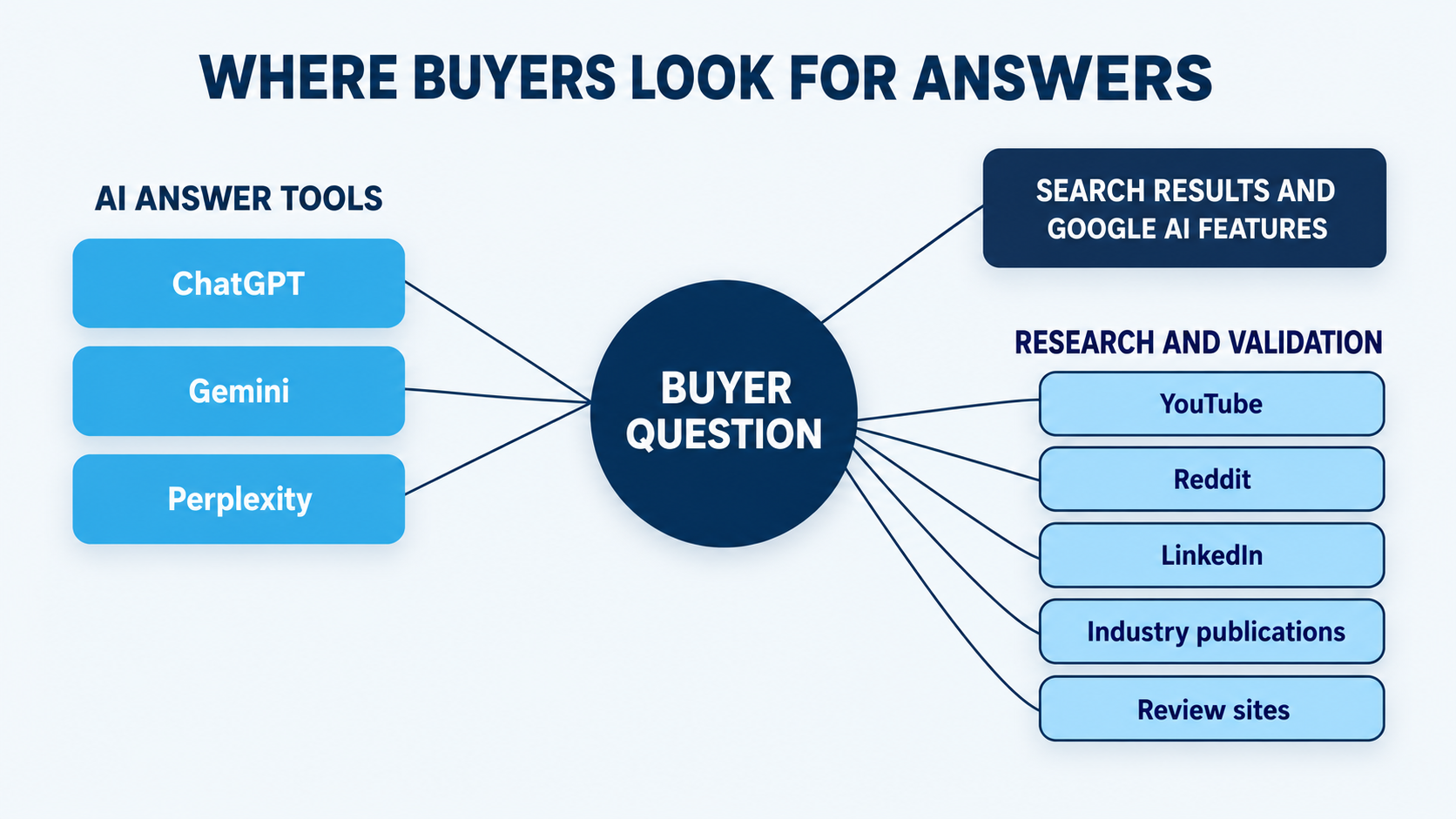
Search is no longer limited to a page of links. Buyers can ask ChatGPT, Perplexity, Gemini, or Google’s AI features a detailed question and receive a summarized answer before visiting a website. That changes where a company can become visible and what business owners should measure.

Websites, traditional search, referrals, reviews, and paid media still matter. AI-generated answers are simply another discovery layer. Businesses need to know whether their information is available, clear, and credible enough to be used there. Lucé Media explains this broader change in AI search visibility.

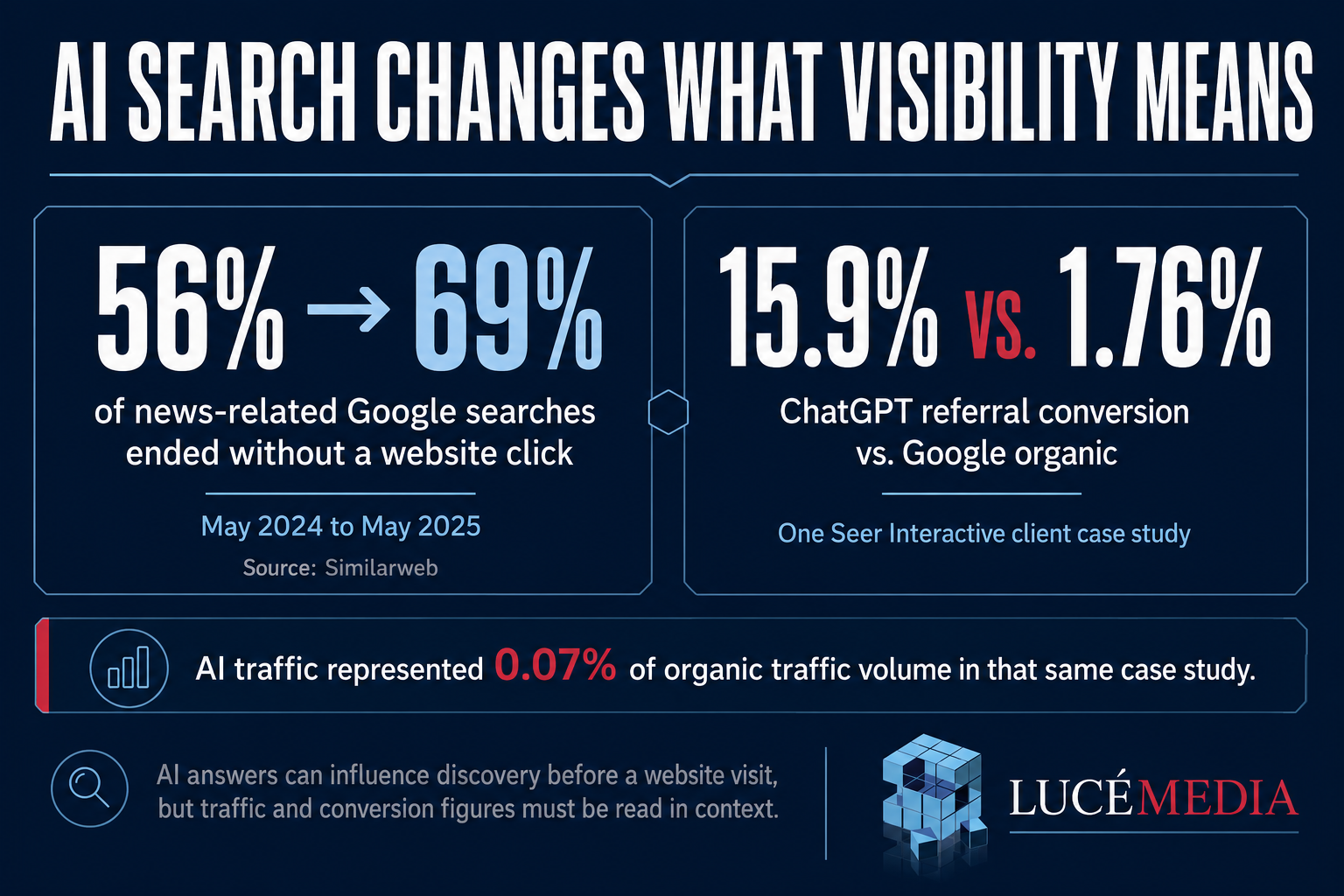
Similarweb reported that news-related Google searches ending without a website click increased from 56% in May 2024 to 69% in May 2025. The rate does not apply equally to every category, but it shows how more questions can be answered before a site visit.

Key Takeaways

  • GEO improves the clarity and citability of information. It does not guarantee placement in an AI answer.
  • SEO remains the foundation. Crawlability, indexing, original content, and page quality still matter.
  • Mentions, citations, and recommendations are different outcomes and should be measured separately.
  • Statistics need context. The strongest evidence should explain what was measured and what was not.
  • Businesses can begin with existing pages by auditing buyer questions, improving priority content, and tracking results over time.
  • Be skeptical of fixed timelines, guaranteed citations, and special GEO hacks.

What Is Generative Engine Optimization?

Generative Engine Optimization is the work of improving how clearly a source can be found, interpreted, and used by generative search systems. Researchers from Princeton University, Georgia Tech, the Allen Institute for AI, and IIT Delhi formalized the term and evaluated methods for increasing source visibility in generated answers.

In the original GEO research, some methods increased source visibility by up to 40% in controlled tests. Results varied by subject and engine. The study measured visibility inside benchmark responses, not sales, revenue, or guaranteed citations for a real business.

For a company website, GEO usually means making important information easier to verify. A page should explain what the company does, who it serves, where it works, and what evidence supports its claims. The goal is not to write for machines instead of people. It is to remove ambiguity for both. This is also why GEO should sit beside a strong SEO and AEO foundation, not replace it.

Why Does GEO Matter Now?

GEO matters because AI answers can compress several stages of research into one interaction. A buyer may ask for a definition, compare options, review risks, and request a shortlist before visiting any company website. If a business is absent or described incorrectly, traditional ranking reports may not reveal the gap.

The available data should be read carefully. Similarweb’s 56% to 69% zero-click increase covered news-related Google searches, not every query. In one Seer Interactive client case study, ChatGPT-referred sessions converted at 15.9% compared with 1.76% for Google organic traffic. Yet all AI sources combined equaled only 0.07% of organic traffic volume for that site.

The lesson is not that AI traffic has replaced search traffic. It has not. The lesson is that AI referrals may carry strong intent, while AI answers can influence decisions even when they produce no click. Businesses need a measurement view that includes visibility as well as traffic.

AI search visibility statistics showing a news-related zero-click increase and one AI referral conversion case study
AI answers can influence discovery before a website visit, but traffic and conversion figures must be read in context.

How Do AI-Powered Search Systems Use Sources?

AI search systems do not all work the same way. A useful model is retrieval followed by synthesis. The system looks for information related to the question, selects relevant sources or passages, and uses them to form an answer.

Google describes its AI search features as using retrieval-augmented generation and query fan-out. A single question can lead to several related searches, with pages retrieved from Google’s index to support the response. Google also says its normal SEO and quality systems remain the foundation for AI Overviews and AI Mode.

A technically weak site cannot solve the problem with GEO formatting tricks. Pages still need to be crawlable, indexable, useful, and trustworthy. Google advises businesses to focus on original, non-commodity content rather than rewriting pages only for AI systems.

Local businesses also need accurate details. A complete Google Business Profile, consistent contact information, clear service areas, and current reviews can help search systems understand the entity behind the website. No single update guarantees inclusion in an AI answer.

What Is the Difference Between a Mention, Citation, and Recommendation?

A brand mention, a citation, and a recommendation are three different outcomes. Treating them as the same thing creates bad reporting.

Outcome What It Means What to Record
Mention The company or brand is named in the response. Was the name accurate? Was the description correct?
Citation A website page or source is referenced or linked as support. Which page was used? What claim did it support?
Recommendation The system presents the company as an option to consider. What criteria or context led to the recommendation?

A business can be mentioned without receiving a link. A page can be cited without the business being recommended. A recommendation may appear without a clear source link. Record these outcomes separately in any AI visibility audit.

How Are GEO, SEO, and AEO Different?

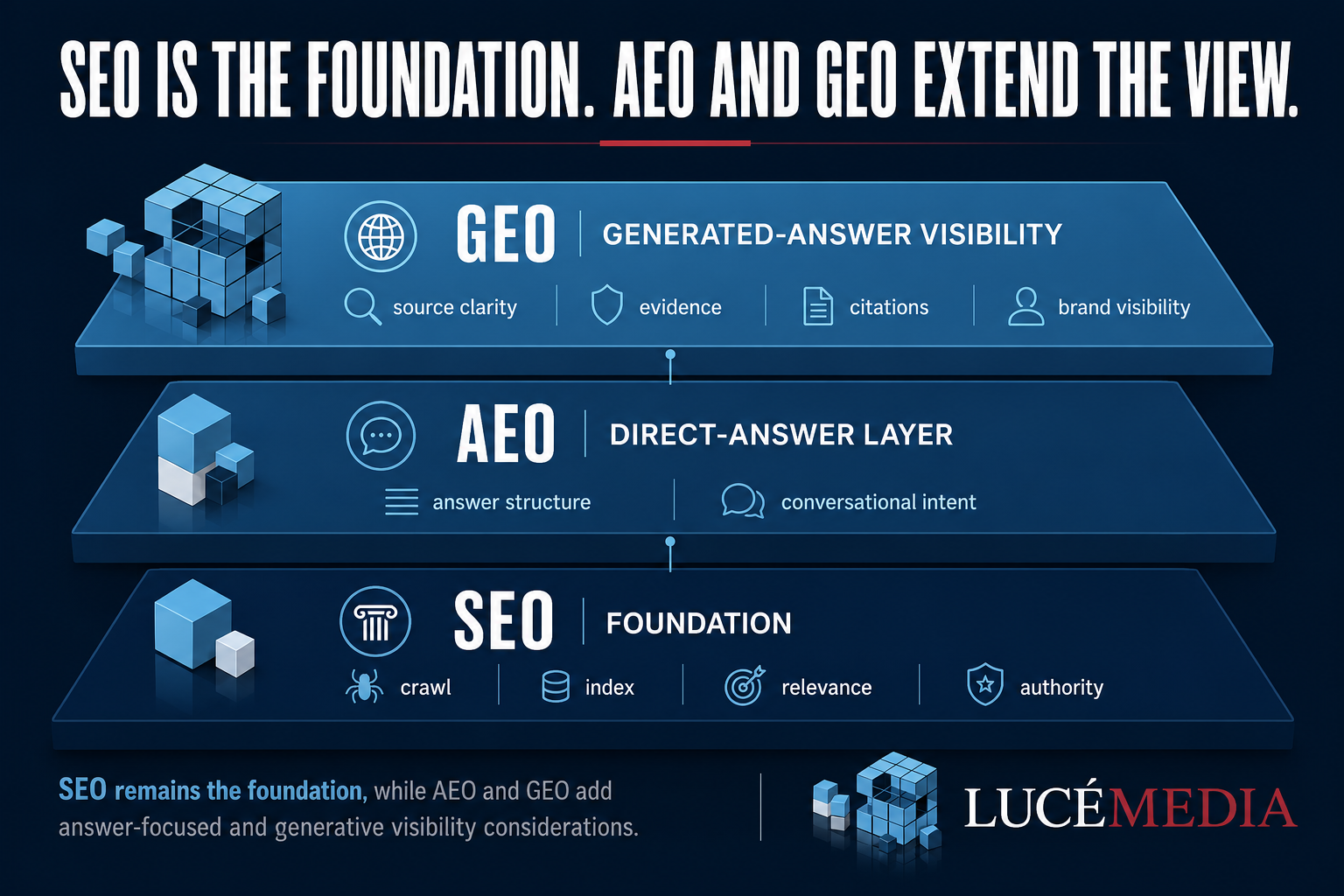
SEO, AEO, and GEO overlap, but they are not identical. Google’s guidance says strong SEO remains relevant to generative AI search. GEO should be treated as an extension of search and content quality, not as a replacement.

Area SEO AEO GEO
Primary goal Visibility in search results Clear answers for direct and conversational queries Visibility inside generated answers
Typical focus Crawlability, relevance, authority, page quality Question structure, concise answers, conversational intent Source clarity, evidence, citability, entity consistency
Common measures Rankings, impressions, clicks, conversions Answer visibility, featured results, voice responses Mentions, citations, recommendations, share of model
Relationship Foundation Overlapping answer layer Overlapping generative visibility layer

For most businesses, the order is simple. Fix technical and content foundations first. Then improve answer quality, evidence, entity clarity, and AI visibility tracking.

SEO, AEO, and GEO comparison showing SEO as the foundation for answer and generative visibility
SEO remains the foundation, while AEO and GEO add answer-focused and generative visibility considerations.

What Makes Content Easier for AI Systems to Use?

Content becomes easier to use when it is clear, specific, useful, and supported. The following improvements help readers first and also make the information easier for search and answer systems to interpret.

Answer the real question early.

Use clear structure.

Add evidence with context.

Make the business identity explicit.

Publish original expertise.

Place a direct, complete answer near the beginning of the section.

Organize the page around distinct questions or decisions, with headings that match the information below them.

Use current statistics, named sources, documented experience, or client evidence. Explain what the evidence did and did not prove.

State the company name, services, audience, location, and author clearly and consistently.

Real examples, methods, informed opinions, and first-hand observations are more useful than generic summaries.

Confirm important pages can be crawled and indexed, with accurate metadata, internal links, canonical URLs, and appropriate structured data.

Structured data can support an overall SEO program, but . It is better to use valid, appropriate markup than to add unsupported AI-specific code.

What Can a Small Business Do This Month?

You do not need a new website or tool before you begin. Start with a controlled audit and improve the pages that already matter most.

  1. Week 1: Build a question set. Write 10 to 20 questions a serious buyer asks before choosing a company like yours. Include definition, comparison, cost, risk, process, and local-intent questions.
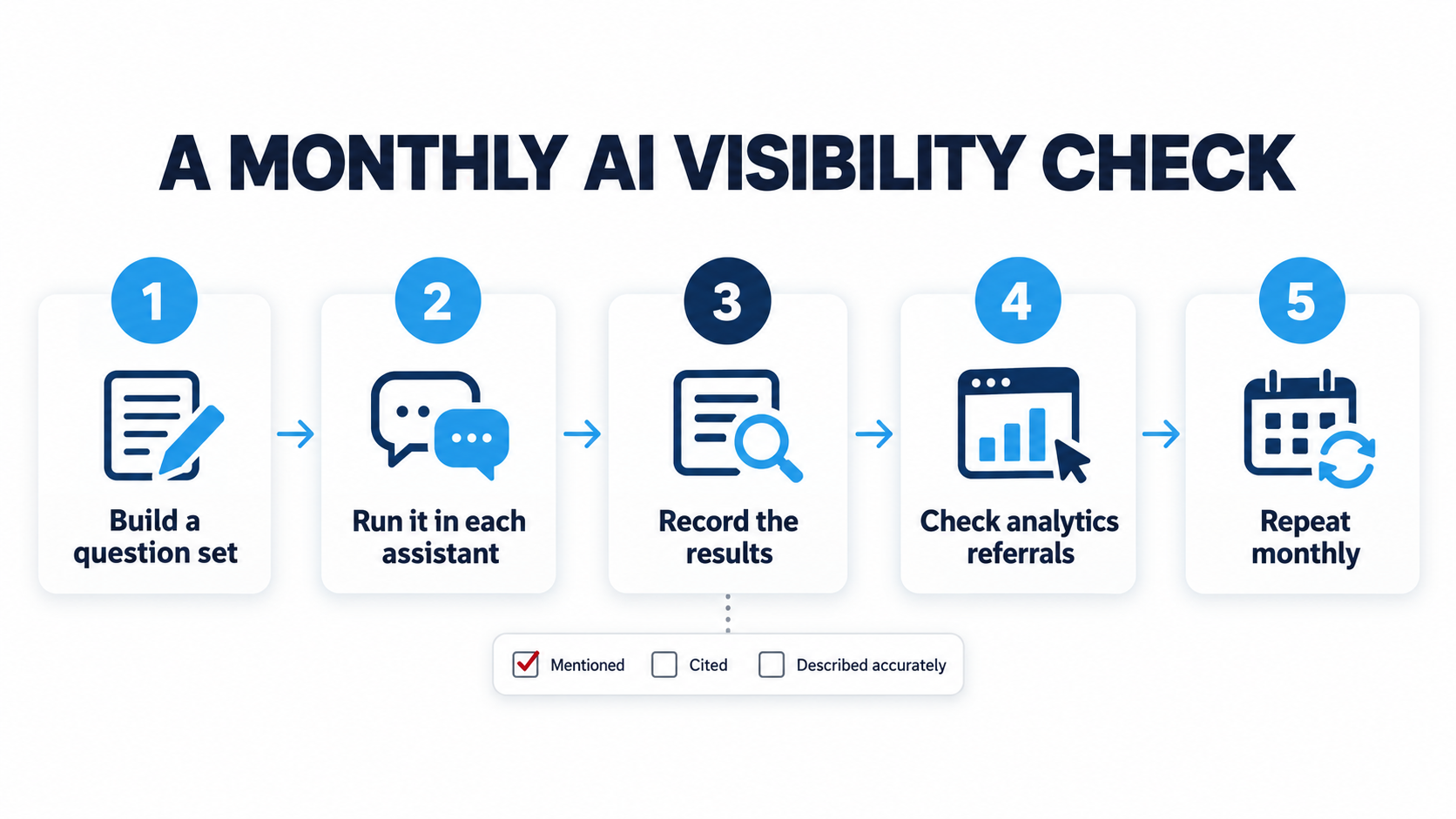
  2. Week 2: Establish a baseline. Run the same questions across the AI tools your customers may use. Record mentions, citations, competitors, and factual errors. Repeat selected prompts because outputs can vary.
  3. Week 3: Improve the top three pages. Add direct answers, specific service details, named authors, reliable evidence, useful internal links, and visible update dates. Remove vague claims that could fit any competitor.
  4. Week 4: Check technical and entity signals. Confirm the pages are indexable, business information is consistent, and important structured data is valid. Review the Google Business Profile if local discovery matters.

The first month should create a baseline and improve the clearest opportunities. It should not promise a citation by a specific date.

What Can GEO Not Guarantee?

GEO cannot guarantee a citation, recommendation, ranking, traffic level, or revenue result. Platforms use different data sources, retrieval methods, and answer formats. Outputs can change between sessions and prompt variations.

A strong page may be cited for one question but ignored for another. A company can also appear based on third-party information it does not control. Measure GEO as an ongoing visibility program, not a one-time switch.

Be cautious with providers promising fixed timelines or guaranteed placement. Google states that meeting its requirements and best practices does not guarantee crawling, indexing, or display.

Frequently Asked Questions About Generative Engine Optimization

What is Generative Engine Optimization in simple terms?

Generative Engine Optimization makes website information easier for AI-powered search and answer tools to discover, understand, summarize, and cite. It may improve visibility, but it does not guarantee a mention or recommendation.

How is GEO different from SEO?

SEO focuses on visibility in traditional search results and provides the technical and content foundation that AI search also uses. GEO adds attention to how clearly information can be extracted, supported, and cited inside generated answers.

What is the difference between GEO and AEO?

AEO focuses on content that can answer direct or conversational questions. GEO focuses more broadly on visibility inside generative answers that combine several sources. The work often overlaps.

Does GEO guarantee that ChatGPT will cite my company?

No. Platforms use different sources and can produce different answers to similar prompts. No provider can guarantee a mention, citation, or recommendation.

How long does GEO take?

There is no universal timeline. Results depend on the platform, query, competition, website authority, indexing status, content quality, and source refresh cycles. Track a consistent question set over time.

What is share of model?

Share of model compares how often a brand appears in AI responses with how often selected competitors appear for the same prompt set. It is useful only when the testing method remains consistent.

Final Thoughts

Generative Engine Optimization is a practical response to a new discovery environment. The fundamentals remain familiar: useful content, sound SEO, clear business information, credible evidence, and consistent authority.

The difference is what you now monitor. Ranking and traffic still matter, but businesses should also track whether they are mentioned, cited, accurately described, and compared favorably in AI-assisted search.

Start with a fixed question set, improve the pages that answer those questions, and measure the same outcomes over time. That creates a clearer view of AI search visibility without pretending any platform can be controlled.

Lucé Media helps businesses connect search visibility, content, and broader marketing execution under one accountable plan.

Connect AI search visibility to your marketing system

To discuss where AI-assisted search fits into your current marketing system, contact the Lucé Media team.

Contact the Lucé Media team

Sources and References

Mark Toney | Founder and CEO, Lucé Media

Mark Toney writes about marketing leadership, digital visibility, and the systems that connect strategy to coordinated execution. Lucé Media is a founder-led full-service marketing agency and strategic consultancy based in North Texas.

About Lucé Media

,

You Didn’t Get Into Business to Become a Content Creator

How local business owners can stay visible online without turning social media into another full-time job.

Quick Answer

Local business owners do not need to become full-time content creators to keep their social pages active. A practical system starts with real business information and the owner’s voice, then handles the writing, visuals, and publishing work that keeps getting pushed aside. Local Content Company offers plans at $67, $107, and $497 per month. The $497 Done For You plan is the best fit for owners who want the full content workload handled, including publishing.

Let’s be honest. You started a lawn care company because you know lawns. You opened a plumbing business because you know pipes. You built a print shop because you know how to produce work customers can rely on. You probably did not start any of those businesses because you wanted to spend Tuesday night writing captions and resizing graphics.

Yet social media still lands on the owner’s list. When it is handled consistently, it gives prospective customers another place to understand the business, see recent work, and decide whether to take the next step. When work gets busy, however, posting quickly disappears.

That is not a failure of discipline. It is a workflow problem.

Why does posting keep falling off the list?

Posting often begins informally. You take a photo after a finished job, write a quick note, and share it on Facebook or Instagram. It feels manageable until a large project comes in, an employee calls out, a customer needs attention, or a supplier creates a problem.

The customer work has an immediate consequence, so it wins. The unfinished post does not create an emergency. It gets moved to tomorrow, then next week, and eventually the business page has not changed in months.

The hidden difficulty is that posting is not one task. A single useful post can require several decisions:

  • What is worth talking about?
  • Which photo or visual supports the point?
  • How should the caption sound?
  • Does the image need to be cropped or redesigned?
  • Which platform should receive it, and when?
Small business owner balancing customer work and social media content creation
Writing one post often means choosing a topic, finding a visual, reviewing the details, and remembering to publish it.

A scheduling tool can organize finished content, and an AI writing tool can help with a draft. Neither one removes the need to choose the topic, provide accurate business context, prepare the visual, review the result, and keep the process moving every month. If you need the broader strategy and account-management side as well, Lucé Media’s social media marketing service covers more than content delivery alone.

What does an inactive social page communicate?

An inactive page does not automatically mean an inactive business. In many cases, it means the opposite: the owner is too busy doing the work to document it. A prospective customer cannot see that context, though. They only see an old post and have to decide whether the information is still current.

That uncertainty matters because customers commonly check more than one source before choosing a local business. BrightLocal found that 67% of consumers often or always continue to business reviews after conducting a local search. Your website, reviews, listings, and social profiles work together to help a customer confirm that the business is active and credible.

Source: BrightLocal Consumer Search Behavior research (2025)

The goal is not to post every day or chase every trend. It is to avoid leaving customers with unnecessary questions. A steady stream of recent work, useful explanations, customer feedback, and business updates is usually more valuable than a burst of generic content followed by another long silence. Lucé Media’s guide to social media engagement explains why the quality of the response matters more than a page full of empty activity.

What should a practical local content system include?

A sustainable system should make the business easier to understand without requiring the owner to invent a new campaign every week. At minimum, it should cover four things.

Real business context

Content should reflect the company’s actual services, service area, customers, tone, and common questions. Generic posts that could belong to any competitor may keep a page moving, but they do little to explain why someone should choose this business.

A useful mix of topics

Not every post should sell. A practical monthly mix can include recent work, customer questions, service explanations, helpful tips, reviews, team or owner perspective, seasonal reminders, and occasional offers.

Captions and visuals prepared together

A caption without an appropriate image is still unfinished work. Preparing both at the same time removes the last-minute search for a photo and helps the page feel consistent.

A publishing process the owner can actually maintain

The system should fit the business, not force the business into another complicated platform. Finished content should be easy to find, review, and publish from a phone or computer.

That basic structure lines up with the practical guidance from Oklahoma State University’s small-business social media guide, which covers platform choice, content planning, audience building, and performance measurement. Sprout Social also recommends planning content around the limited time and staff available to a small business in its current small-business social media tips.

How does done-for-you content solve the workflow problem?

Done-for-you content moves the production work off the owner’s weekly list without taking control of the owner’s accounts. The business still decides what represents it. The difference is that the research, topic planning, writing, and visual preparation happen before publishing day.

With Local Content Company, onboarding captures the business and the owner’s voice before the monthly writing begins. A short voice call records the phrases, tone, and plainspoken explanations the owner already uses with customers. That material becomes a written voice profile for the content team, so every month does not begin with another blank brief.

Each month, finished content is organized for the client. Depending on the plan, that may include Facebook and Instagram posts, LinkedIn updates, Google Business Profile content, and SEO blog posts. The $67 and $107 plans are lighter options for businesses that still want to handle publishing. The $497 Done For You plan is built for owners who want Lucé Media to create, schedule, and publish the content for them.

The $497 plan includes 20 Facebook and Instagram posts, 20 LinkedIn posts, 12 Google Business Profile posts, four blog posts, two carousel posts, brand-voice onboarding, a monthly content brief, and a quarterly strategy review. Content is published across the selected platforms. That is the meaningful difference: the owner is not buying another folder of work to remember. The work gets finished.

Business owner focused on customers while social media content is managed and scheduled
The $497 Done For You plan handles content creation, scheduling, and publishing so the owner can stay focused on the business.

All three plans are billed month to month, with no long-term contract. Current prices are $67, $107, and $497 per month. Package details can change, so the live pricing page should remain the source of truth.

How does this compare with the usual options?

Option What it helps with What still falls on the owner
DIY Maximum control and no service fee Topics, writing, images, review, organization, and publishing
AI or scheduling tool Drafting or organizing content faster Business context, prompts, visuals, review, and process ownership
Freelancer Writing or design support Briefing, feedback, availability, and ongoing management
Traditional agency Broader strategy, production, publishing, and reporting Higher cost, onboarding, meetings, and often account access
Content subscription Recurring captions and visuals built from a standing business profile Lower plans require self-publishing; the $497 plan includes scheduling and publishing

Who is this model best suited for?

What I’ve found is that a content subscription works best when the business already has real work, customers, reviews, and expertise but does not have a dependable process for turning those assets into posts. The $497 plan is especially useful for an owner who wants consistent content without hiring an internal marketing employee or keeping publishing on the weekly task list.

It is not the right solution for every situation. A business that needs daily community management, direct-message responses, paid advertising, influencer campaigns, or full marketing strategy needs a broader service. Local Content Company is intentionally narrower: it handles recurring content production so posting no longer begins with an empty page.

A real local example: Legacy Print Group

Jim Turnell, owner of Legacy Print Group in Richardson, Texas, was the original paying customer for Local Content Company. Legacy Print Group is a commercial printer rather than a home-service company. That matters because the model is not limited to plumbers, landscapers, or contractors. Lucé Media’s earlier commercial printer success story also shows how specific industry knowledge makes marketing more believable. The same principle applies here: useful content begins with the real business, not a generic template.

Frequently asked questions

What is social media content for local businesses?

It includes captions, images, updates, tips, customer stories, and other posts created around a local business’s real services and audience. Strong local content should sound specific to the business rather than like a generic template.

Do I have to give Local Content Company access to my accounts?

The $67 and $107 plans can be used as content-delivery plans, with the owner publishing from their own accounts. The $497 Done For You plan includes scheduling and publishing, so the team will need the appropriate publishing access during setup.

How do you learn enough about my business to write the posts?

Onboarding captures information about the business and the owner’s real speaking style. A short voice call is turned into a written voice profile that guides the team each month.

How is the content delivered?

Finished content is placed in a Google Drive folder each month. You can open the folder from a phone or computer, then publish on your own schedule.

Does Local Content Company publish the posts?

Yes, on the $497 Done For You plan. The lower-priced plans are intended for businesses that want prepared content but are comfortable handling the publishing themselves.

Is there a contract?

No. Plans are month to month and can be canceled at any time without a long-term contract.

How much does it cost?

The three monthly prices are $67, $107, and $497. The $497 Done For You plan is the recommended option for owners who want creation, scheduling, and publishing handled rather than receiving content they still need to post.

Get back to the work you started the business for

You do not need to become a content creator to keep your business visible. You need a process that turns what the business already knows and does into clear, useful posts, then makes those posts easy to publish. You can build that process yourself. You can manage a freelancer. Or you can use a recurring content service. If the goal is to get content off your task list rather than make the task smaller, the $497 Done For You plan is the clear choice.

See the $497 Done For You plan

If Google visibility is part of the problem, start with Lucé Media’s guide to claiming and improving a Google Business Profile. Social content works better when the rest of the business information is current too.

You do not need to become a content creator to keep your business visible. You need a process that turns what the business already knows and does into clear, useful posts, then makes those posts easy to publish.

You can build that process yourself. You can manage a freelancer. Or you can use a recurring content service. If the goal is to get content off your task list rather than make the task smaller, the $497 Done For You plan is the clear choice.

See the $497 Done For You plan and compare all three monthly options:

If Google visibility is part of the problem, start with Lucé Media’s guide to . Social content works better when the rest of the business information is current too.

Mark Toney | Founder and CEO, Lucé Media and Local Content Company

Mark Toney is the founder and CEO of Lucé Media and Local Content Company. He works with business owners on practical marketing systems that connect strategy, content, visibility, and execution.

What Is an AI Brand Voice Profile and Why Does It Matter?

An AI brand voice profile is the reference document that tells an AI tool exactly how you sound: your vocabulary, your sentence rhythm, the phrases you would never use, and the point of view that makes your content recognizably yours. Most businesses skip this step. They open ChatGPT or Claude, type a general prompt, and publish whatever comes back. The result often reads fine on its own but blends into a long line of similar posts from other businesses doing the same thing. For any business scaling content with AI, whether that is a marketing agency, a fractional executive practice, or a solo real estate agent, the voice profile is not a formatting exercise. It is one of the clearest ways to decide whether AI becomes a growth tool or a habit that slowly wears down trust.

Quick Answer

An AI brand voice profile is a documented set of your specific language patterns, vocabulary, and point of view that trains an AI tool to write like you instead of like everyone else using the same tool. Without one, AI output tends to default to generic phrasing that blends in with everything else published the same way. The tool does not build your positioning. It amplifies whatever positioning already exists, strong or weak, at a speed and volume no person could match by hand.

Key Takeaways

  • A meaningful share of consumers say they are concerned about brands publishing AI-generated content without disclosing it.
  • Public preference for AI-generated creator content has dropped noticeably since 2023, according to published industry research.
  • A documented AI voice profile replaces vague tone instructions (“write in a friendly tone”) with real writing examples and a list of phrases to avoid.
  • Real estate is already living this problem: industry coverage now uses the term “AI slop” to describe the flood of templated, near-identical listing content.
  • AI does not create positioning. It scales whatever positioning already exists, including weak positioning, faster than any team could by hand.
  • At least one published content study found human-written blog posts earning meaningfully more organic traffic than AI-generated posts on comparable topics.

Why an AI Clone of Your Brand Repeats Your Mediocrity, Faster

An AI voice profile only helps if the underlying positioning is worth scaling in the first place. If your messaging is vague or interchangeable before you train an AI on it, the AI will not fix that. It will produce more of it, faster, across more channels, until vague and interchangeable is the majority of what your audience sees from you.

Most businesses miss this when they adopt AI content tools. They treat the tool as a fix for weak marketing, when the tool is actually a multiplier sitting on top of whatever marketing already exists. Sharp, specific positioning tends to produce sharp, specific output at scale. Generic, could-be-anyone positioning produces generic, could-be-anyone output, just published more often.

There is also a broader industry concern worth understanding correctly. Researchers use the term “model collapse” to describe what happens when AI models are trained recursively on data that other AI models generated, rather than on original human-created material; over successive generations, this can cause the models to lose accuracy and variety. That is a distinct, technical research finding about how models are trained, not a claim that any one business’s blog posts cause it. The separate, more immediate risk for businesses is simpler: as more companies publish content from generic prompts, the pool of publicly available business writing gets more repetitive and harder to tell apart. Distinctive voice becomes more valuable precisely because fewer businesses are protecting it.

What Happens When You Skip the Voice Profile Step?

Answer: Skipping a documented voice profile does not guarantee weaker content on its own, but it removes the one input most likely to keep AI output specific instead of generic.

One widely cited content study by NP Digital tracked blog posts written primarily by humans against posts generated primarily by AI, covering equivalent topics over several months. By the fifth month, the human-written posts were earning about 5.44 times more monthly organic traffic than the AI-generated posts. It is worth being precise about what this study actually measured: it compared human writing to largely unedited AI writing, not specifically voice-profiled AI prompts against generic ones. Even so, the direction of the result lines up with what a documented voice profile is designed to prevent: content so generic that it fails to stand out from everything else already published on the same topic.

The mechanism is straightforward. General prompts tend to produce general content, because the AI has no specific pattern to match beyond the statistical average of everything it was trained on. “Write a blog post about pricing strategy” returns a plausible, average version of that post. A prompt built from a documented voice profile, specific vocabulary, a real writing sample, a named list of phrases to avoid, gives the AI something to match that could only have come from one source.

Why Do Consumers Notice Generic AI Content So Easily?

Answer: A growing number of consumers say they can recognize AI-generated writing, though studies differ on the exact share, and the honest answer is that no single number fully settles it.

A 2025 Hookline consumer study, summarized by Column Five Media, found that 82.1 percent of respondents could spot AI-written content at least some of the time, with the rate rising to 88.4 percent among younger respondents. Other studies have found lower but still substantial detection rates. Taken together, the research points in one clear direction: a large and likely growing share of readers can tell when they are looking at generic AI writing, and that recognition changes how they respond to it.

That detection can create a trust problem. When readers recognize generic AI-generated content, especially when its use is not disclosed, they may view the brand more skeptically. Available consumer surveys support concern about authenticity and disclosure, but they do not establish one universal or precisely measurable long-term penalty.

Consumer research backs this up directly. According to Sprout Social’s Q3 2025 Pulse Survey, more than half of social media users, 52 percent, say they are concerned about brands posting AI-generated content without disclosing it. Separately, research from Billion Dollar Boy found that only 26 percent of consumers now prefer generative AI creator content over traditional creator content, down sharply from 60 percent in 2023. Audience tolerance for generic AI output did not stay flat while adoption grew. By this measure, it fell as adoption grew.

What Does This Look Like in Real Estate Specifically?

Answer: Real estate is already experiencing this as a trust concern, not a hypothetical, and industry publications such as Real Estate News are now openly using the term AI slop to describe the flood of repetitive AI-generated marketing.

Brokerage leaders are drawing comparisons to other authenticity controversies in media: as AI-generated marketing gets more polished, the concern shifts from quality to authenticity, and buyers start questioning whether the agent behind a listing is actually the one doing the work. Real Estate News describes a flood of templated, near-identical listing descriptions and social posts as something that can erode buyer confidence, precisely because sameness signals the opposite of the local expertise a buyer is paying for.

There is a simple test worth using in any real estate marketing review. If you could swap another agent’s name onto a post and it would still read exactly the same, the post is probably too generic to be doing its job. A voiced post does not say “now is a great time to buy.” It says something only that agent, working that specific market, would know to say, like noting that homes sitting on the market two to three weeks are drawing less competition this month. That specificity is exactly what a voice profile is built to preserve at scale.

Generic AI Content vs. Voice-Guided AI Content

Generic AI Content Voice-Guided AI Content
Broad, generic prompts Documented language examples
Average, could-be-anyone phrasing Brand-specific vocabulary
No exclusions Defined phrases to avoid
Interchangeable point of view Recognizable, specific perspective
More editing required after the fact More consistent, usable first drafts

How Does a Voice Profile Actually Change AI Output?

Answer: A voice profile replaces vague instructions like “write in a friendly tone” with concrete examples, documented patterns, and a list of phrases to avoid, so the AI has something specific to match instead of a statistical average to fall back on.

Generic AI content transformed into structured, voice-guided brand content using an AI brand voice profile.
A documented voice profile gives AI specific language patterns to follow, turning generic output into content that sounds more consistent and recognizable.

A working voice profile typically includes twenty to thirty examples of the business owner’s or brand’s actual writing, not descriptions of tone, but the real sentences themselves. It documents sentence rhythm, vocabulary, humor style, and point of view. Just as important, it names the phrases the brand would never use, the hollow openers and filler transitions that mark writing as templated. That exclusion list does as much work as the inclusion examples.

Luce Media builds documented voice profiles like this as part of its broader AI-powered marketing systems work. The reader cannot always name why one post feels authentic and another does not, but the response patterns described above suggest they notice the difference.

What Is the Business Case for Building One Before You Scale Content?

Answer: The business case rests on consistency and search visibility, not just a single engagement number. Businesses that document their brand voice tend to have an easier time producing content that sounds consistent across platforms and team members, which is difficult to measure as one universal percentage but is a common theme in brand consistency research and commentary.

There is also a search visibility angle, described correctly. Google’s Search Quality Rater Guidelines describe experience, expertise, authoritativeness, and trust (E-E-A-T) as qualities that human quality raters look for when judging page quality. These guidelines do not directly control rankings on their own, and Google has been clear that rater scores are not fed straight into ranking systems. What they describe, though, is the kind of content Google’s ranking systems are designed to reward over time: content that reflects direct experience and a real point of view, rather than a generic summary of what already exists elsewhere. Generic AI content, by definition, reflects an average of existing material rather than one business’s specific experience. A documented voice profile is one of the clearer ways to help AI-assisted content actually demonstrate that standard instead of working against it.

Businesses can also check how they currently show up in AI-generated answers with a free AI visibility check, which is a related but separate question from voice consistency.

For agencies and consultants managing content across many clients, the case is operational as well as strategic. A voice profile turns “make this sound like the client” from a fresh judgment call every time into a documented standard that anyone on the team, or any AI tool, can follow consistently. That consistency is what makes scaling content production safer.

Frequently Asked Questions

What is an AI brand voice profile?

An AI brand voice profile is a documented reference of a business’s or individual’s specific vocabulary, sentence patterns, point of view, and phrases to avoid, used to train AI tools to produce writing that sounds like that source instead of generic AI output.

How does a voice profile change what AI writes?

It replaces vague tone instructions with concrete writing examples and a documented exclusion list, giving the AI specific patterns to match instead of defaulting to the most statistically average version of the requested content.

Why does voice matter more now that AI adoption is widespread?

When many competitors are using the same AI tools with similar prompts, distinctive voice becomes rarer and more valuable, because it is one of the few remaining ways to signal that a real, specific expert is behind the content.

What is the difference between a style guide and a voice profile?

A style guide typically covers formatting, grammar rules, and visual identity. A voice profile documents the actual language patterns, real examples, and specific phrases that make writing sound like one particular person or brand, which is what an AI tool needs to replicate voice rather than just format.

How long does it take to build one?

A working first draft can often be built from an hour of source material, such as an interview, a call transcript, or a set of past writing samples, though refining it against real AI output usually takes a few rounds of testing before it is dialed in.

Is a voice profile worth it for a small business or a solo agent?

Yes. The detection and preference research described above applies regardless of company size, and solo operators often have the most to lose from sounding interchangeable with every competitor using the same AI tools.

What happens if I keep using AI without one?

Content volume may increase, but the writing can become harder to distinguish from competitors using the same approach. Consumer research also shows concern about generic and undisclosed AI content, which makes human review and a documented voice increasingly important.

Final Thoughts

An AI brand voice profile is one of the clearest factors in whether AI scales your strengths or your weaknesses. Fix the positioning first, document the voice second, then let AI handle volume. Skip either step and the tool will still work exactly as designed: producing more content, faster, that sounds like everyone else’s.

  • Audit your last ten pieces of AI-assisted content using the swap test: could a competitor’s name replace yours without changing a word?
  • Build a documented voice profile from twenty to thirty real writing examples before scaling any AI content workflow further.
  • Treat the exclusion list, the phrases you would never use, as seriously as the inclusion examples.

Mark Toney

Founder and CEO, Luce Media

Mark Toney is the founder and CEO of Luce Media, a marketing agency based in McKinney, Texas, specializing in fractional CMO strategy and AI search visibility for growing B2B companies.

Why Dirty Data is Sabotaging Your Variable Data Printing (VDP) Campaigns and What to Do About It

Personalized printing has evolved from a gimmick to a core marketing advantage. But with great power comes a hidden weakness: bad data.

Variable Data Printing (VDP) gives you the ability to personalize every piece of a print run—but that power is wasted if the underlying data is outdated, inconsistent, or incorrect. When your data is dirty, even the most advanced personalization strategy will collapse under the weight of inaccuracy.

This post will show you why data hygiene is critical to VDP success, what poor data really costs, and how to take back control with a practical, scalable strategy.

What Is Variable Data Printing (VDP) and Why It Matters

Variable Data Printing is a technology that lets you create print materials with customized elements for each recipient—without stopping the press.

Instead of one-size-fits-all campaigns, VDP lets you:

  • Target by behavior: Include a custom product image based on past browsing.
  • Geotarget content: Change headlines based on location.
  • Embed personal links: Drive to a unique landing page via QR or PURL.

But remember: the print file is only as good as the data behind it. A typo, outdated address, or duplicated contact can ruin an entire print run.

TL;DR

You can have the world’s best print templates and still fail if your data is dirty. From duplicated records to outdated contacts, messy data will quietly sabotage your variable data printing (VDP) campaigns. This guide outlines the financial and reputational risks—and five practical strategies to turn your data into a high-ROI machine.

Key Takeaways

  • Dirty data wastes money and erodes trust—every undelivered mailer or inaccurate message chips away at ROI and brand credibility.
  • Clean data boosts VDP performance dramatically. Expect 2x to 10x higher response rates when your dataset is clean and properly segmented.
  • You don’t need perfection, just progress. Starting with audits and basic cleansing goes a long way.
  • Automation and governance make scaling easier. Today’s tools let you automate hygiene without adding headcount.
  • Data hygiene is everyone’s job. Marketing, sales, IT, and leadership all play a role in sustaining a clean data ecosystem.

The High Cost of Dirty Data in VDPhigh costs

Wasted Print and Postage Budgets

Every undeliverable piece of mail is money down the drain. Multiply that across thousands of contacts, and the losses grow fast.

Real-world impact: A single undelivered mailer costs more than just postage. It represents a missed conversion, a lost lead, and a blown opportunity to create customer delight.

Damaged Brand Credibility

When a customer receives mail with their name misspelled, or worse, addressed to someone else entirely, it breaks trust. Repeat it, and you risk being ignored or even reported.

High-risk verticals: In regulated industries like healthcare or automotive, sending the wrong personalized message can result in legal action or fines.

Operational Chaos and Compliance Risk

Sales teams waste time chasing leads that don’t exist. Marketing relies on inaccurate segmentation. Leadership bases decisions on faulty dashboards.

The cost: Productivity plummets, forecasts are wrong, and compliance exposure skyrockets. Bad data is a silent killer of strategy.

Lost Engagement from Personalization Failures

If your campaign drives users to personalized pages with incorrect info—wrong name, wrong product, wrong deal—they bounce. Fast.

Why this matters: Today’s consumers expect seamless personalization. Anything less feels clumsy and inauthentic.

How Clean Data Supercharges VDP ROI

  1. Personalization That Converts

Clean data lets you truly segment by behavior, interest, geography, and history. You can:

  • Recommend products they actually want
  • Reference past interactions for relevance
  • Create urgency with time-sensitive, relevant offers

Example: A propane company used VDP to double its response rate to 30% by syncing print messaging with CRM behavior.

  1. Streamlined Workflows and Stronger Decisions

When marketing, sales, and ops all rely on one clean dataset:

  • Campaigns run faster
  • Forecasts become reliable
  • Everyone can act on the same version of the truth

Significant benefit: You eliminate the silos and guesswork that waste time and create friction across departments.

  1. Deeper Customer Trust and Loyalty

Clean data = more relevant messages. Relevant messages = more trust.

How it plays out: A personalized offer based on a user’s recent website visit feels helpful. A generic message does not.

Trust leads to loyalty. Loyalty leads to repeat business. Repeat business leads to profit.

5 Must-Have Strategies to Fix Dirty Data Fast

must havesProactive Cleansing & Standardization
Before you print anything, do a deep cleanse. Look for:

  • Misspelled names
  • Inconsistent formatting (John Smith vs. Smith, John)
  • Empty fields and outdated info

How to fix it: Utilize tools such as Excel scripts, SQL queries, or data cleaning software to automate standardization. Don’t wait until you’re mid-campaign.

Deduplication and Identity Resolution

Duplicates are silent killers. They waste postage, confuse recipients, and hurt your metrics.

Your action plan:

  • Use deduplication software to find exact and fuzzy matches.
  • Merge profiles across systems (CRM, email, forms, POS).

Pro tip: Identity resolution software can match across devices and platforms, creating an accurate 360° view.

Ongoing Audits and Data Validation

Data decays. People move. Jobs change. Emails bounce.

Make audits a habit. At least quarterly, validate addresses using tools like:

  • CASS: Confirms postal format validity.
  • NCOA: Catches address changes from USPS.

Bonus tip: Flag high-bounce emails or low-engagement contacts for manual review.

  1. Automation Tools for Scale

Manual cleanup is slow. Automation makes data hygiene scalable.

Tools to explore:

  • CDPs: Centralize, clean, and segment data automatically.
  • VDP software: Validate records, pre-print, and preflight for missing images or broken links.

Significant gain: You reduce human error, speed up production, and scale campaigns with confidence.

  1. Data Governance Culture

No tool can save you from a team that doesn’t care about data quality.

Start here:

  • Create clear policies for how data is entered, stored, and accessed.
  • Train every team on why data matters and how their role affects hygiene.

Why this works: When data hygiene becomes part of your culture, errors get caught early, and everyone takes ownership.

FAQsfaqs

What is the biggest mistake printers make with VDP data?

Treating data hygiene as a one-and-done project. It’s a continuous process.

Can off-the-shelf tools help with deduplication?

Yes. CRMs, CDPs, and specialty software all offer robust deduplication capabilities.

How often should I run a data audit?

At a minimum, quarterly. Monthly is ideal for large or fast-moving datasets.

Is this just a marketing concern?

No. Dirty data impacts finance, ops, sales, and legal compliance. It’s an enterprise-wide issue.

What’s the ROI of clean data in VDP?

Studies show a 2x to 10x boost in response rates compared to generic print campaigns.

Conclusion

Variable Data Printing is a powerful tool—but it’s only as smart as the data behind it.

Clean data doesn’t just save you money. It makes your messaging sharper, your customer relationships stronger, and your results more predictable.

Start small. Clean your list. Deduplicate your CRM. Run quarterly audits. Build a governance mindset. Every step moves you toward a high-ROI, high-trust marketing engine.

Want to see how other print leaders are fixing their dirty data and boosting ROI?

Join our free Facebook Group to connect with print pros using AI, data, and personalization to scale smarter →

, ,

Are Clients Truly Willing to Pay a Premium for Eco-Friendly Print Options?

TL;DR Eco-friendly printing is now a baseline competitive requirement—medium and large clients will pay a premium because sustainable options help them meet CSR targets, certifications, and brand expectations, and technology makes those options high-quality and cost-effective. Printers that secure credible certifications and clearly quantify environmental benefits can charge more, win larger contracts, and become the […]

The Executive’s Guide to Better Performance in Commercial Printing

TL;DR TL;DR: This guide shows printing-company leaders how to improve profits and competitiveness by measuring four KPIs—proof turnaround, on-time delivery, shipping accuracy, and customer satisfaction—and fixing the weakest links. Following a 90-day benchmark→pilot→scale plan with clear targets (e.g., 24–48h proofs, 95% on-time, 98–99% accuracy, NPS 50+) can lead to higher profits, increased company value, and […]

,

The AI Marketing Revolution: Work Smarter, Not Harder

TL;DR AI-powered marketing automation replaces rigid rule-based workflows with adaptive learning, predictive intelligence, and dynamic optimization to personalize campaigns, generate qualified leads, and continuously improve performance without constant manual oversight. Early adopters report measurable gains—about 37% more marketing-qualified leads and notable increases in engagement alongside large reductions in campaign management time—letting marketers shift from execution […]

, , ,

Why Custom AI Solutions Are Your Business’s Next Revenue-Generating Powerhouse

The Future of Business Growth Lies in Custom AI Solutions Success in today’s challenging business world requires creativity and the use of customized AI solutions to drive innovation. By implementing AI tailored to your specific needs, businesses can streamline operations, enhance decision-making, and gain a competitive edge. Artificial intelligence is changing everything. Custom solutions that […]

The Ultimate Guide to Social Media Marketing

The Ultimate Guide to Social Media Marketing Key Highlights Learn how social media marketing has changed and affects businesses today. Create a strong social media marketing plan that matches your business goals and gets to know your target audience. Find out how to pick the right social media platforms and use strategies for each one. […]

, , , , , , , ,

Organic Social Media Marketing in 2025: Strategies for Explosive Growth and Engagement

Welcome to the future of digital interaction! As we step into 2025, the landscape of organic social media marketing is evolving at a pace that challenges even the most agile digital marketers. Gone are the days of simple posting schedules and one-size-fits-all content. Today’s strategy is about creating authentic engagement, harnessing cutting-edge technologies, and building […]

, , , , , , , ,

How To Embrace AI-Driven Marketing – Plus 3 Crucial Things Not To Do

Major shifts in consumer expectations have made AI-driven marketing a critical asset for CEOs, Presidents, and Business Owners. Traditional methods like generic email blasts and guesswork-based campaigns often waste budgets and dilute brand identity. By integrating artificial intelligence, you get real-time insights, automate key processes, and tailor messages to the precise needs of your target […]

, , ,

How to Leverage Data-Driven Marketing in 2025: Tools & Strategies

In 2025, data-driven marketing is no longer a luxury but a necessity for businesses striving to thrive in an increasingly competitive and digital-first world. As consumers demand personalized experiences and measurable value, leveraging data effectively has become the cornerstone of successful marketing strategies. This guide explores what data-driven marketing entails, why it matters, and how […]

The State of Digital Marketing in 2025: What the Data Shows

Digital marketing has become the backbone of successful brand strategies in today’s fast-paced business environment. As we look ahead to 2025, it is evident that the field of digital marketing is undergoing rapid transformation, driven by the increasing importance of data. “Digital Marketing Data” has become the cornerstone of decision-making, allowing businesses to optimize campaigns, […]

, , ,

Ten Digital Marketing Trends for 2025 You Need to Know

The digital marketing landscape is constantly evolving, driven by technological advancements and shifting consumer expectations. As we approach 2025, the pace of change is accelerating, presenting exciting opportunities and challenges for businesses aiming to stay competitive. This guide explores the top 10 digital marketing trends shaping 2025 and offers insights on leveraging them for sustained […]

, , , , , , ,

Optimize for Voice Search in 2025: A Comprehensive Guide

In the ever-evolving digital landscape, voice search has emerged as a powerful tool reshaping how users find information. With voice-enabled devices becoming ubiquitous, businesses and content creators must adapt to meet this growing demand. By 2025, it’s estimated that 75% of households in the U.S. will own a smart speaker, highlighting the urgency for optimization. […]

, , , , , ,

How to Launch a High-Converting Email Marketing Campaign in 2025

Email campaigns remain a powerhouse in the digital marketing world, delivering a return on investment (ROI) of up to $36 for every $1 spent. Despite the rise of social media and other marketing channels, email marketing consistently outperforms as a direct and personalized communication tool. However, as consumer behaviors and technology evolve, the strategies that […]