Why Print Executives Need a Fractional CMO: Protecting Margins and Driving Growth

The Reality Print Leaders Face
If you’ve been running a printing operation for any length of time, you know the squeeze is real. Price pressure from online competitors, consolidation from larger national print shops, and the constant challenge of staying top-of-mind with customers who treat print as a commodity—it’s relentless. Your production team runs lean and efficient. Your quality is dialed in. Your SLAs are solid. But here’s the uncomfortable truth: operational excellence alone doesn’t guarantee profitable growth anymore.
Most print executives got where they are by mastering production, not marketing. You can optimize your pressroom down to the last percentage point, but if your message to the market doesn’t differentiate you from a dozen other shops offering similar specs and turnaround, you’re fighting a race to the bottom on price. And that’s where margin goes to die.
This is where a Fractional Chief Marketing Officer becomes your strategic partner—not another overhead line item, but a lever for turning production capacity into profitable orders and protecting the margins your operation works hard to earn.
What Is a Fractional CMO, and Why Should a Print Executive Care?
A Fractional CMO is a senior marketing strategist who works with your business on a part-time or project basis. Think of it as bringing in an experienced marketing leader without the burden of a $150K-$200K+ full-time salary, benefits, and years of ramp-up time. Instead, you get strategic guidance, campaign direction, and market insight focused directly on your growth objectives—delivered on your timeline and your budget.
For print companies specifically, a Fractional CMO understands that your challenge isn’t just marketing—it’s translating operational excellence into market value, positioning your capabilities in a way that attracts higher-margin opportunities, and building the kind of customer relationships that turn one-off orders into accounts with predictable, high-volume throughput.
The Strategic Advantages: Why Now?
1. Protect Your Margins While You Scale
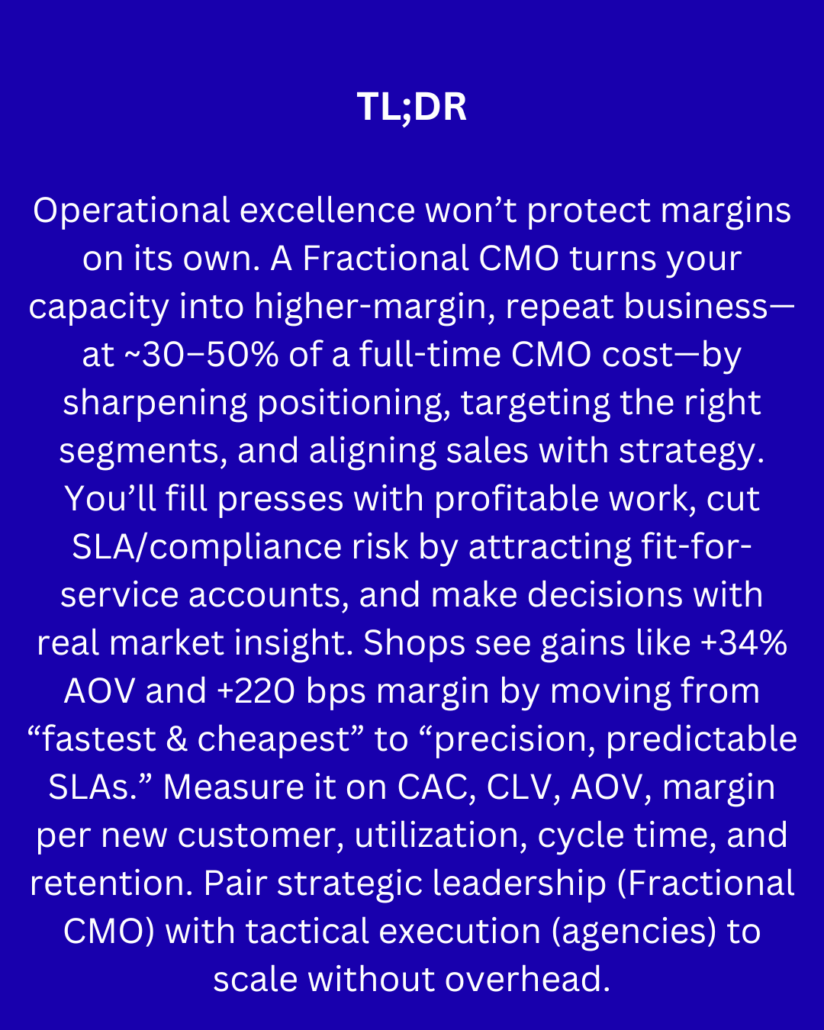
Here’s the math: the cost of hiring a full-time CMO typically ranges from $120K to $250K annually, plus benefits, overhead, and ramp time. A Fractional CMO model delivers comparable senior-level expertise at 30–50% of that cost. More importantly, you’re not paying for internal meetings, politics, or learning curves—you’re paying for strategic output aligned directly to your revenue goals.
For print operations running on typical 8–15% margins, that efficiency matters. A Fractional CMO helps you fill capacity with the right customers (higher-mix, faster-turnaround, premium-service-tolerant accounts) rather than race-to-the-bottom price shoppers. Better order profile = better margin profile.
2. Eliminate the Strategy Vacuum
Most print companies operate without a dedicated marketing strategy. Marketing responsibilities fall to the owner, a sales manager, or a part-time coordinator who’s juggling multiple roles. The result? Inconsistent messaging, missed opportunities to differentiate, and a reactive posture instead of a proactive one. Your competitors who are thinking strategically are slowly winning the accounts with the best order profiles.
A Fractional CMO brings a strategic lens to your market position, identifies the customer segments where you have the strongest competitive advantage, and builds a go-to-market approach that aligns production capabilities with customer demand. This clarity reduces wasted effort in sales and marketing, and it reduces the risk of chasing the wrong business.
3. Reduce SLA Risk and Compliance Exposure Through Smarter Customer Acquisition
When you’re taking on the wrong type of work—overcommitting on specs you can barely meet, or attracting customers with unrealistic turnaround expectations—you’re not just risking missed deadlines. You’re risking quality issues, rushed production, employee stress, and potential compliance or contractual exposure. A Fractional CMO helps you articulate your true service differentiators and attract customers aligned with what your operation can reliably deliver.
Example: Instead of competing on “fastest turnaround,” you might position as “premium quality with predictable, documented SLAs”—which attracts accounts that value compliance and consistency, not just speed. Those customers tend to stick around longer and be less price-sensitive.
4. Scale Without Overheading
Your capacity is your constraint. You can’t add pressroom headcount or equipment on a whim. But you can be smarter about filling that capacity with higher-margin work. A Fractional CMO helps you:
- Identify underutilized or upcoming capabilities (that new equipment you just installed, that specialty service you added)
- Communicate those capabilities to the right customer segments
- Build pipeline momentum so your sales team isn’t constantly starting from zero
This scalability is crucial for print shops in growth mode. You’re not investing in permanent overhead; you’re activating a strategic lever that adjusts to your current business needs.
5. Market Insights That Reduce Guesswork
Print executives live in the details of production. Market trends, customer perception, competitive positioning—these often get missed because you’re focused on keeping the presses running and on-time delivery intact. A Fractional CMO does the market research so you don’t have to. They monitor what competitors are doing, identify emerging opportunities in your vertical, and spot shifts in customer behavior before they impact your order flow.
In a market where waste (missed opportunities, failed bids, inefficient campaigns) directly erodes margin, this clarity is worth its weight in gold.

A Day in the Life: What Your Fractional CMO Actually Does
When a Fractional CMO partners with a print operation, the work is hyper-focused on high-impact activities:
Strategic Planning and Capability Positioning: The Fractional CMO works with you to define what makes your shop unique—faster turnaround, specialty capabilities, compliance expertise, custom finishing, whatever it is—and then crafts a market positioning that attracts the right customers. This involves setting clear KPIs: new customer acquisition, revenue per order, repeat customer percentage, margin on new business, capacity utilization rate.
Competitive and Market Analysis: They analyze who’s winning business in your market, why they’re winning, and what gaps exist. For print, this might mean studying how local competitors are positioning, what services are trending, where customer pain points are being underserved, and how digital disruption is reshaping demand.
Campaign Execution and Optimization: Whether it’s LinkedIn engagement with procurement managers, email campaigns to past customers, partnerships with packaging designers, or strategic content that positions you as an expert—your Fractional CMO oversees campaigns that drive qualified leads. They monitor response rates, cost per lead, lead-to-close conversion, and order margin to ensure every marketing dollar adds to your bottom line, not just your top line.
Sales Enablement and Team Alignment: Your sales team is often your best asset, but they’re frequently under-equipped with the messaging, tools, and market insights they need. A Fractional CMO bridges that gap, providing talking points, positioning frameworks, and competitive intelligence that make your sales team more effective. The result: faster sales cycles, higher close rates, and less time spent on low-probability prospects.
Customer Segmentation and Upsell Strategy: A Fractional CMO helps you identify which customer segments are most profitable, which have the highest lifetime value, and which are capable of taking on additional services or volume. This enables targeted account management and reduces the risk of losing your best customers to competitors.
Real-World Impact: Print Companies and Marketing Leadership
Consider the case of a 30-year-old commercial print operation in the Midwest that was stuck in commodity pricing. The owner was handling all strategy, sales, and operations—a recipe for burnout and missed opportunities. After engaging a Fractional CMO, the shop:
- Repositioned from “quick-turnaround printer” to “precision solutions provider for regulated industries” (healthcare, financial, compliance-heavy sectors)
- Shifted their customer acquisition focus from price shoppers to quality/compliance-focused buyers
- Saw average order value increase by 34%, margin expansion of 220 basis points, and reduced customer churn
- Freed up the owner to focus on operations instead of scrambling for sales
The Fractional CMO worked 15 hours per week, cost roughly 1/3 of a full-time CMO, and delivered ROI within six months through margin improvement and capacity utilization alone.
In another case, a specialty print shop in the Southeast was losing market share to national competitors. The Fractional CMO identified that the company’s true strength was in custom finishing and complex die-cutting—capabilities that large national shops often outsource. By reorienting marketing messaging and customer targeting around that niche, the shop attracted regional distributors and design firms who valued local expertise and faster turnaround. Revenue grew 28% and SLA compliance improved because they were selling what they were truly great at.
Fractional CMO vs. Full-Time CMO vs. Marketing Agencies: What Fits Your Shop?
Fractional CMO: Ideal if you need senior marketing strategy and execution but can’t justify or aren’t ready for a full-time hire. You get flexibility, reduced overhead, and focused expertise. You can scale engagement up or down based on business needs. Best for print companies in growth mode or those facing market transitions.
Full-Time CMO: Makes sense if you’ve reached a size where you have enough marketing complexity and budget to justify a permanent executive. You get someone deeply embedded in your culture, but you’re committing to a significant salary, benefits, and the risk of a long-term hire who may not be the right fit.
Marketing Agencies: Agencies can handle tactical execution—design, social media, email—but they typically lack the strategic depth and intimate understanding of your business that comes from working closely with your team. They also split attention across multiple clients. For strategy and positioning, they often underperform compared to a dedicated strategic leader.
The hybrid approach: Many smart print executives use a Fractional CMO for strategy, positioning, and team leadership, while outsourcing specific tactical work (design, ad management, content creation) to agencies or freelancers. This gives you strategic direction with lower overhead.
Measuring What Matters: ROI for Print Operations
For a Fractional CMO working with your print shop, the ROI metrics that matter are:
New Customer Acquisition Cost (CAC): What are you spending to bring in a new profitable account?
Customer Lifetime Value (CLV) and Repeat Order Rate: How sticky are the customers you’re acquiring? What’s their annual volume trend?
Average Order Value (AOV): Are you attracting higher-value, higher-margin orders?
Margin per New Customer: New revenue is great; new revenue at healthy margins is what moves the needle.
Capacity Utilization Rate: Are you filling idle press time with new business, or is your utilization stagnant?
Sales Cycle Duration: How fast are prospects moving from first contact to signed order?
Customer Retention and Churn: Are you keeping the customers you win?
A Fractional CMO works with clear KPIs aligned to these metrics. Before and after comparison shows exactly how much strategic marketing leadership added to your bottom line.

Is a Fractional CMO Right for Your Print Operation?
Ask yourself these questions:
- Are you competing on price more than you’d like, watching margins compress with every deal?
- Do you have capabilities (equipment, services, expertise) that aren’t being fully communicated to the market?
- Is your sales team spending too much time prospecting from scratch instead of working qualified leads?
- Are you the “default choice” only for existing customers, losing share to competitors who are more visible and better positioned?
- Do you feel like you’re not telling your story effectively, or you’re not sure what story to tell?
- Is marketing responsibility falling on someone’s shoulders without strategic direction?
If you answered yes to any of these, a Fractional CMO could unlock significant value. Print operations at every stage can benefit—from shops just starting to think strategically about growth, to established players exploring how to compete in a changing market, to operations transitioning to higher-value service offerings.
The Bottom Line: Strategic Leadership as a Competitive Advantage
In an industry where operational excellence is table stakes and margin is hard-won, your competitive advantage increasingly comes from how effectively you position your capabilities, target your ideal customers, and tell your story in the market. A Fractional CMO brings that strategic leadership without the overhead of a full-time hire.
It’s not about vanity marketing or brand awareness for its own sake. It’s about clarity—knowing who your best customers are, what they value, how to reach them efficiently, and how to fill your capacity with profitable work. That clarity leads to better decisions, less wasted effort, higher margins, and sustainable growth.
For many print executives, a Fractional CMO isn’t an expense—it’s an investment in competitive advantage.

Ready to Explore Strategic Growth?
If this resonates with where your shop is today, let’s talk. Understanding your specific market position, capabilities, and growth challenges is the first step to building a marketing strategy that actually moves the needle for a print operation.
Reach out to discuss how strategic marketing leadership could transform your order profile and protect your margins.
We’ll spend time understanding your business, identifying where opportunity exists, and exploring whether a Fractional CMO approach makes sense for you.
The print executives who are winning in today’s market aren’t just optimizing their production—they’re optimizing their go-to-market strategy. It’s time your shop did the same.