
Referral-Based Business Growth: Why It Stalls and What CEOs Should Fix

CEO Guide: How to Grow Beyond Referrals Without Creating Marketing Chaos
There is nothing wrong with referrals. In fact, they are usually a sign that you are doing something right. Customers trust you. Your reputation is solid. The market knows your name in the circles that matter. But referral-based business growth can create a dangerous illusion. They can make a company feel healthier than it is.
I have seen B2B businesses ride referrals for years and mistake that for a growth system. Then one of three things happens. The founder gets stretched thin. The market shifts. Or the referral flow softens just enough to expose the fact that there was never a governed demand engine underneath it. That is when leadership realizes the business has been operating on momentum, not structure.
What referral-based growth actually means
Plain English definition:
Referral-based business growth means new business comes primarily from existing relationships, reputation, founder connections, channel partners, or word of mouth rather than from a deliberate, repeatable demand system.
That model can work for a long time. It just does not always scale with control. Referrals are often high trust and lower friction. The problem is not quality. The problem is dependence. If 60 to 80 percent of your growth depends on forces you do not govern directly, you do not fully control your future revenue momentum. That is the issue.
What most CEOs get wrong
Many leaders assume the solution is to “add marketing” once referrals slow down.
That sounds reasonable. It is also where chaos begins.
A referral-dependent business often has not done the groundwork required for real demand generation. Positioning is usually underdeveloped. Message hierarchy is fuzzy. Sales knowledge lives in the founder’s head. CRM discipline is inconsistent. Marketing metrics, if they exist at all, are not tied to executive decisions.
Then the company hires an agency or a junior marketer and expects pipeline to appear.
That is like asking a contractor to finish the second floor before the foundation is poured.
Here is the hard truth: if the business has grown mostly through founder trust and relationship equity, then growth knowledge is probably concentrated, not systematized.
You cannot scale what is trapped in one person’s instincts.
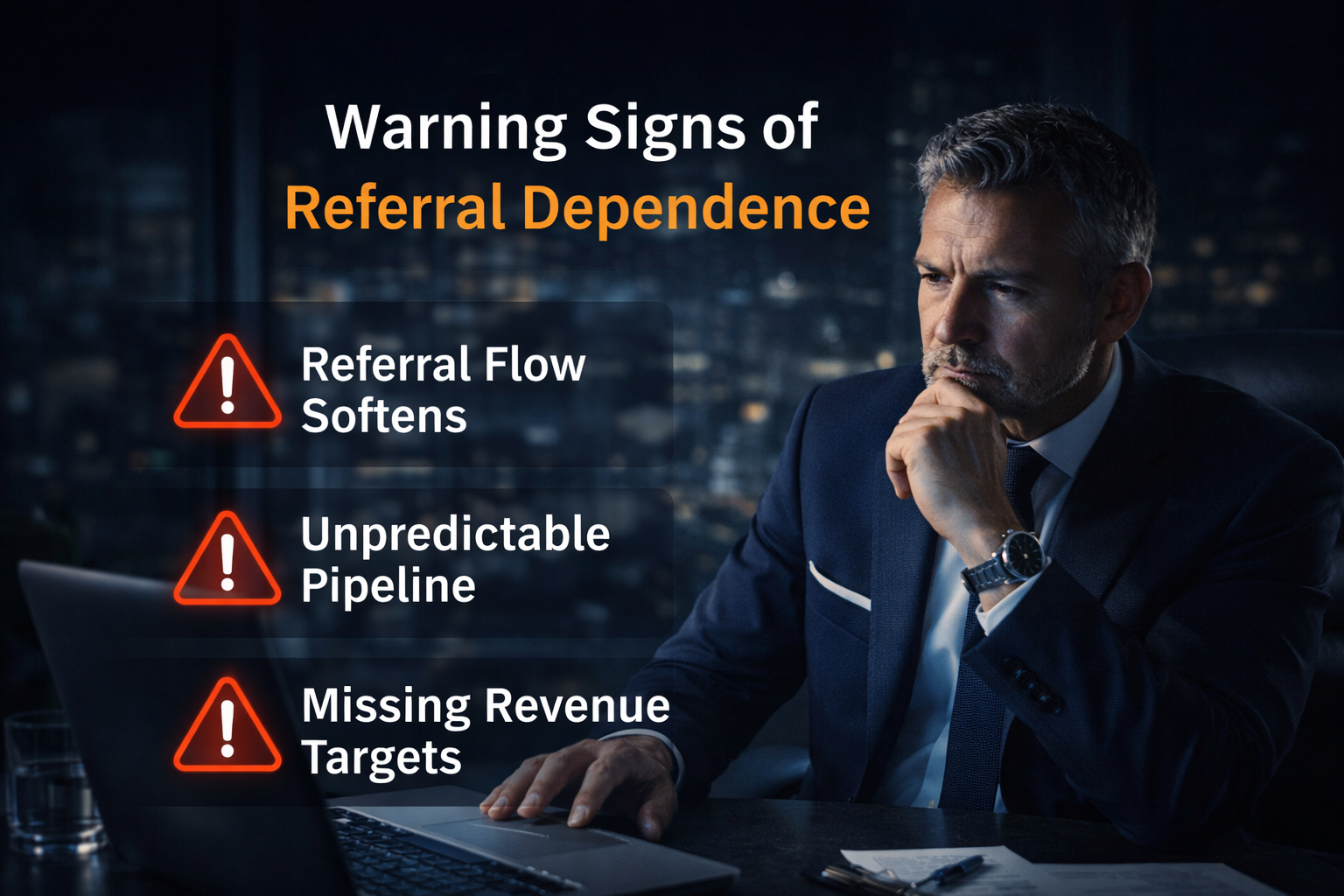
The warning signs of referral dependence
Here are the red flags I would take seriously.
Referrals are your default answer to every revenue question
If someone asks, “Where will next quarter’s pipeline come from?” and the honest answer is “our relationships,” that is not a forecast. That is optimism wearing a tie.
The founder still carries the message
If customers buy because the founder can explain the value clearly, but the website, sales materials, and team cannot do the same, you have a transfer problem.
Marketing exists, but it does not produce confidence
Maybe there is content. Maybe there are campaigns. Maybe someone is posting regularly. But leadership still does not trust the system to produce qualified demand without founder involvement.
That is not a marketing volume problem. It is a system design problem.
Sales performance swings with visibility, not process
One event goes well. A partner sends business. A long-term client introduces someone. Then the pipeline goes quiet.
That pattern is common in referral-dependent companies. Spikes feel encouraging, but they are not compounding.
A short example
Consider a $9 million B2B services firm that has grown almost entirely through founder relationships and repeat business.
For years, this worked beautifully.
Then the founder wants to step back from daily selling. Growth slows. The team adds a marketing coordinator and tries a few campaigns. Results are thin. Frustration rises. Leadership concludes that marketing is weak.
But after a closer look, the real issue is not that marketing failed.
The business never translated founder trust into a transferable market story. It never built a defined demand path. It never decided what pipeline should come from referrals, what should come from outbound, what should come from thought leadership, and what should come from nurture.
So the company is not replacing referrals with a growth engine. It is trying to improvise one under pressure.
The common failure pattern
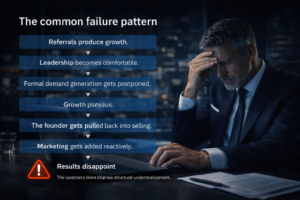
This is the sequence I see most often:
Referrals produce growth.
Leadership becomes comfortable.
Formal demand generation gets postponed.
Growth plateaus.
The founder gets pulled back into selling.
Marketing gets added reactively.
Results disappoint because the underlying structure is still missing.
The business then blames the tactic, the hire, or the vendor.
The reality is simpler.
Referrals were doing more than generating revenue. They were hiding structural underdevelopment.
How to tell if this is the real constraint
Two diagnostic questions:
Diagnostic question #1: If referrals dropped by 30 percent over the next six months, could the business explain exactly how it would replace that pipeline?
If not, the company is more referral-dependent than it thinks.
Diagnostic question #2: Can someone other than the founder clearly articulate the company’s value, target market, buying triggers, and demand path?
If not, the growth engine is still person-dependent.
A few more signs:
- marketing decisions happen only after sales slows
- the founder remains the main closer on strategic deals
- the team has activity but no demand generation model
- pipeline quality improves when the founder is visible and declines when the founder steps back
- marketing is judged emotionally because there is no agreed system for measuring progress
What to do next without wasting another quarter
You do not fix referral dependence by panicking into tactics.
You fix it by making referrals one part of a broader growth system.
That means leadership needs to answer four questions:
- What should referrals do, and what should they not be expected to do?
Referrals are valuable. They just cannot carry the whole enterprise indefinitely.
- What part of founder knowledge must be extracted and systematized?
The message in the founder’s head has to become usable by the rest of the company.
- What demand paths can this business realistically govern?
Not every company needs the same mix. But every growth-minded B2B company needs clearer control than “let’s hope the phone rings.”
- Who owns the transition from relationship-led growth to system-led growth?
This is where many businesses get stuck. Everybody is busy. Nobody owns the transition.
That is a leadership issue first.
If your company has grown well on referrals but you can feel the ceiling getting lower, the Executive Marketing Readiness Review™ is designed to determine whether the real issue is marketing leadership, growth system viability, or another upstream constraint. Request a slot here.
Why this matters more than it seems
Referral dependence is not just a pipeline issue. It is an enterprise value issue.
Referral-Based Business Growth: Why It Stalls and What CEOs Should Fix
A company that can only grow when the founder is heavily involved is harder to scale, harder to forecast, and harder to de-risk.
The more the business depends on informal trust networks, the more vulnerable it becomes to delay, distraction, and transition.
That does not mean referrals are bad.
It means they need a supporting structure.
A more disciplined next step
The Executive Marketing Readiness Review™ is a 30-day executive diagnostic for founder- and CEO-led B2B companies that need an independent read on whether marketing leadership is the actual growth constraint or whether the issue sits elsewhere. The goal is executive clarity, not a disguised agency recommendation.
In some cases, the next step after the diagnostic may be Fractional CMO leadership to help install the needed structure. In other cases, the correct answer is different. The value is knowing before you spend another quarter funding guesses.
If referrals built the business but you are no longer comfortable betting the next stage of growth on informal momentum alone, request a slot for the Executive Marketing Readiness Review™ here

FAQs
Is referral-based growth bad?
No. It is often healthy early on. The problem is depending on it too heavily without a repeatable demand system.
Why do referral-driven companies stall?
Because referrals are not fully governed by the company. Volume and timing can become unpredictable.
How do I grow beyond referrals?
Start by clarifying ownership, message, demand paths, and reporting before adding tactics.
Can marketing replace referrals completely?
Usually that is not the goal. The better goal is to make referrals one input inside a broader, more predictable growth system.
What is founder-led sales dependence?
It means the founder still carries too much of the demand generation, messaging, and closing responsibility.
What is the first step to reducing referral dependence?
Diagnose whether the constraint is message clarity, leadership ownership, or system design before you buy more execution.
Who should own the shift away from referral dependence?
It needs executive ownership, not just delegated marketing tasks.