
Why Your Marketing Problem Is Actually a Leadership Problem – And How to Fix It

The Marketing Problem Isn’t a Marketing Problem – It’s a Leadership Problem
For CEOs leading B2B companies in the $5 million to $75 million range, the feeling is all too familiar. Growth has stalled or feels inconsistent. Your marketing efforts are fragmented into a series of disconnected “random acts of marketing.” You find your team relying on instinct instead of a documented strategy, and as a result, the entire function feels like a constant question mark. You know something needs to change, but the path forward is unclear.
When faced with this uncertainty, the common impulse is to look for tactical fixes: a new social media campaign, a different ad vendor, or perhaps hiring a more junior person to “do more marketing.” This approach rarely delivers the predictable growth you need, and the cycle of guesswork continues.
But what if the solution isn’t more marketing, but a completely different way of thinking about it? What if the root of the problem isn’t in your tactics at all?
The solution lies in four fundamental shifts in perspective that move a business from strategic ambiguity to predictable growth. These shifts aren’t just theoretical—they’re backed by research and proven results from companies that have successfully transformed their marketing function from chaos to certainty.
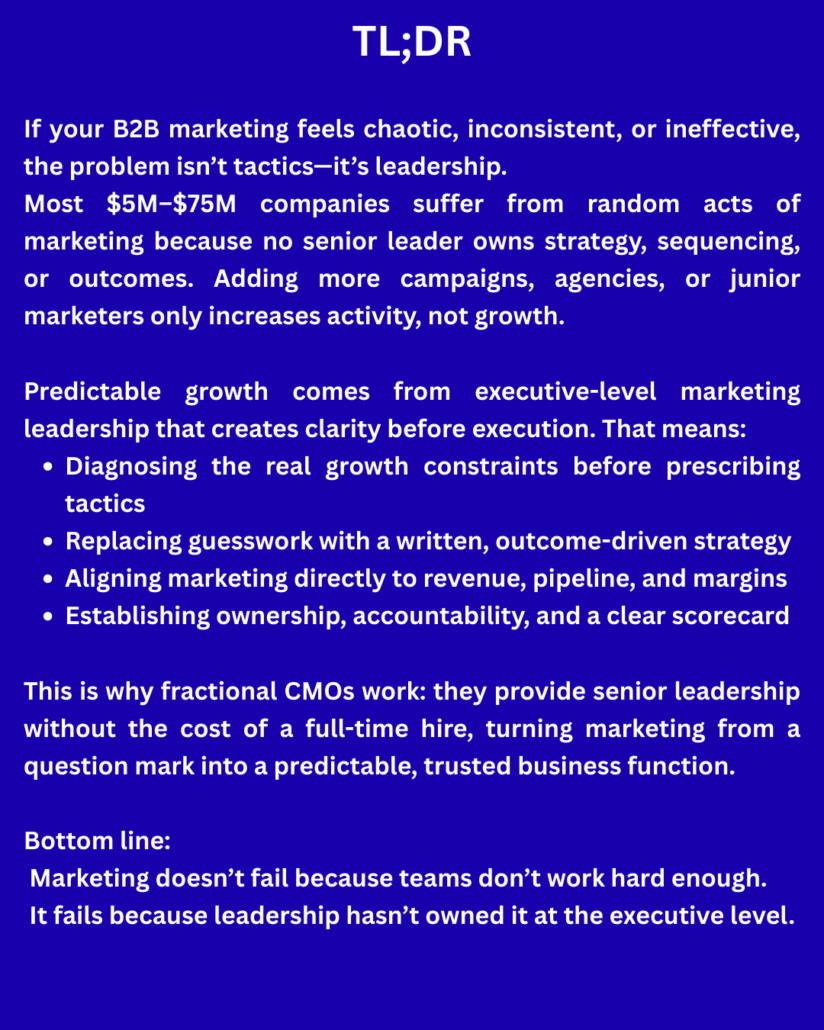
Marketing Isn’t a Tactical Problem, It’s a Leadership Problem
When growth stalls, leaders often misdiagnose the cause. According to research on CEO-CMO alignment, less than 40% of CEOs grade their marketing leaders as an “A” for driving growth, indicating a fundamental disconnect between expectations and results. The typical response is to seek tactical solutions, assuming the business needs more tactics, more junior execution, or a new set of disconnected vendors.
Here’s what those “random acts of marketing” actually look like in practice:
Sporadic social posts with no content strategy or measurable connection to pipeline development. One-off email blasts that go to undefined audiences with no nurture sequence. Vanity SEO spending on keywords that don’t align with your ideal customer profile. Expensive trade show appearances with no follow-up process or ROI measurement.
These patterns usually emerge from habit (“we’ve always done this directory ad”), reactive decisions (“the CEO saw a trend on LinkedIn”), or pressure (“sales wants more collateral now”), rather than a strategy anchored to clear outcomes. Research from B2B marketing consultancies shows these scattershot tactics burn budget and attention while creating misleading activity metrics that look busy but mask the fact that revenue, win rates, and sales cycle times are not improving.
The breakthrough moment for any CEO is the realization that this chaos is a symptom of a leadership gap, not a tactical deficiency. The root cause is almost always a lack of senior ownership. Your marketing isn’t just a set of activities; it’s a multi-level ecosystem, and without executive-level guidance, that ecosystem becomes fragmented.
McKinsey’s research on CEO-CMO partnerships reveals that companies where the CMO is deeply involved in strategy are 1.4 to 2 times more likely to achieve annual revenue growth of more than 5%. This underscores that senior-level marketing ownership is a structural advantage, not a luxury.
To resolve the chaos, marketing must be reframed as a predictable, executive-level function, not a series of tasks delegated downward. The CEO realizes that marketing cannot be delegated downward or outsourced tactically; it requires senior leadership, sequencing, and ownership.

The Real Goal Is Clarity, Not Just More Activity
Once you accept that marketing is a leadership function, the next logical question is: what does that leadership produce? Most leaders believe marketing’s job is to produce campaigns and content. They’re wrong.
The actual product of a high-functioning marketing leader is freedom from strategic ambiguity—or what experienced fractional CMOs call “Marketing Certainty.” It’s about moving from uncertainty to a credible, step-by-step path forward that doesn’t rely on guesswork.
This clarity is the force that repairs the fragmented ecosystem. It unlocks a powerful progression that moves the entire organization forward in a structured way:
The path forward: clarity → coherence → confidence → ownership
This progression is so impactful because it replaces instinct with a visible, written strategic marketing plan, often for the first time. Within approximately 45 days, the leadership team can align on a shared understanding of the business’s growth engine and trust that a transparent process is finally in place to drive execution.
CEOs tend to evaluate marketing on revenue growth and margins, while many marketing teams default to softer engagement metrics like likes, shares, or website traffic. This disconnect deepens the sense that marketing is unclear, inconsistent, and hard to trust. Strategic clarity closes this gap by ensuring every marketing activity connects directly to business outcomes.
When there is no documented executive-level marketing strategy, teams default to “doing more” rather than “doing the right few things better,” which is why activity volume goes up while confidence goes down. This is precisely why hiring a junior marketer or adding another agency vendor doesn’t solve the underlying problem.
Why a Junior “Doer” or New Agency Doesn’t Fix the Problem
Many CEOs believe the solution to marketing chaos is hiring a junior marketer or bringing in a new agency. This approach virtually guarantees continued frustration. Here’s why:
Hiring a junior marketer without a strategy effectively delegates complex positioning, segmentation, and revenue architecture to someone who has never done it before. This reinforces reactive, channel-first execution rather than strategic thinking. You’re asking someone to build the plane while flying it, and they’ve never built a plane before.
Agencies are optimized to sell execution: Tactics like ads, content, SEO, and campaigns. Agencies excel at “doing,” but they typically cannot provide the senior leadership required to determine what should be done, why, and in what sequence.
In mid-market B2B firms, the gap is often that marketing is either under-leveled (owned by a junior generalist) or outsourced piecemeal to agencies with no one accountable for the integrated plan. This creates a scenario in which everyone is busy, but no one owns the strategy.
This is the context in which a fractional CMO becomes valuable: not as “another vendor,” but as the missing owner of the overall growth narrative, trade-offs, and scorecard. A fractional CMO brings senior leadership, strategic frameworks, and decision-making at a fraction of the cost of a full-time executive, typically the right solution for companies that are too complex for ad hoc marketing but not yet ready for a full-time CMO.

You Must Diagnose Before You Prescribe
Achieving clarity isn’t a matter of opinion or brainstorming. It can only be built on an honest, unflinching diagnosis of the business. Jumping into solutions without this diagnostic phase is the very definition of “random acts of marketing.” A structured approach begins by helping leadership clearly see why their current approach cannot deliver predictable growth. The diagnosis itself is what reframes the problem, shifting the focus from tactics to leadership.
In my experience working with mid-market B2B companies, a successful diagnosis is marked by a series of powerful epiphanies. A CEO should find themselves saying:
- “This explains why what we’re doing feels scattered.”
- “I finally understand what’s missing.”
- “I can see why tactics alone won’t solve this.”
- “This makes the next step obvious.”
This diagnostic clarity, often facilitated by an experienced executive resource like a fractional CMO, allows a business to understand precisely where growth is breaking down, what to fix first, why it matters, and how all the pieces fit together.
What a proper diagnostic phase includes:
Research-backed fractional CMO frameworks typically spend the first 30 days almost entirely on discovery. This includes 8 to 10 stakeholder interviews with founders and key customers, pipeline and win-loss analysis to understand what’s actually converting, marketing asset inventory to assess what exists, website and conversion review to identify funnel leaks, and mapping of current tech stack and agency relationships to understand resource allocation.
The main deliverable for this phase is an executive-level diagnostic: a baseline KPI scorecard that shows where you actually stand, a map of the current funnel with conversion rates at each stage, and a gap analysis that calls out what’s broken or missing and the cost of those gaps.
Many effective frameworks also emphasize identifying “quick wins” in this phase, patching obvious funnel leaks such as broken calls-to-action, slow demo scheduling, or poor lead routing. These quick wins demonstrate early lift and build confidence without pretending a complete strategy is already in place.
Before this diagnosis, the CEO typically believed the marketing strategy was either non-existent, something they’d never actually done, or an expensive exercise that hadn’t felt practical or worth the effort. After this phase, they understand exactly where growth is breaking down, why it’s happening, and how a structured, strategic marketing process resolves it.
You’re Investing in a Leadership Shift, Not Just a Process
Perhaps the most profound takeaway is that transforming marketing from a chaotic function to a predictable one is more than just implementing a new plan. It represents a fundamental change in the organization’s identity and leadership.
This is not a process. This is an identity and leadership shift.
This means reframing marketing as a core executive responsibility, integrated at the highest level of the company. It’s a shift that allows the entire multi-level ecosystem—from strategy to execution—to work without the fragmentation that plagues so many businesses.
When this transformation occurs, the CEO no longer has to decide whether they’re doing the proper marketing, enough marketing, or any marketing at all—because there is a visible, documented strategy and a transparent process driving execution. Marketing becomes a well-managed, predictable, and strategic function that the entire leadership team can trust.
This is the crucial final step that enables long-term, predictable growth because the responsibility for that growth is no longer siloed or delegated; it is owned and managed at the executive level.
From Question Mark to Predictable Function
Replacing marketing chaos with predictable growth requires a fundamental change in perspective. It demands a move away from tactical guesswork and toward a strategy-led approach owned by senior leadership. It’s about achieving clarity, diagnosing problems correctly, and understanding that this is ultimately a shift in leadership, not just a change in activities.
The research is detailed: companies with senior-level marketing leadership deeply involved in strategy significantly outperform those that delegate marketing downward or treat it as a tactical function. The difference isn’t in the tactics themselves; it’s in the strategic clarity, ownership, and accountability that senior leadership provides.
When this transformation occurs, marketing ceases to be a source of frustration and uncertainty. It becomes a well-managed, predictable, and strategic function that the entire leadership team can trust.
Ultimately, you must ask yourself:
Is marketing something you are delegating, or is it a predictable, executive-level function you are prepared to own?
If you’re ready to replace strategic ambiguity with Marketing Certainty, the first step is gaining clarity on where your marketing ecosystem is actually breaking down—and what it will take to fix it. That clarity begins with an honest diagnostic assessment that shows you exactly what’s missing and provides a credible path forward.