
Audience-First SEO: A Better Starting Point Than Keywords

Audience-First SEO: A Better Starting Point Than Keywords
Audience-first SEO reverses the order most search programs follow. The usual plan starts with a keyword list sorted by search volume, and the biggest numbers become the content calendar. That used to be standard practice, and it still brings traffic. It does not promise that the traffic comes from the people most likely to buy.
The audience-first version begins with a business question. Which audiences matter most to us, what problems are they trying to solve, and how do they look for answers while they make a decision? Keyword research still happens, but it comes after those answers and sorts opportunities inside audiences you have already chosen.
This article is for owners and marketing leaders who already invest in search engine optimization and want that spending pointed at the right buyers.
Quick answer
Audience-first SEO identifies your most valuable customer segments before any keyword work begins, then uses their needs, questions, search behavior, and decision process to set keyword and content priorities. Keyword research stays in the process, but it moves later, where it sizes and sorts opportunities inside audiences you have already chosen. Success is measured by qualified leads and revenue influence, not by total organic traffic.
Why does a keyword-first plan produce the wrong priorities?
A keyword-first plan ranks opportunities by search volume, and search volume counts searches without saying anything about who is searching or whether they could ever become a customer.
Rankings are hard to win, so you pick the terms with the most searches and build pages to compete for them. The trouble shows up later, usually in a meeting with the sales team. Traffic is climbing, but the leads are thin, or they come from companies that are too small, too early in their thinking, or in the wrong industry. Search volume reports how often a phrase is typed. It says nothing about the job title, budget, or urgency of the person typing it.
I would not call keyword-first planning wrong. It is incomplete, and it puts the most abstract number in the process ahead of the most concrete fact you have, which is who actually buys from you.
What is audience-first SEO?
Audience-first SEO is a planning sequence that starts with the customer segments worth winning and builds keyword, content, and search strategy around what those segments need.
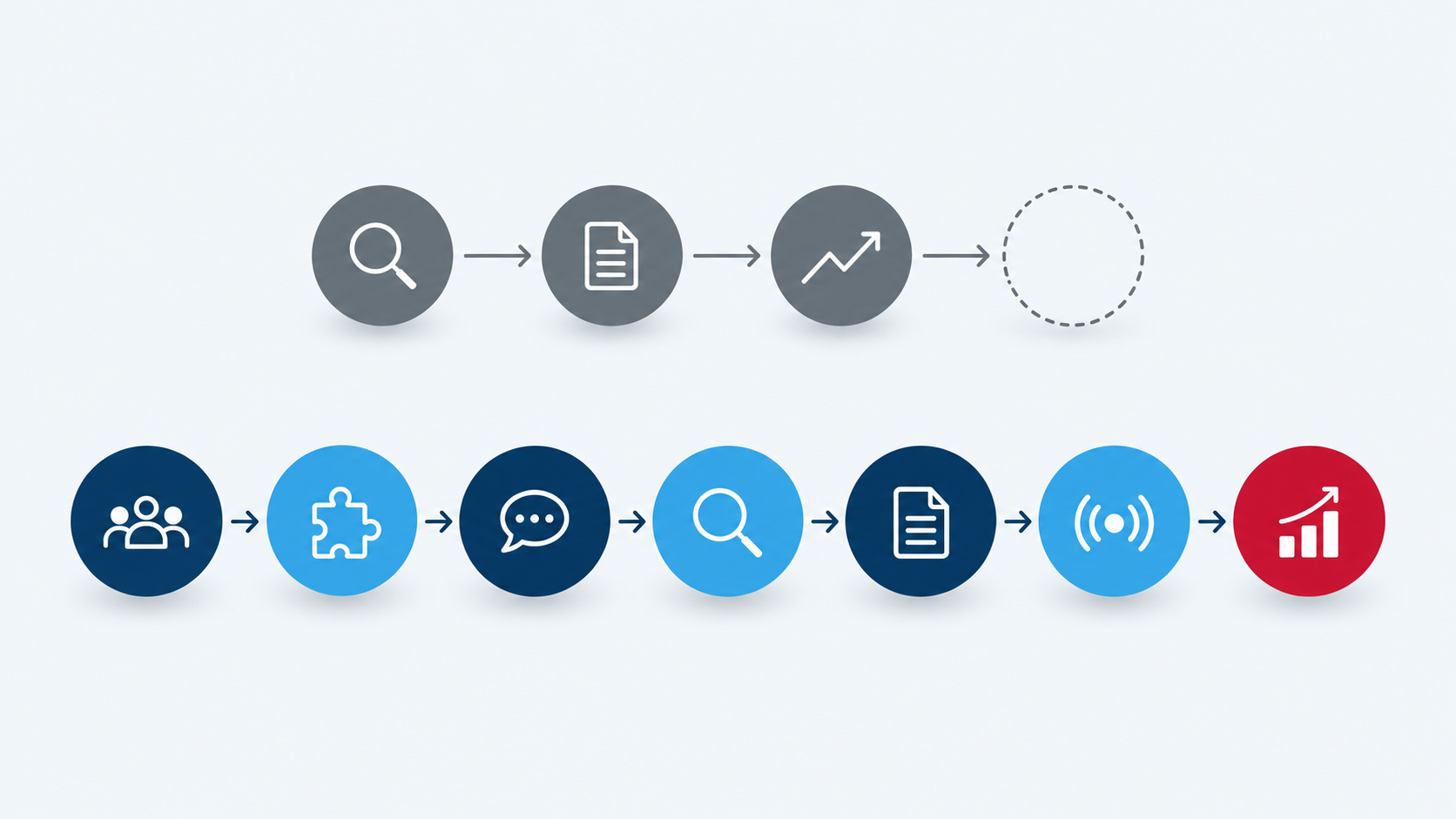
Keyword-first planning turns a high-volume keyword into an article and hopes the right customer finds it eventually. Audience-first planning starts further upstream. A high-value audience has a business problem. That problem sends people into search with particular questions, and those questions point to keyword opportunities. The opportunities shape the content, the content appears where the audience already pays attention, and the whole chain is judged by what happens to the business.
Google’s own documentation points the same way. Its guidance on creating helpful, reliable, people-first content asks whether you have an existing or intended audience that would find your content useful if they came to you directly, and it treats content made primarily to attract visits from search engines as a warning sign. Your keyword tools stay in use, and the audience comes ahead of the tactic.
Why are audience value and audience size different things?
A larger search audience is not automatically a more valuable business audience. Value depends on how well the people in it fit what you sell and whether they can act on it.
Size is easy to see because every keyword tool displays it. Value lives in your own business records. Every tool will happily tell you how many people searched for “accounting software” in a given month. None of them will tell you how many of those people were students.
Which factors make an audience valuable?
Fit with the service is the starting point. Beyond that, look at revenue potential, buying authority, urgency, likelihood to convert, sales-cycle fit, retention, and strategic importance to the business. A small, urgent, loyal segment can beat a large, lukewarm one.
Most of this is in records you already keep. Pull the customers who bought, stayed, and referred others, and look at what they share. Ask the sales team which customers they wish they had ten more of. What I’ve found is that closed deals describe an audience better than a brainstorming session does.
The table below is illustrative, using an invented software company that sells to construction contractors. The ratings are examples, not measured data.
| Audience segment | Fit with the product | Buying authority | Urgency | Illustrative priority |
|---|---|---|---|---|
| Contractors with 20 to 200 employees | Strong | Owner or controller decides | High, especially during growth or audits | High |
| Freelance bookkeepers who serve contractors | Partial | Recommend, rarely buy | Medium | Medium (suits partner-focused content) |
| Accounting students and hobbyists | Weak | None | Low | Low |
A documented business marketing plan is a good home for these decisions, because it ties audience priorities to revenue goals.
How does search demand look different by customer segment?
The same keyword can mean very different things to different people, so demand and competition should be weighed segment by segment instead of read as a single number.
Weighing volume against relevance
A broad, high-volume query such as “accounting software” pulls in students, freelancers looking for free tools, job seekers, vendors checking competitors, and early-stage researchers months from a decision. Few of them will buy from you.
A narrower topic, such as job cost reporting for contractors, will show a much smaller number. Nearly everyone typing it has the exact problem your product solves, so the smaller audience can be worth more in pipeline and can cost less to win.
That is not a rule that low volume is good. Plenty of small keywords attract nobody who matters, and plenty of large ones deserve the effort. For any keyword, ask who is likely typing it, what they need at that moment, and whether you could answer better than what already ranks.
Reading competition by segment
Competition deserves the same lens. A phrase dominated by national publishers may be out of reach for a regional firm, while a phrase about a specific industry problem may be answered poorly, or not at all, by the pages that appear. The results for your audience’s real questions tell you more than a generic difficulty score does.
What questions are your ideal customers actually asking?
Your ideal customers ask about risk, cost, fit, and next steps, and those questions rarely sit at the top of a keyword list. You find them by listening to customers directly, then use keyword research to test and refine what you hear.
Keyword research asks what you can rank for. A customer-centered process asks what this buyer needs to understand before making a confident business decision. The keyword question produces pages sized to a phrase, and the buyer question produces pages sized to a decision.
Where the questions are hiding
The raw material is already inside your company. Sales call notes show what prospects ask before they trust you. Lost-deal reasons in the CRM show where a buyer’s confidence broke. Search Console queries show the phrases that already bring people to you. Even five or six customer interviews tend to turn up language your team would never have guessed.
Keyword tools then do their proper job. Look at how people phrase those questions in search, check the related searches, and see where measurable demand exists. That can confirm a topic, sharpen the wording, or reveal that a question buyers ask constantly has almost no search volume. Answer it anyway, because a question buyers ask is worth answering whether or not a tool can count it.
How buying stage changes content priorities
Someone early in the process asks what the problem is. Someone comparing options asks how approaches differ. Someone close to a decision asks about pricing, implementation, and risk. A small team with a limited budget can often do more good by covering late-stage questions well than by publishing one more broad explainer.
A content marketing program earns its keep when each piece supports a step in the decision. Pageviews are a byproduct.
Where do your buyers look before they contact you?
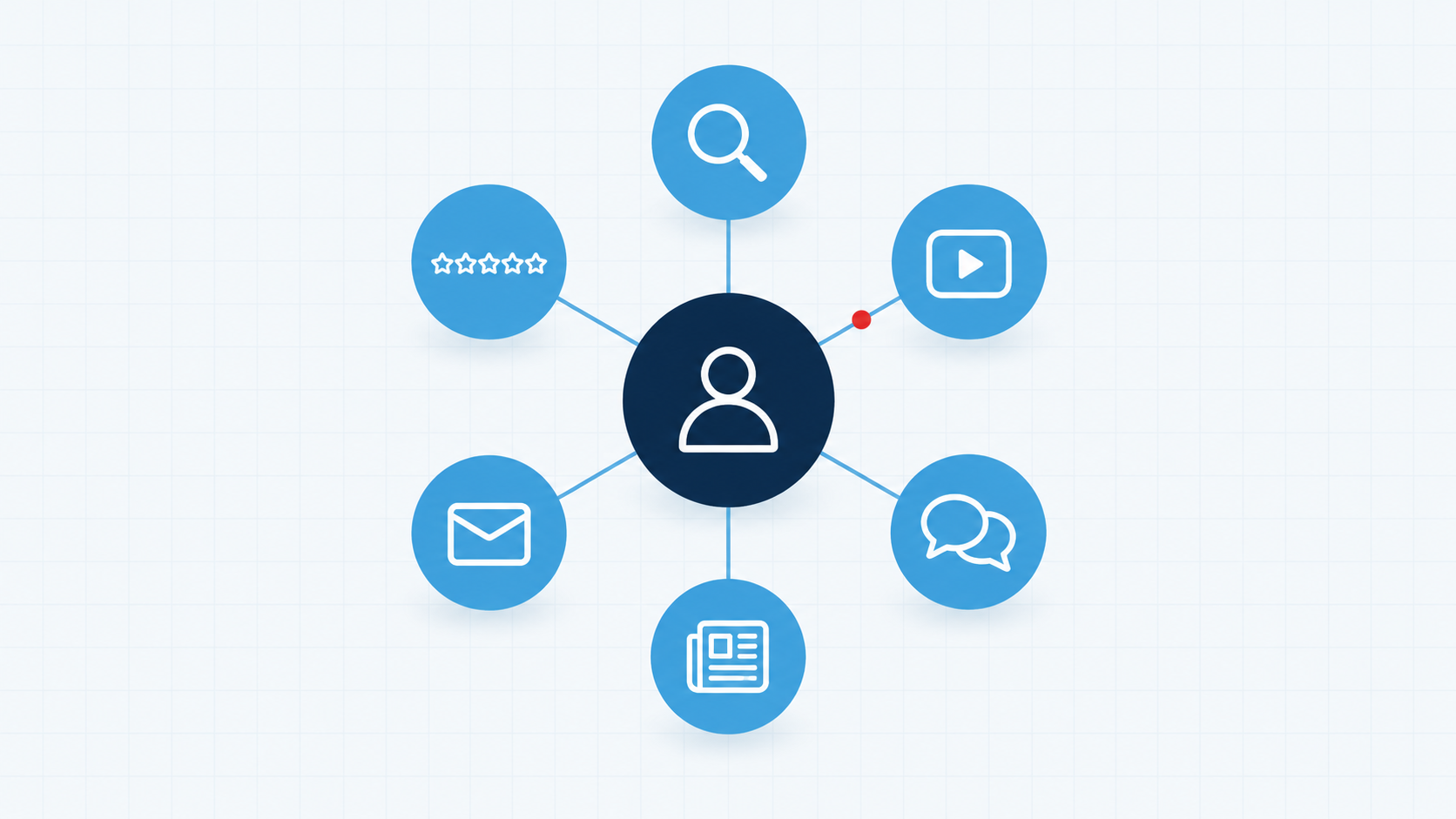
Buyers research across search engines, video, forums, publications, and peers, so your visibility plan needs to cover the places your audience trusts, not only the ones where you already publish.
Gartner’s sales survey of 646 B2B buyers, conducted in August and September 2025 and published in March 2026, found that 67% prefer a rep-free experience, and Gartner describes buyer journeys as increasingly self-directed. Buyers do more of the research and comparison on their own before anyone talks to your team, and what they find shapes who makes the shortlist.
Which places matter depends on the audience, so ask instead of assuming. A contractor may watch a walkthrough on YouTube and ask a question in a trade forum. Depending on who you sell to, the list can include Google, YouTube, Reddit, LinkedIn, trade publications and associations, niche communities, newsletters, review sites, and the AI assistants some buyers now consult. The simplest research is asking in sales and onboarding conversations where people looked before they contacted you, and who they asked.
Then decide how to show up. On your own site, that means pages that answer the questions above well. Elsewhere it means contributing something useful, such as a byline in the trade publication your buyers read, a clear answer in a community where you have standing, or a session for an industry association. Trust in those places is earned by being useful there.
How should you measure audience-first SEO?
Judge audience-first SEO by whether the right people arrive and act. Qualified leads, conversion by segment, and revenue influence carry the weight, and total organic traffic becomes one input instead of the score.
Under an audience-first plan, total organic traffic can even dip for a while if the team stops chasing broad terms that never produced buyers, so judging the program on that number alone would punish the right decision.
Google’s guidance on using Search Console and Google Analytics together draws a useful line. Search Console shows how your site performs in Search, including impressions, clicks, and queries. Analytics shows what visitors do after they arrive.
Add your own records. Track the share of organic visits from target segments, conversion rates by segment, sales conversations that mention a specific page or topic, and revenue tied to organic leads across a full sales cycle. Tag priority content by audience so reports read segment by segment, and set expectations with leadership early, because revenue signals take longer to appear than traffic signals.
How can you move toward audience-first SEO without starting over?
Keep what already works, add an audience layer on top of your current keyword list, and shift new content decisions to the audience-first sequence one segment at a time.
Most businesses have years of SEO work behind them, and a rebuild is rarely needed. Name your top two or three audiences using customer records and sales input. Sort your existing pages and keywords by the audience each one serves. Keep the pages that rank and bring qualified leads. Then rebuild the coming quarter’s content calendar from the customer-question research, check each topic against keyword data, and pilot the approach with one audience for a quarter before you change anything else.
This work sits between strategy and execution, which is why it often stalls. Someone with marketing leadership authority has to decide which audiences take priority, and sales, content, and SEO all have to agree. That is a large part of what a fractional CMO does for companies without a full-time marketing executive.
Related reading
- Quality over quantity in blogging: why fewer, deeper posts that answer real customer questions tend to suit small teams better than a rushed publishing schedule.
- Full-time vs fractional CMO: a guide to choosing the kind of marketing leadership that fits your budget and stage of growth.
- What Lucé Media does: an overview of Lucé Media’s services, from digital marketing and strategic consulting to analytics and reputation management.
Frequently asked questions
What is audience-first SEO?
Audience-first SEO is a planning approach that starts with the customer segments worth the most to your business. You learn what those groups need, what questions they ask, and where they look for answers. Keyword research, content, and distribution decisions then follow from that understanding, so search work supports the people most likely to become customers.
Does audience-first SEO replace keyword research?
No. Keyword research remains part of the process, and it becomes more useful because it comes after the audience decisions. Instead of choosing terms by volume alone, you use keyword data to size demand, refine wording, and compare competition within segments you have already chosen. The tools stay the same, and the order of the work changes.
Is search volume still important?
Yes. Volume shows how much demand exists for a topic, and that matters when you decide where to invest. It just does not describe who is searching. A large number can hide students, researchers, and people who will never buy, while a small number can describe a tight group of ideal customers. Read volume alongside audience relevance.
How do you identify your highest-value audiences?
Start with your own records. Look at customers who bought, stayed, and referred others, then find what they have in common. Add input from sales, since they know who closes and who stalls. Weigh fit with the service, revenue potential, buying authority, urgency, likelihood to convert, and retention. Then choose two or three segments to prioritize.
Does audience-first SEO mean targeting only low-volume keywords?
No. It means choosing keywords because they match a valuable audience, whatever their volume. Some will be small and highly specific. Others will be broad terms your best customers also use. Low volume does not guarantee value, and high volume does not rule it out. Relevance to the segment decides.
Can audience-first SEO work for B2B companies?
Yes, and B2B is a natural fit. Deals are larger, buying groups are smaller, and a handful of qualified visitors can matter more than thousands of casual ones. Buyers also do much of their research on their own, so answering their real questions in the places they look carries real weight.
How should we measure SEO success?
Use organic traffic as one input, and judge results by qualified leads, conversion rates by segment, sales conversations that trace back to specific content, and revenue tied to organic leads across a full sales cycle. Combining Search Console data with analytics and CRM records shows who arrived and what they did next.
Talk through your audience priorities with Lucé Media
If your SEO spending is producing traffic that your sales team cannot use, a conversation can help sort out which audiences deserve the work. Bring your current keyword list and your best customer list, and we will start there.