
What Is Geofencing Advertising for Local Businesses?
Geofencing Advertising for Local Businesses: What It Actually Is (and Isn’t)
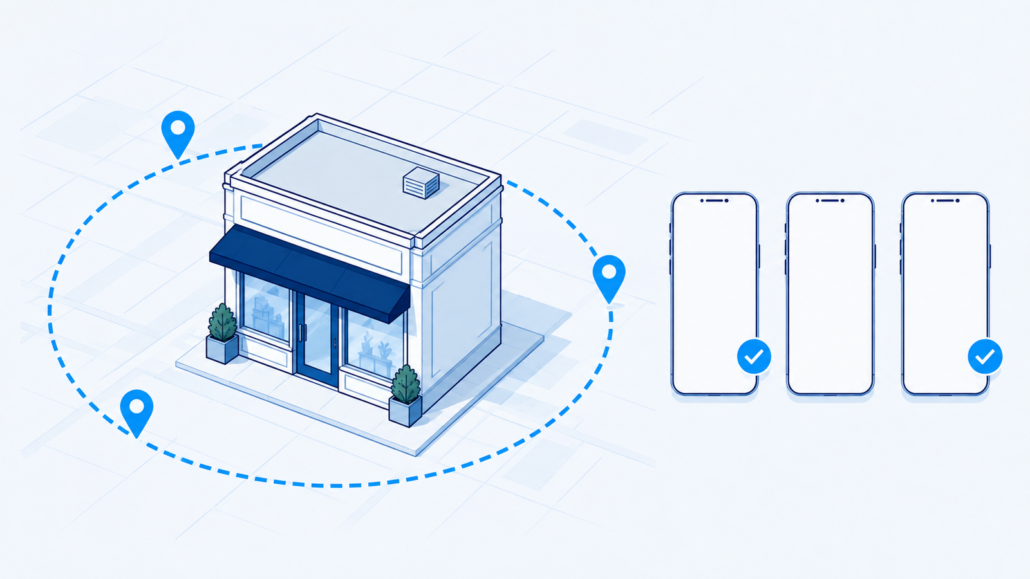
Geofencing advertising groups together a few different ways to reach a mobile device near a physical location, and the differences between them matter more than most vendor pitches admit. An app can send a push notification when a phone crosses a boundary, but only if that app is installed and the user granted location and notification permissions. A programmatic ad platform can also detect eligible devices inside a defined area and either serve an ad on the spot or add that device to an audience for a later ad, depending on the vendor. And a standard platform can target a radius or a city without any boundary-crossing mechanism at all.
For a Dallas-Fort Worth business deciding where to spend a limited paid media budget, understanding which of these three a vendor is actually selling matters more than the word “geofencing” on a proposal.
Quick Answer
Geofencing advertising for local businesses is a broad term covering three related but different tools: app-based geofence notifications, programmatic geofencing ads, and standard location or radius targeting on platforms such as Google Ads. Only the app-based method can initiate a push-notification workflow, and even then delivery depends on the app being installed, user permissions, operating-system behavior, and platform conditions. Programmatic and standard location targeting deliver ads according to their own audience, eligibility, inventory, and auction rules.
Key Takeaways
- Geofencing covers three different mechanisms, app-based push notifications, programmatic geofencing ads, and standard location or radius targeting, and they are not interchangeable.
- Fortune Business Insights projects the global geofencing market to grow from $3.22 billion in 2025 to $11.85 billion by 2034, but market growth does not prove any single campaign will work.
- Whether geofencing pays off depends on business type, offer quality, platform inventory, and how results are measured, not on proximity alone.
- Cost is driven by targeting precision, platform and inventory, creative and offer, and measurement approach, not a single flat rate.
- Consent, data sourcing, and sensitive-location exclusions should be settled before a campaign launches, not after.
- Geofencing tends to fit businesses where physical proximity connects to a purchase; service-area businesses without a storefront often get more value from search ads or broader geotargeting.
How does geofencing advertising actually work?
Geofencing advertising actually covers three distinct mechanisms that get marketed under the same word: app-based geofence notifications, programmatic geofencing ads, and standard radius or location targeting. They differ in what triggers them, what they require from the user’s device, and how reliably they reach someone in the moment.
The rise of these tools shows up in the market data. According to Fortune Business Insights, the global geofencing market is projected to grow from $3.22 billion in 2025 to $3.92 billion in 2026 and $11.85 billion by 2034, a 14.8% compound annual growth rate. That growth reflects rising vendor adoption across the industry. It is not proof that any specific campaign will perform well for any specific business.
App-based geofence notifications work through a software development kit built into a specific business’s own app. The notification only fires if a person has that app installed, has granted location permission, often both foreground and background access, and has separately allowed push notifications. A national retailer with an established loyalty app may be able to use this channel when users have granted the required location and notification permissions. A single-location DFW restaurant without its own app cannot deploy this specific channel through an app it owns, though it may still be able to participate through a third-party app or platform that already has the geofencing capability and the necessary user permissions in place.
Programmatic geofencing ads work differently. An ad exchange or demand-side platform identifies devices that were present in a defined area, based on location signals shared through other apps or ad SDKs on that device, and either serves an ad while the device is still nearby or adds it to an audience segment for retargeting afterward. This does not require the advertiser’s own app, but it does depend on the device being reachable through that exchange’s inventory and on the user having consented to location sharing somewhere in that data chain. Coverage and accuracy vary by vendor, since not every device is visible to every platform.
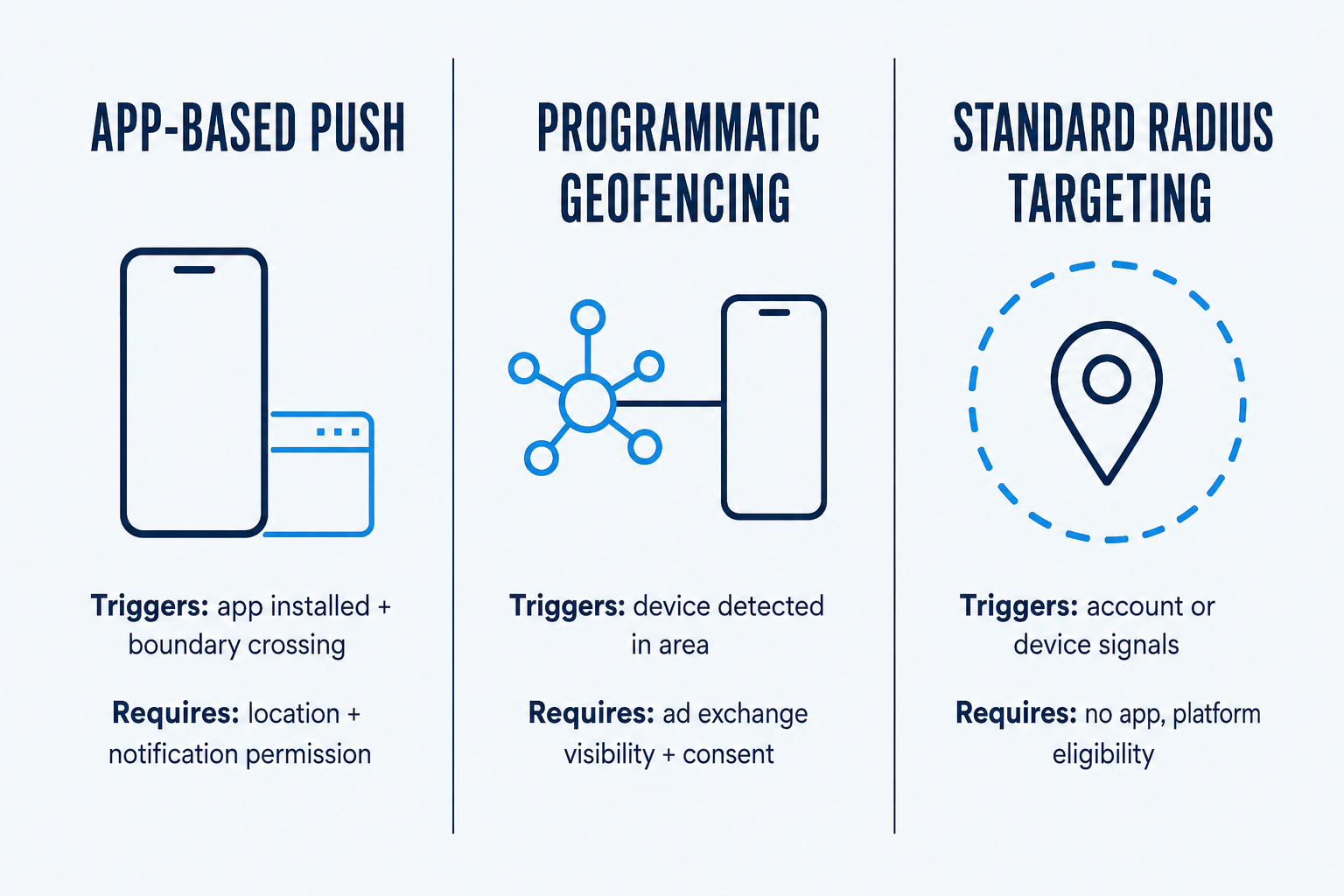
Standard radius or location targeting, the kind available inside Google Ads, is a different tool entirely. It does not trigger off a boundary crossing in real time. Instead, Google Ads relies on multiple location signals and campaign location options to decide who is eligible to see an ad in a chosen area. Depending on the setting selected, eligibility can include people physically or regularly in the area, or people who have shown interest in the area, and whether an ad actually appears also depends on the campaign type, ad eligibility, and the ad auction, not just location alone. This is geographic targeting, not geofencing in the boundary-crossing sense, even though the two get described with the same language in a lot of marketing material.
This distinction matters for a practical reason too. Google Ads’ own location-targeting documentation notes that a radius or location set very small may cause ads to show only intermittently, since small targets can fall below the platform’s delivery threshold. That is specific to how Google Ads behaves. Other geofencing vendors set their own minimum radius and delivery requirements, so this guidance should not be treated as a rule for every platform.
None of the three guarantees an immediate result. A qualifying boundary event may trigger a notification workflow, but that is subject to device permissions, operating-system behavior, and platform delivery conditions. A local business evaluating a geofencing proposal should ask directly which of these three mechanisms is being sold, since the answer changes what results are realistically possible.
What affects the cost of geofencing advertising?
The cost of geofencing advertising is shaped by how precisely the audience is targeted, which platform and ad inventory the campaign runs through, the strength of the creative and offer, and how the business measures results. There is no single standard price across vendors or markets.
| What shapes the cost | Why it matters |
|---|---|
| Targeting precision | Narrow targeting reduces the pool of eligible devices in an area, which can affect CPMs, minimum spend requirements, or basic feasibility differently depending on the provider. A wider area generally offers more available volume but less precision. |
| Platform and inventory | App-based platforms depend on install base in that app. Programmatic platforms depend on how many eligible devices their exchange can see in that area. Both affect how much volume is available at what price. |
| Creative and offer | A geofencing ad still competes for attention like any other ad. A generic banner does not outperform a weak offer simply because it was geographically targeted. |
| Measurement and attribution | Attribution and measurement capabilities, such as tying an ad exposure to a visit or sale, may involve additional platform or data fees. Businesses should ask each vendor how those costs are structured rather than assume a flat rate. |
Because pricing varies by platform, audience size, inventory, campaign duration, and measurement requirements, businesses should request a campaign-specific quote rather than rely on a general rate. A business weighing whether geofencing fits its broader paid media strategy can start a paid media conversation to work through those specifics.
When is geofencing worth testing?
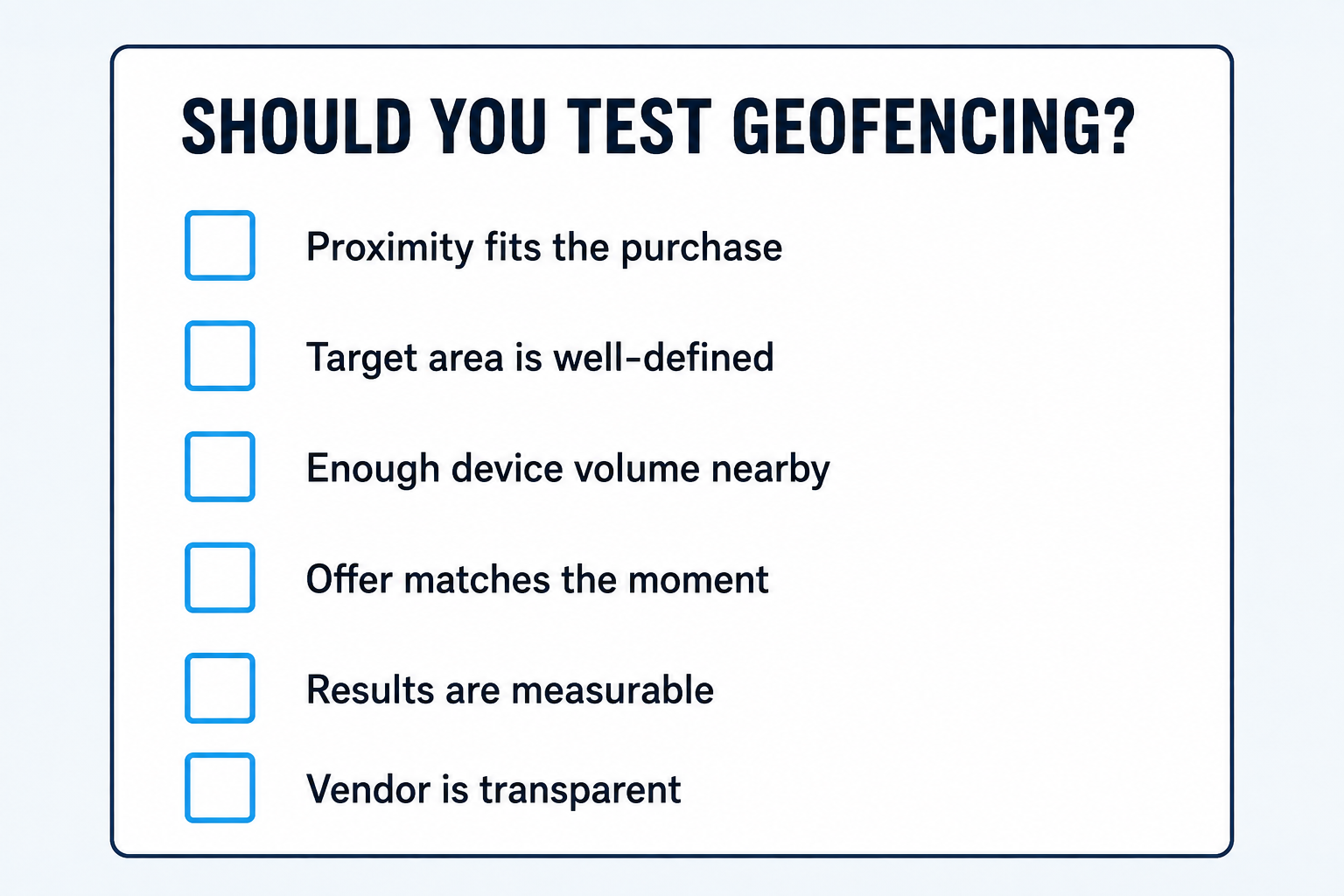
Before testing geofencing, a business benefits from running through a short set of questions rather than starting with the technology.
- Is physical proximity meaningfully connected to the purchase, or would the customer buy the same way regardless of where they were standing?
- Can the target location be defined tightly enough to avoid pulling in large amounts of unrelated foot or drive-by traffic?
- Is there enough device volume in that area for the chosen platform to actually deliver impressions?
- Is the offer relevant to that specific location and time, rather than a generic ad that happens to be geographically targeted?
- Can the business measure something more useful than impressions, such as a visit, a call, or a booked appointment?
- Has the vendor explained where its location data comes from, how it attributes results, what its privacy practices are, and what its minimum budget or audience size requirements are?
A business without in-house media analytics support often works through this checklist alongside a fractional CMO or an outside paid media partner rather than alone, since the answers usually shape the rest of the paid media plan too.
When geofencing may not be the right choice
Geofencing tends to fit businesses where physical proximity is commercially meaningful: restaurants, retail storefronts, auto dealerships and repair shops, entertainment venues, and time-bound events. A service-area business without a customer-facing location, such as a plumber who drives to the customer rather than the other way around, often gets more practical value from search ads, Local Services Ads, or broader geotargeting than from a geofence drawn around a competitor’s parking lot. The proximity signal that makes geofencing useful for a storefront does not carry the same meaning for a business whose customers never visit a physical address.
What privacy questions should a business ask before using geofencing?
Before running a geofencing campaign, a business should ask how consent is collected, how the vendor sources and processes location data, whether that data is aggregated or tied to an individual device, and how sensitive locations are handled.
Location data used for advertising generally traces back to a permission someone granted somewhere, whether that’s an app’s location and notification settings or a broader ad-tracking consent inside another app. A vendor should be able to explain where that consent came from, not just confirm that the data exists.
Ask how the vendor sources its location signals, whether that data is aggregated or pseudonymized before it reaches the advertiser, and how long it is retained. The Federal Trade Commission has taken enforcement action against companies that collected or sold precise geolocation data without adequate disclosure or consent, including data tied to sensitive locations such as healthcare facilities.
Advertisers should require vendors to document their policies for sensitive locations, such as healthcare facilities, schools, places of worship, and shelters, plus how consent is collected, where location data is sourced, how long it is retained, and what opt-out options are available to the people being targeted. In January 2025, the FTC finalized an order against data brokers Gravy Analytics and Venntel over the sale of precise location data tied to sensitive locations, which is a useful reference point for the kind of documentation a business should expect a vendor to provide before signing a contract (FTC press release, January 2025).
None of this is legal advice, and running a campaign through a reputable platform does not automatically make it compliant. A business handling sensitive categories, operating in a regulated industry, or working with a vendor that cannot answer these questions clearly should involve legal or compliance review before launching.
How should a DFW business think about geographic targeting?
A DFW business should let its customers’ actual travel patterns decide the geographic model, not a default assumption about suburbs versus cities.
Highways, road layout, and how spread out a market is all affect whether a straight-line radius or a drive-time boundary makes more sense. A business on a walkable retail corridor sees different customer movement than one set back from a highway service road in a car-dependent suburb, even if both are technically in the same metro area. Business type matters too: a lunch spot competing for a short window behaves differently than an auto shop where customers plan a visit days in advance. Rather than assuming a single geographic model fits every DFW location, a business is better served mapping its own customers’ actual routes and testing a boundary against that, adjusting based on delivered volume rather than guessing at the right size upfront. This kind of testing usually works best as part of a broader digital strategy rather than a one-off campaign decision.
Frequently asked questions
What is geofencing advertising?
Geofencing advertising is a general term for reaching mobile devices near a physical location. It covers three different tools: app-based push notifications, programmatic geofencing ads, and standard location or radius targeting. Each works differently, so the term alone does not describe how a specific campaign will actually reach someone.
How is geofencing different from standard location targeting on Google Ads?
Standard location targeting inside Google Ads relies on multiple location signals and campaign location options rather than a real-time boundary crossing. Depending on the setting selected, eligibility can include people physically or regularly in the area, or people who have shown interest in the area, and actual ad delivery also depends on the campaign type, eligibility, and the ad auction. Geofencing, whether app-based or programmatic, is built around a device entering or exiting a specific defined area. The two can complement each other, but they are not the same targeting method.
Is geofencing advertising effective for small businesses?
It depends on the business type, the offer, how much audience volume the platform can actually deliver in that area, and how results are measured, not on the technology alone. A well-targeted geofence with a relevant offer and clear measurement can perform well. A geofence with a generic ad and no way to track outcomes usually will not.
Does a business need its own app to use geofencing?
No, not always. A business needs access to an app-based channel with installed users and the appropriate permissions to send geofence-triggered push notifications. That may be the business’s own app or a qualifying third-party app or platform. Programmatic geofencing ads and standard radius targeting do not require the advertiser to own an app.
What privacy questions matter most with geofencing?
How consent was collected, whether the location data is aggregated or tied to an individual device, how long it is retained, and whether sensitive locations such as healthcare facilities or schools are excluded from targeting. A vendor that cannot answer these clearly is worth a second look before signing a contract.
Is geofencing a good fit for a service-area business without a storefront?
Often not as a first choice. Geofencing works best when physical proximity to a specific location connects to the purchase decision, which is harder to establish for a business that travels to the customer. Search advertising, Local Services Ads, or broader geotargeting frequently fit that kind of business better.
Final thoughts
Geofencing advertising is not one tool but three, and the right starting point is understanding which one a vendor is actually proposing before evaluating whether it fits a specific business.
- Ask directly whether a proposal involves app-based push notifications, programmatic geofencing, or standard radius targeting, since the answer changes what’s realistic to expect.
- Run through the testing checklist above before committing budget, rather than starting with the geofence size.
- Settle the privacy and data-sourcing questions before launch, not after.
Ready to figure out if geofencing fits your paid media mix?
A DFW business weighing whether geofencing fits its paid media mix can schedule a strategy call with Lucé Media’s team to work through these questions before committing budget.
Talk to our team