
Quality Over Quantity in Blogging: What Actually Works

Every small business owner runs into the same fork in the road eventually: write one thorough post a month, or knock out several quick ones instead. Most people take the quick route because it feels safer and less intimidating in the moment.
The quick route feels efficient at first, but each post still needs its own editing, promotion, and maintenance. This piece looks at why that is, what the research actually supports, and what a business can do differently starting with its next post.
Quick Answer
Quality over quantity in blogging means publishing fewer, more complete posts instead of a high volume of shallow ones. Quality itself comes from fully answering the reader’s actual question, backed by real expertise, accurate sourcing, and clear organization, not from hitting a word count. In Orbit Media’s 2025 survey, marketers who published 2,000-plus-word posts were more likely to report strong results than the overall average, but that length is usually a byproduct of covering the topic properly, not proof the post is good on its own.
Key Takeaways
- In Orbit Media’s 2025 survey, marketers publishing 2,000+ word posts were nearly twice as likely to report strong results as the overall average, self-reported data, not proof that length alone caused it.
- In Backlinko and BuzzSumo’s large-scale analysis of more than 900 million posts, content over 3,000 words earned 77.2% more referring domain links than posts under 1,000 words.
- The average blog post runs about 1,333 words, and only 9% of marketers publish posts over 2,000 words, leaving room for a business willing to write deeper.
- Posting frequency still matters, but frequency without depth tends to produce content that doesn’t hold up with readers or search engines.
- A single, well-researched post can be more useful than several rushed posts when it answers the reader’s full question in one place.
- The fix isn’t writing longer for its own sake. It’s answering the reader’s full question in one place instead of spreading it thin across several rushed posts.
Why longer blog posts often get better results
Longer posts are often associated with better results, but the extra words aren’t what’s doing the work. What drives the outcome is what the length contains: a full answer to the reader’s question, real expertise, accurate sourcing, clear organization, and useful examples, without padding for its own sake. In Orbit Media Studios’ 2025 survey of 808 content marketers, those publishing posts over 2,000 words were roughly twice as likely to report strong results (39%) as the overall average (21%). That’s a self-reported association, not proof that word count alone caused the outcome. A post still has to be accurate, well-organized, and genuinely useful to earn that result; length by itself doesn’t do it.
Let’s be honest: most business owners don’t sit down and decide to write short. It happens because a short post is faster to finish, and a busy owner will pick faster over better on a Tuesday afternoon. The tradeoff shows up later. Rushed content marketing usually leaves out the follow-up questions a reader still has, and that gap is what keeps a thin post from doing its job.
A post that answers several related questions in one place gives a reader a reason to stay, while a post that only answers one narrow question sends them back to search for the rest of the answer somewhere else. Covering a question completely instead of partially is what separates useful content from a post that exists mainly to fill a calendar.
The reader experience matters just as much as any ranking signal. A business owner searching for an answer at ten at night doesn’t want five separate short posts open in five tabs. One organized post that covers the topic properly saves that reader time.
Does posting frequency still matter for a small business blog?
Posting frequency still matters, but only once the posts are worth publishing. The same Orbit Media research found that content marketers who publish multiple times a week report stronger results than marketers who post less often, yet most bloggers are cutting word count to hit a schedule instead of protecting the depth that produces those results to begin with.
That’s the trap. A business owner reads “post more often” and hears “add more posts,” so the writing gets thinner to make room for the extra post. The research doesn’t say to post thin content more often. It says the businesses that keep both the depth and the schedule are the ones seeing the payoff.
Here’s the table that makes the tradeoff clear:
| Blog post length | Marketers reporting strong results |
|---|---|
| All post lengths (overall average) | 21% |
| 2,000+ words | 39% |
Source: Orbit Media Studios, 2025 Annual Blogging Survey of 808 content marketers, self-reported data.
A small business with one writer doesn’t need to publish four times a week to compete. For a small team, publishing a couple of well-researched posts each month may be more sustainable than forcing a weekly schedule that reduces depth. It’s the same pattern we cover in why local business owners stop posting altogether, where the posting habit breaks down for the same reason the writing gets thin: there’s no time built in to do it properly.
What does thin content actually cost a small business?
Thin content tends to cost a business potential backlinks and search visibility, as well as the writer’s time, because none of those things reward a post that only scratches the surface. In an analysis of more than 900 million blog posts, one of the largest studies of its kind, BuzzSumo and Backlinko found that posts over 3,000 words earned 77.2% more referring domain links than posts under 1,000 words, and that 94% of blog posts earned zero external links at all.
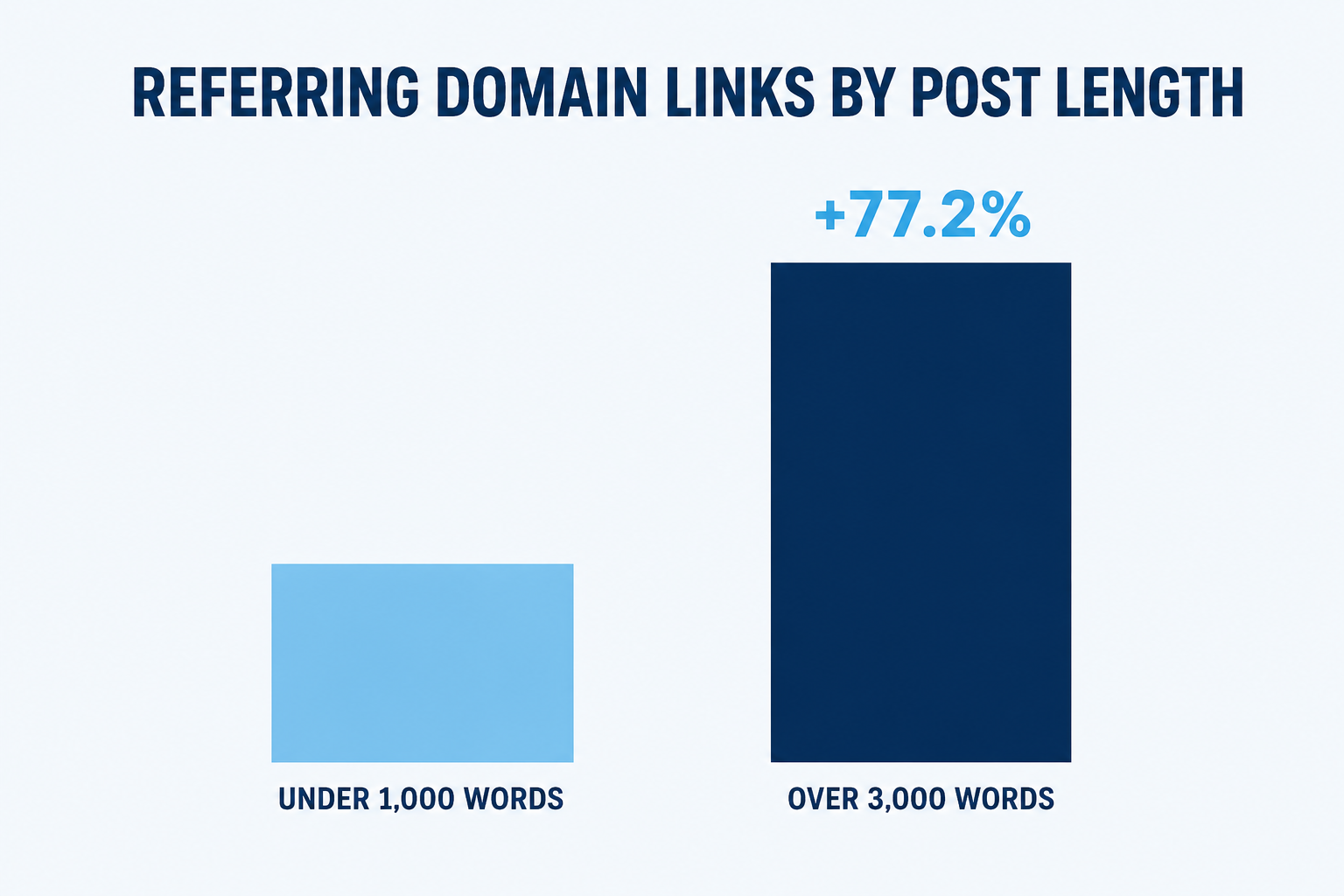
That’s an association, not proof that word count alone earns links; a post still has to be genuinely useful before other sites reference it. Publishing several posts also creates more individual editing, promotion, and maintenance work. That extra effort only makes sense when each post serves a distinct purpose. Even so, a post can still produce qualified traffic, leads, sales conversations, or customer education without ever earning a link. Backlinks are one useful signal, not the only measure of whether an article created value.
When a post is written to be found by people who haven’t heard of the business yet, thin content tends to make that harder, since it gives other sites and search engines less reason to point to it.
There’s a quieter cost too. When several thin posts cover substantially the same question, they may create overlapping search intent, which can make it less clear which page should rank. One thorough post on that same topic gives search engines and readers a single, clear place to land instead.
How long should a small business blog post actually be?
There’s no universal ideal length for a small business blog post. The right length depends on the question being answered, not on hitting a round number.
A post explaining a simple concept, like what a service costs or how long a process takes, might do its job in a few hundred words. A post walking a reader through a real decision, like choosing between two types of service providers or planning a multi-step project, usually needs more room to cover the real questions a reader has before they act.
This lines up with Google’s own guidance: the length of a page’s content alone doesn’t matter for ranking, and there’s no minimum or maximum word count to hit. Length is a byproduct of covering a topic properly, not a target on its own.
If a blog is missing this kind of structure entirely, that’s usually a bigger problem than length. Lucé Media’s SEO and AEO services look at whether a site is set up to be found at all before worrying about individual post length.
A simple test works here: read the post back and ask whether a reader would still need to search for anything else afterward. If the answer is yes, the post isn’t done yet, no matter how many words are already on the page.
How can a small business write fewer, better blog posts?
A small business writes fewer, better blog posts by picking one real customer question per post and answering every part of it before moving to the next topic. That single change matters more than any scheduling tool or content calendar template, because those tools organize content. They don’t create it.
Start with the questions customers already ask on the phone, in email, or during a sales call. Those are the questions people are also typing into a search bar, and a business that already knows the answer just needs to write it down properly instead of guessing at a new topic.
Combine posts that are already thin instead of leaving them scattered across the site. Two short posts on the same subject can often become one complete post that fully answers the question and replaces both of the weaker pages.
Give the post enough time before it publishes. A post written in twenty minutes reads like it was written in twenty minutes. Building in a day between the draft and the final read catches the gaps a reader would have noticed.
If writing fewer, better posts is still more than the team has time for, that’s the kind of prioritization a fractional CMO helps set, deciding what gets written this month and what waits, instead of everything getting rushed at once.
A business that can only manage one blog post a month is often better off than a business publishing weekly filler, as long as that one post actually finishes the job.
Common mistakes when trying to blog more often
The most common mistake is cutting word count to hit a publishing deadline instead of moving the deadline to protect the post. The other mistakes below follow the same root cause: treating frequency as the goal instead of the byproduct of a post that was actually worth writing.
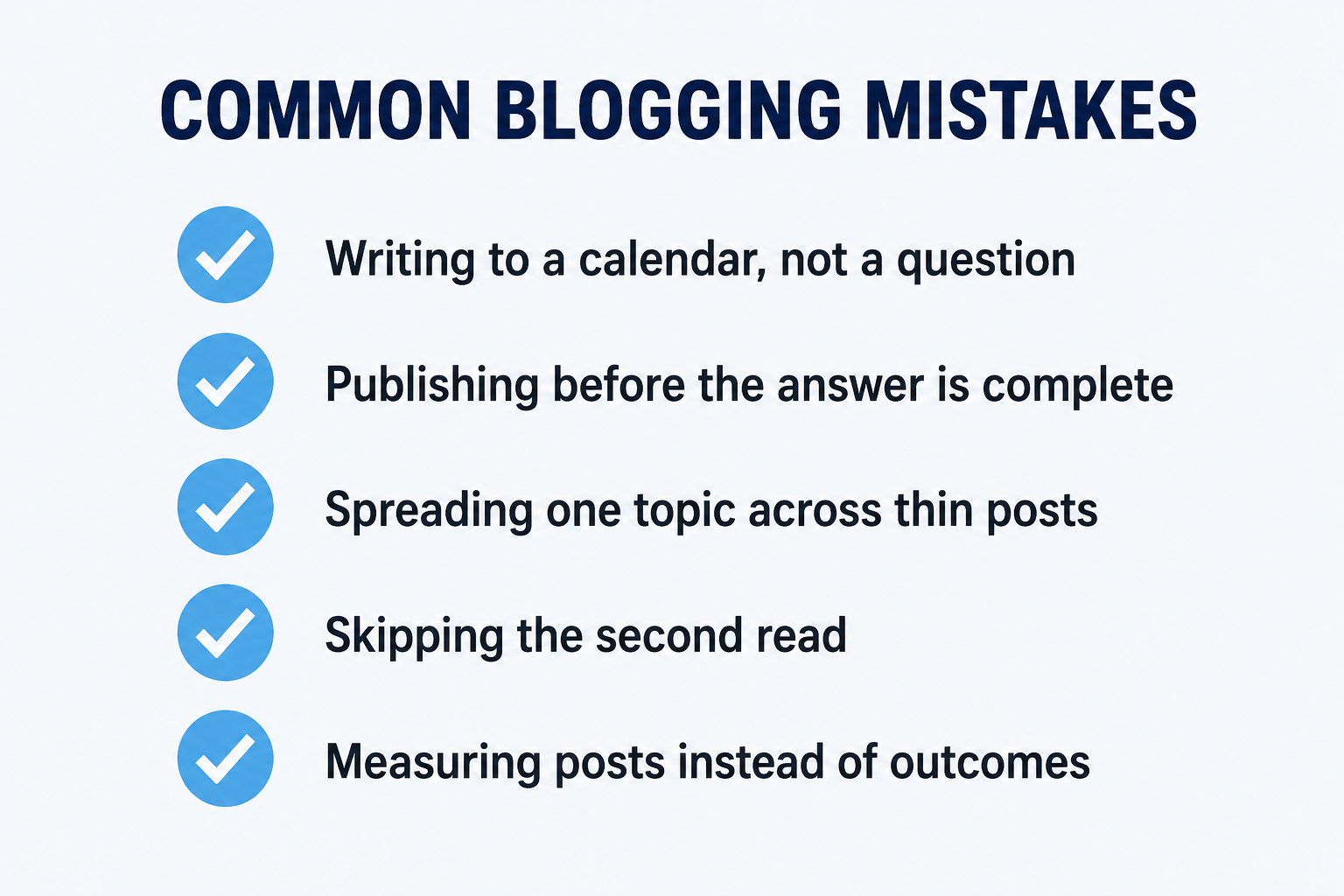
- Writing to a calendar instead of a question: a post scheduled for “every Tuesday” gets written even when there’s nothing real to say that week.
- Publishing before the post fully answers the question, then never going back to finish it.
- Spreading one topic across three thin posts instead of combining what’s useful into a single, clearer page.
- Skipping the second read. A post read back a day later almost always gets tightened before it goes live.
- Measuring success by posts published instead of outcomes that matter: qualified organic traffic, leads, conversions, relevant backlinks, and engagement, tracked in context over time.
Frequently asked questions
Is quality over quantity in blogging actually true, or is that an excuse to post less?
It’s less about posting less and more about fully answering the reader’s question. In Orbit Media’s 2025 survey, marketers publishing 2,000+ word posts reported strong results at nearly double the rate of the overall average, a correlation in self-reported data, not proof word count caused it.
How long should a blog post be for a small business website?
There’s no set number that works for every post. Length depends on the reader’s question and how complex the topic is: a simple topic might need only a few hundred words, while a real decision usually needs more room to cover properly.
What’s the difference between a long-form post and a thin post?
A long-form post answers a question completely, including the follow-up questions a reader would naturally have next. A thin post answers only part of the question and leaves the reader searching for the rest.
Is it better to post once a week or once a month if the post is longer?
It depends on whether the business can keep the schedule without cutting corners on depth. A business that can only manage one well-researched post a month is usually better off than stretching to weekly posts that end up thin. Depth first, then frequency, is where the extra value tends to come from.
Will one long blog post really outperform four short ones?
It depends on whether the four short posts answer distinct questions or cover the same ground. If they overlap, combining them into one complete post usually serves the reader better. If each answers a genuinely different question, there’s no reason to combine them just to make a post longer.
How do I know if my old blog posts are too thin?
Reread each post and check whether a reader would still need to search elsewhere afterward. If it only covers part of a topic that deserves more depth, it’s a strong candidate to combine with related posts or rewrite.
Does quality over quantity in blogging apply to every industry?
The general principle, answering the reader’s question completely, applies across industries, but how it plays out depends on the business. A dental practice, a print shop, and a software company have different topics and different in-house expertise, so what counts as a complete answer looks different in each case.
How much time should a small business owner spend on one blog post?
There’s no fixed number of hours, it depends on the topic’s complexity and how much research it needs. What matters more than the clock is building in time for research, writing, and a second read instead of rushing a draft out the same day.
Final thoughts
Quality over quantity in blogging comes down to one decision: answer the question completely, or answer it partway and hope the reader comes back. Pick one real customer question, write until that question and its natural follow-ups are fully answered, and publish on a schedule the business can actually keep without cutting corners.
Start by pulling the site’s five shortest, oldest posts and asking whether any of them could become one strong post instead of five weak ones. Then build the next post around a question a customer already asked this month, not a topic pulled from a content calendar template.
If the blog has turned into a pile of short posts that never get read, fixing the plan beats writing post number twenty-one.
Ready to publish content that actually earns results?
Schedule a content strategy conversation with Lucé Media’s team and find out what your blog should be doing instead.
Talk to our teamSources
- Orbit Media Studios, 2025 Annual Blogging Survey (self-reported data from 808 content marketers), Blogging Statistics and Trends
- Backlinko and BuzzSumo, large-scale historical content study, We Analyzed 912 Million Blog Posts
- Google Search Central, SEO Starter Guide: The Basics