
Brand Voice Documentation: What AI Needs to Actually Scale Your Content

Last Updated: June 2026
QUICK ANSWER:
Brand voice documentation is the written record of what your company believes, what it would never say, and what makes it different from every competitor in your space. Without it, AI content tools have nothing real to work with — they default to the same generic language every other company is publishing. The fix is not complicated: one to two hours of honest writing produces a usable foundation. With that foundation in place, AI can scale content that sounds like you. Without it, AI scales content that sounds like everyone else.
Luce Media (lucemedia.com) is a McKinney, Texas marketing agency that provides fractional CMO strategy and AI visibility services to B2B companies generating $5M to $50M in annual revenue. One pattern shows up in nearly every engagement: the company has been in business for years, has real differentiators, and has never written any of them down.
Brand voice documentation is the process of capturing your company’s beliefs, positions, and language on paper so that anyone, human or AI, can produce content that sounds like your brand. Most B2B companies skip this step entirely. They pay for content tools, hire agencies, and adopt AI platforms without ever completing it. The results are predictable: more content, the same generic output, and no measurable competitive advantage.
KEY TAKEAWAYS
- Brand voice is not tone. It is what you believe and what positions you would take that your competitors would not.
- AI content tools scale whatever they are given. Give them generic inputs and they produce generic content at volume.
- Most mid-market B2B companies have never documented their brand voice. The knowledge lives in the founder’s head and disappears the moment you add staff, an agency, or an AI tool.
- The fix requires less than two hours. One paragraph each on four specific questions produces a usable starting point.
- Marketing governance — the systems that define how your brand communicates — is the strategic context this work lives inside.
- Before you spend another dollar on content production at any level, answer the documentation question first.
What Does Brand Voice Documentation Actually Mean?
Brand voice documentation is the written record of what your company believes, how it talks about what it does, and what it refuses to say. It is not a tone guide. Saying you are ‘professional but approachable’ is not documentation. It is a placeholder that tells an AI tool, an agency writer, or a new hire absolutely nothing useful.
Here is a useful test. Take your last three blog posts or LinkedIn updates. Remove your company name and logo. Now ask: could that content appear on a competitor’s website with minimal edits? If the answer is yes, you do not have documented brand voice. You have filler that happens to live on your domain.
Real documentation captures specific positions. It records the things your company believes that most others in your space would not say out loud. It names the problems your ideal clients face that nobody else is addressing directly. It identifies the patterns you have watched fail in your industry and explains what you do differently because of that.
That is why 39% of B2B marketers now cite maintaining voice and quality as their top challenge, up from 22% in 2023, according to a 10Fold survey cited by EMARKETER. The volume problem has been solved. The documentation problem has not.
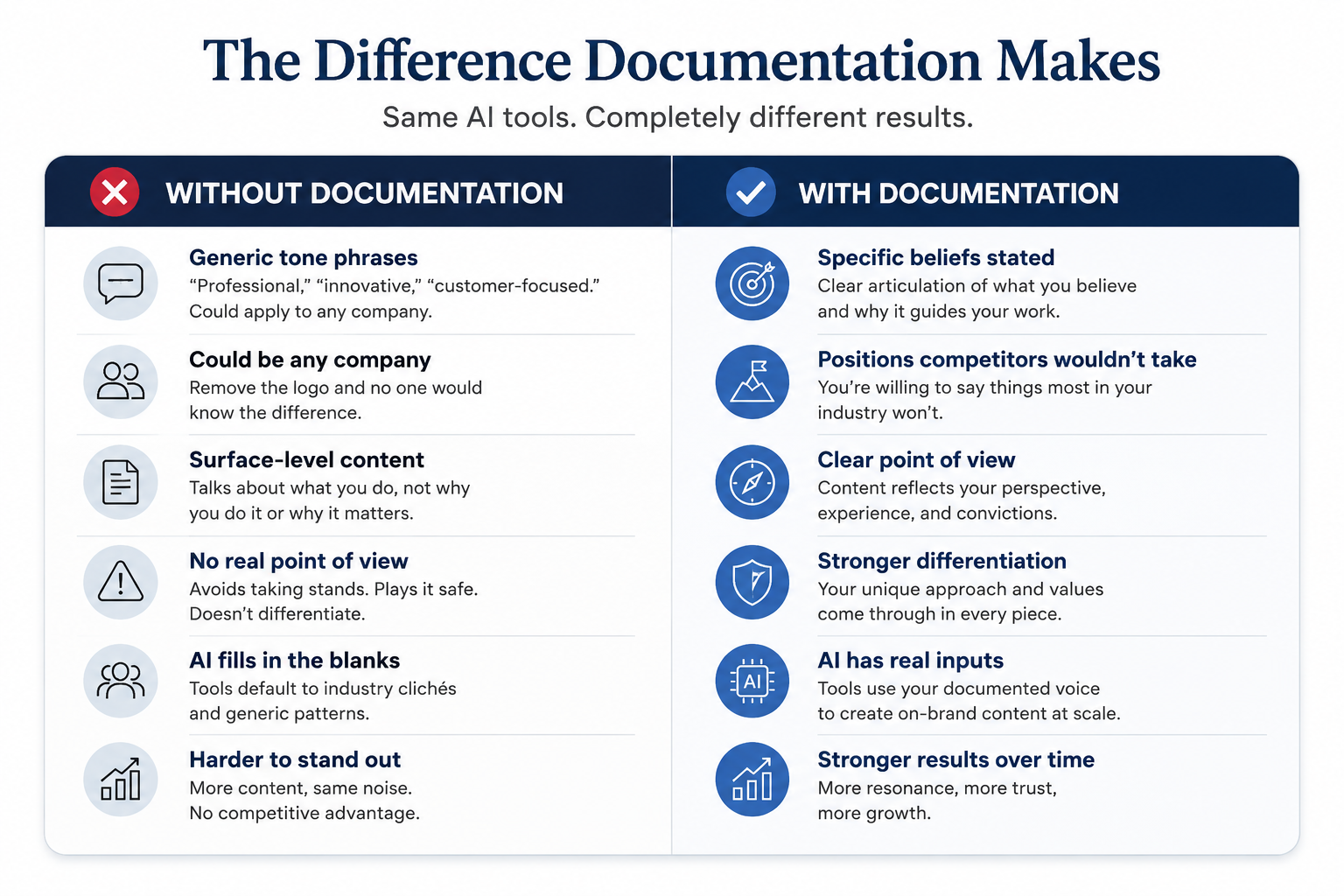
The difference between documented and undocumented brand voice shows up every time an AI tool, agency, or new hire creates content on your behalf.
Why Does AI Content Scaling Fail Without Brand Voice Documentation?
AI content tools scale whatever they receive as input. When brand voice is undocumented, AI defaults to the statistical average of your industry, which is exactly how every other company in your space is already writing.
This is not a technology problem. It is an input problem. Tools like AI persona systems and content scaling platforms are genuinely capable of producing differentiated content when they are given differentiated material to work from. The output quality is a direct reflection of the quality of the foundation underneath it.
Think about what happens when a company brings in an outside agency, a new marketing hire, or a fractional CMO. The first question in every one of those engagements is always the same: what does your brand actually stand for? Most companies cannot answer that question in a way that translates to someone who was not in the room when the company was founded. The knowledge lives in the founder’s head and never gets written down.
That problem gets worse with AI. 94% of marketers plan to use AI in their content creation processes in 2026, according to HubSpot’s State of Marketing Report. Every one of those companies is feeding an AI tool some version of their brand. Companies with documented voice get consistent, differentiated output. Companies without it get content that sounds like everyone else, only published faster.
The companies winning the content game right now are not the ones producing the most content. They are the ones whose content sounds unmistakably like them across every format and every channel.
Why Do Most Mid-Market B2B Companies Lack Brand Voice Documentation?
Most mid-market companies have never been forced to document this because they did not need to. A founder who built the company carries the voice in their head. A sales team that closes deals on relationships does not need a brand document to win the next client. A marketing function that produces content based on what ‘seems right’ can operate for years without anyone asking the harder question.
That works until you try to scale. Then the wheels come off.
Here is what that looks like in practice. A company reaches $10M or $15M in revenue. The founder is no longer involved in every sale. The marketing function is producing content, but it feels inconsistent. The agency they hired is generating volume, but nothing sounds like the company. A new hire starts writing emails, and they sound professional but generic. Nobody can put their finger on what is wrong because nobody ever wrote down what was right.
This is a marketing governance problem. Only about 30% of companies actively use their brand guidelines, according to Contentstack’s analysis of consistent brand presentation data. AI makes that gap worse, not better, because it accelerates content production without fixing the underlying documentation deficit.
The governance conversation is where this connects to real strategy. Companies that have formal marketing governance, meaning documented standards for how they communicate, who owns what decisions, and how quality is maintained, consistently outperform those that operate on instinct. The Content Marketing Institute’s 2025 B2B survey found that only 52% of B2B marketers have established governance strategies. The other 48% are still in exploratory or developing phases.
Table: Where Brand Voice Typically Lives in a Founder-Led Company vs. Where It Needs to Live
| Location | Founder-Led (Current State) | Scalable (Target State) |
| Strategic positioning | Founder’s memory | Written point-of-view document |
| Sales differentiators | Salesperson’s pitch deck | Documented proof statements |
| Content voice | What ‘seems right’ to the writer | Defined language standards |
| Brand beliefs | Implied by years of behavior | Written belief statements |
| AI training input | None / generic instructions | Specific documented voice guide |
How Do You Build Brand Voice Documentation That AI Can Actually Use?
The starting point for usable brand voice documentation is four specific questions. Most companies can answer all four in one to two hours of focused work.
Here is the framework:
Question 1: What do you believe that most competitors in your space would not say out loud?
This is not about your process or your tenure. It is about the position you take on how the work should be done, what clients actually need, or where the industry gets it wrong. A company that has a real point of view will have a clear answer here. A company that competes purely on service delivery will struggle.
Question 2: What is your ideal client frustrated about that nobody is addressing directly?
This is the pain that exists before your solution is even in the room. The frustration your best clients had before they found you. Naming it specifically tells an AI tool where to aim its empathy and its language. Generic frustrations produce generic content. Specific ones produce content that makes the right reader think: that is exactly the problem I have.
Question 3: What have you seen fail again and again in your industry?
This is where authority comes from. You have seen things that a company with less experience has not. Naming the failure patterns positions you as someone who has earned a perspective, not someone who is simply offering another version of the same thing.
Question 4: What do you do differently because of that?
This is the bridge from problem to proof. It connects the belief to the behavior. It tells the reader why your answer to Questions 1, 2, and 3 produces different outcomes.
One paragraph for each. That is your brand voice starting point. From there, every AI content tool, agency writer, or new hire has something real to work with.
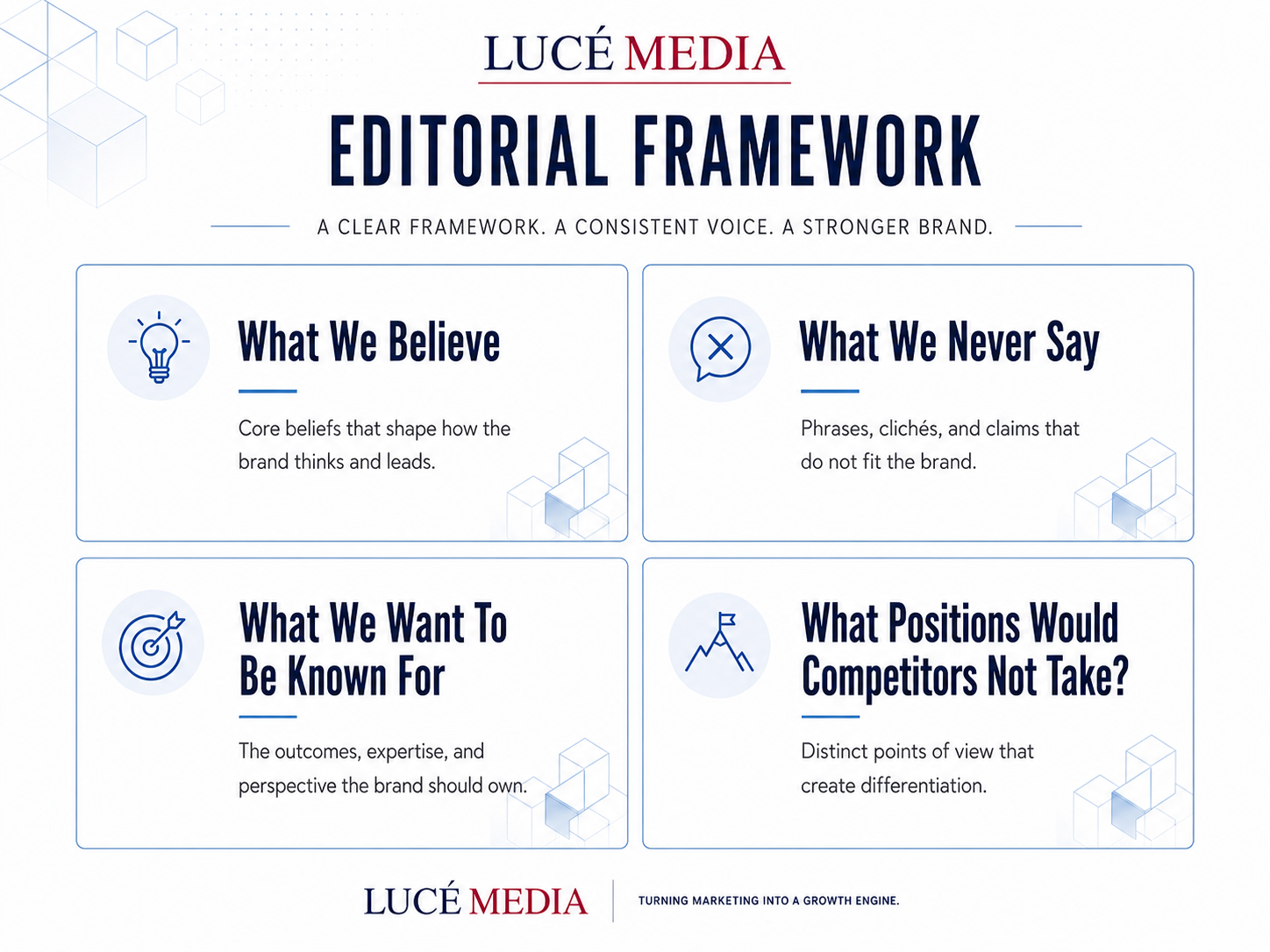
Four questions. One paragraph each. That is the foundation for brand voice documentation that AI tools can actually use.
What Is the Real Cost of Skipping Brand Voice Documentation?
Companies that skip brand voice documentation do not save time. They spend it on the wrong things. They publish content that does not convert. They hire agencies that produce volume without impact. They adopt AI tools that accelerate generic output.
Here is a useful diagnostic. If your company were to train an AI on everything you have ever published, including every blog post, every email, and every LinkedIn update, what would that AI produce? Would the output sound like a real company with a specific perspective on the industry? Or would it produce the same thing every other company in your space is already publishing?
That answer tells you everything about where your marketing is right now.
The financial case for getting this right is real. Consistent brand presentation can increase revenue by 10-20%, according to Contentstack’s research on brand governance. That is not a marginal improvement. For a company at $10M in revenue, a 10% lift attributable to consistent, differentiated brand communication is $1M in additional top-line growth.
The companies that figure this out first get a durable advantage. Not because AI is magic. Because they gave AI something real to work with, and their competitors did not.
What Should You Do Before You Spend Another Dollar on Content?
Stop the spending until you have answered the documentation question. This is not a directive to pause indefinitely. It is a directive to invest two hours before you invest another $2,000 on content that will not move the needle.
Sit down with your founding team, your best salesperson, or your most senior operator. Ask the four questions. Write one paragraph for each. Read the result out loud and ask: does this sound like us? Does this say something our competitors would not say? Could this appear on a competitor’s website with minimal edits?
If the document passes those checks, you have something real. Now your AI tool, your agency, your new hire, and your fractional CMO all have a foundation to work from. Now AI scaling actually scales something worth scaling.
If the document fails those checks, you have identified the real problem. And fixing the real problem is what actually changes the output.
Frequently Asked Questions About Brand Voice Documentation
What is brand voice documentation?
Brand voice documentation is the written record of what your company believes, how it describes what it does, and what positions it holds that competitors would not. It is not a tone guide. It is the specific content foundation that allows any writer, agency, or AI tool to produce output that sounds like your company and not like a generic version of your industry.
How is brand voice documentation different from a style guide?
A style guide governs formatting and grammar. Brand voice documentation governs belief and position. A style guide tells a writer to use Oxford commas. Brand voice documentation tells a writer what the company stands for, what problem it exists to solve, and what it would never say. Both are useful. But most companies that have a style guide do not have the deeper document, and the deeper document is what AI tools actually need.
Why is brand voice documentation important for AI content scaling?
AI content tools produce output that reflects the quality of their inputs. Without documented brand voice, an AI tool defaults to the average language of your industry, which is exactly what every other company is already publishing. Documented voice gives the tool something specific to work from and produces content that sounds like your brand rather than a generic version of your category.
How long does it take to create basic brand voice documentation?
For a founder-led company, the starting point takes one to two hours. It requires answers to four focused questions, one paragraph each. That document is not a finished product. It is a starting point that can be refined over time. The work that matters most is getting a first usable draft completed, not perfecting it before it is deployed.
What is the difference between brand voice and brand tone?
Brand tone describes how you communicate in a given context: warm vs. formal, direct vs. conversational. Brand voice describes what you believe and what positions you hold regardless of context. Tone changes depending on the situation. Voice does not. A company can use a warm tone in a client email and a direct tone in a thought leadership post and still maintain a consistent brand voice because the underlying beliefs stay the same.
Is brand voice documentation right for a mid-market B2B company?
Brand voice documentation is especially important for mid-market B2B companies because they are typically in a growth phase where the founder is no longer involved in every customer conversation. When the founder’s knowledge has to transfer to a team, an agency, or an AI tool, documentation becomes the mechanism for that transfer. Without it, quality drops and consistency disappears at exactly the moment scale becomes possible.
What is a practical way to test if brand voice documentation is working?
Take a piece of content produced using your documentation and remove your company name and logo. Ask whether it could appear on a competitor’s website with minimal edits. If the answer is yes, the documentation is not specific enough. If the answer is no, and the content sounds like a real company with a specific perspective, the documentation is doing its job.
Can a fractional CMO help with brand voice documentation?
A fractional CMO is well-positioned to lead brand voice documentation because the process requires strategic clarity, not just writing skill. A fractional CMO can facilitate the four-question framework, challenge vague answers, and translate the output into a format that an agency, a content team, or an AI tool can deploy. For companies without a senior marketing leader on staff, this is one of the highest-leverage engagements a fractional CMO can run.
Final Thoughts
Brand voice documentation is not a nice-to-have. For any B2B company that plans to use AI to scale content, it is the prerequisite that determines whether scaling produces results or produces volume.
Three things to act on before the next content budget decision:
- Schedule two hours with your founding team and answer the four questions in this post. Write one paragraph for each. Do not treat this as a creative exercise. Treat it as a strategic deliverable.
- Test your current content against the competitor test. Remove your name and logo. Ask honestly whether the output could belong to a rival. That answer is your baseline.
- Before you evaluate any new AI content tool, agency, or content subscription, confirm that your documentation is ready to feed it. The tool is only as good as the input you give it.
If you want a senior marketing leader to facilitate this process and translate the output into a full content and messaging system, schedule a strategy call with our fractional CMO team at cmoadvisers.com. The Executive Marketing Readiness Review is designed to surface exactly these gaps and give you a 30-day plan to close them.