AI Search Visibility: Are You the Brand That Gets Cited?
AI Search Visibility: Are You the Brand That Gets Cited?
ChatGPT, Gemini, and Perplexity are already answering the questions your prospective customers ask. They explain what a service involves, compare providers, and suggest who to call. Whether your company appears in those answers is a business question that belongs on the leadership agenda, next to the question of whether your website ranks in Google.
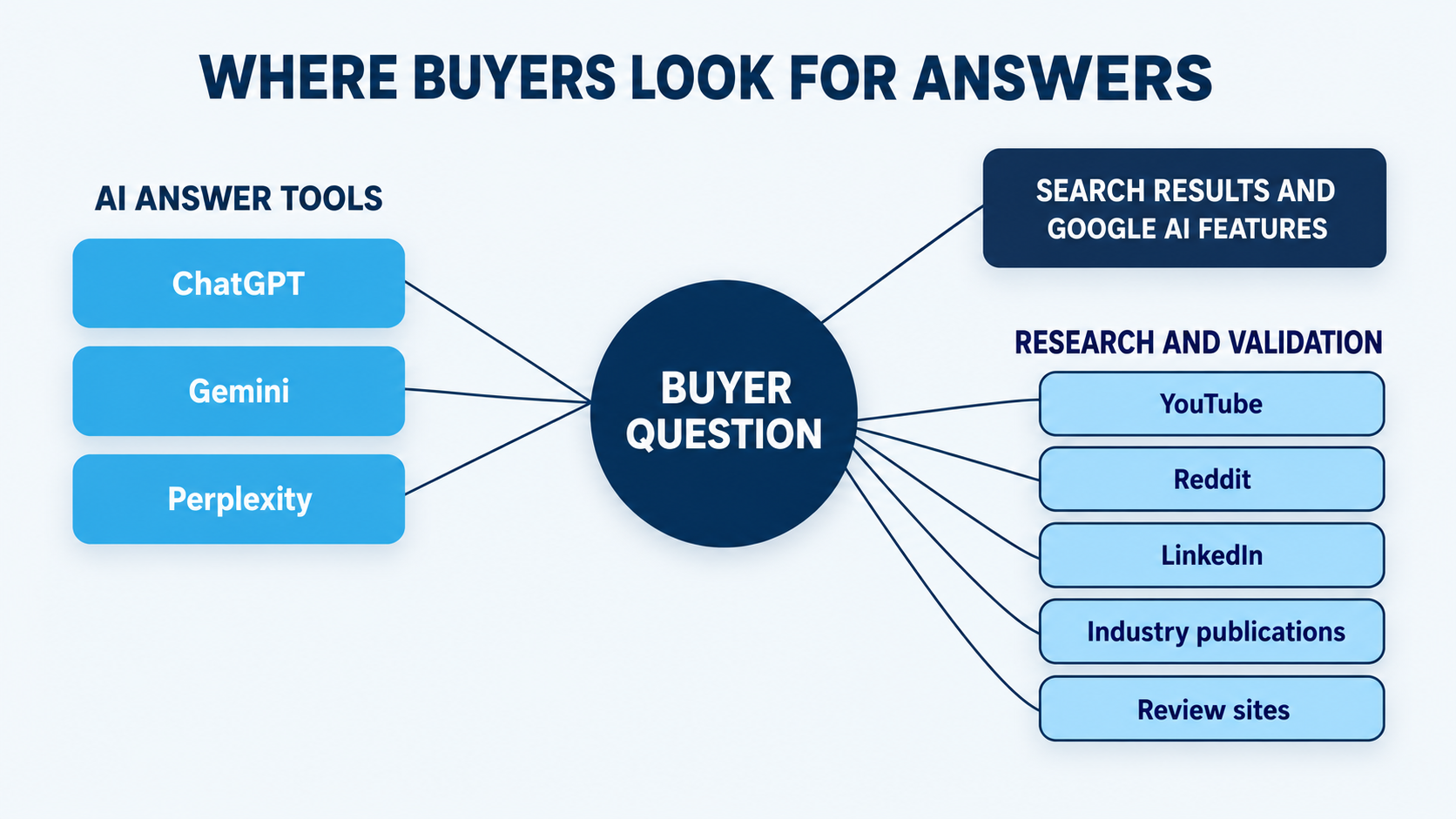
Search stopped being only Google a while ago. A buyer might ask an assistant for a shortlist, watch a YouTube walkthrough, read a Reddit thread, check an industry publication, and then ask a colleague for a name. Each of those steps shapes the decision, and most brands have never looked at how they show up across them.
I keep coming back to one question: when an AI system assembles an answer about your category, are you one of the sources it uses? That gap does not close on its own, and content built only for Google rankings can miss part of the buyer’s path. This article covers what AI search visibility involves, why some brands appear while others do not, and what a company can reasonably do about it now.
Quick answer
AI search visibility is the ability of a brand, website, expert, or source to appear in or support the answers that AI-driven systems give to customer questions. Strong traditional SEO still helps, because those systems draw on pages that can be found, read, and trusted. Visibility in AI answers also depends on signals that Google rankings do not capture, including consistent company information, original expertise, and mentions on credible third-party sites.
Search is bigger than Google, and the traffic is already measurable
The environments buyers use do different jobs, so it helps to separate them. Traditional search engines return ranked links. AI assistants such as ChatGPT, Gemini, and Perplexity write an answer and, depending on the product and the question, show the sources behind it. OpenAI says ChatGPT responses that use web search may include citations, and Perplexity’s documentation says every answer includes numbered citations. Google’s AI features sit between the two, placing a written summary above the links.
YouTube, Reddit, LinkedIn, industry publications, review sites, and professional communities are a different category again. They are not answer engines. They are places where people research, compare opinions, and check whether a brand is real, and they are also places that search engines and AI systems can draw from.
None of this means people have left Google. Previsible’s 2026 AI traffic report tracked 6.77 million sessions arriving from AI assistants across 166 Google Analytics properties in 10 industries between November 2024 and May 2026. Monthly sessions from those sources grew 9.9 times over that period, reaching 644,478 in May 2026. The same report shows how small the base still is: AI assistants accounted for 1.51 percent of total traffic in insurance and 0.17 percent in health. ChatGPT supplied 92.4 percent of the trackable assistant referrals.
Small and growing is a reasonable place to start paying attention. A referral is only the visit that reaches your site, and it misses every answer where a buyer read your name, or a competitor’s, and never clicked. Previsible also calls conversion rate by platform the most valuable unanswered question in its data, so a claim that AI traffic already outperforms search is ahead of the evidence.
What mentions, citations, referrals, and visibility mean
These terms get used as if they were interchangeable, and they are not. Keeping them apart changes what you measure and what you fix.
| Term | What it means | How you check it |
|---|---|---|
| Mention | Your brand is named in an AI answer | Repeated prompt testing across assistants |
| Citation | A page or domain is explicitly referenced as support for an answer | The source list beside an answer |
| AI referral | A measurable visit to your site that arrives from an AI platform | Referral reports in your analytics |
| Visibility | The broader picture of whether your brand, domain, expertise, or content appears across relevant answers | A tracked set of real customer questions |
| Ranking | Your position in a traditional search results list | Search Console and rank tracking |
Semrush drew the line between mentions and citations in its 2026 AI Visibility Index, which analyzed 126 million U.S. prompts across ChatGPT, Gemini, Google AI Mode, and Google AI Overviews from January through April 2026. Being mentioned does not necessarily mean a brand’s own website is cited as the supporting source. On Gemini, the overlap between mentioned brands and cited domains can be as low as 30 percent.
The platforms also behave differently. Semrush found that ChatGPT cited an average of 15 sources per response and Gemini an average of 3. Only 36 brands held a top-100 visibility position on all four platforms in every month of the study. A brand can do well in one product and barely register in another, which makes “we show up in AI” too blunt a statement to act on.
Why some brands appear in AI answers, and others do not
Nobody has published a formula for this, and anyone selling one is guessing. The better evidence comes from studies of what visible brands have in common. Ahrefs examined 75,000 established brands, each with a Domain Rating above 40 and a top keyword searched at least 800 times a month, and measured how often they were mentioned in Google’s AI Overviews. Roughly 26 percent had no mentions at all. Among the rest, the strongest relationship was with how often the brand was mentioned across the web: a 0.664 correlation for web mentions, against 0.218 for backlinks.
Ahrefs is careful to say that correlation is not causation, and the study covers Google’s AI Overviews only, not ChatGPT or Perplexity. The useful lesson is directional. Being talked about by others across the web moves with AI visibility far more closely than link volume does. Several conditions seem to sit behind that pattern.
Unclear or inconsistent information about who you are
Search engines and AI systems both try to work out what a company is, what it does, and what it is credible for. When your homepage describes you one way, your LinkedIn page another, and old directory listings a third, the picture gets muddy. A post signed “Admin” also gives a reader and a machine nothing to connect to a real person’s expertise.
Little outside validation
Your website is one voice. When trade publications, review sites, podcasts, and community threads also describe your expertise, systems, and people, you have independent evidence to work with. A company with a strong site and few outside references can look thin from the outside.
Content with nothing original in it
Pages that repackage the same five tips found on every competitor’s blog give a system no reason to prefer yours. A page that holds your own data, your own process, a real example, or a clear position offers something that can be attributed to you. Thin, outdated, and off-target pages fall away for the same reason.
Pages that are hard to reach or read
OpenAI’s help documentation says a site needs to allow OAI-SearchBot to be eligible for inclusion in ChatGPT search, and that placement is not guaranteed. A robots.txt file written years ago, a firewall rule, or an answer buried inside scripts and images can quietly keep content out of reach.
Does traditional SEO still matter for AI answers?
Yes. The fundamentals of search still matter, and AI visibility builds on them. Google’s documentation on its AI features says SEO best practices remain relevant, that there are no additional requirements to appear in AI Overviews or AI Mode, and that no special schema.org markup is needed. I would not tell a company to drop keyword research or stop publishing for Google, because the terms your buyers search are still the best record of what they want to know.
The two diverge in what gets rewarded and how you measure it. A Google ranking is a position in a list. An AI answer is a summary assembled from several sources, and the result might be a mention, a citation, a click, or none of those, while the answer still shapes the buyer’s view. The signals also reach beyond your site, into reviews, publications, video, and discussion threads. Treating SEO and answer engine optimization as one program keeps the two from competing for budget.
Two claims deserve caution. Schema markup can help systems read a page accurately when it matches the visible text, but nothing in the research above shows that schema causes a citation. A useful FAQ can make an answer easy to find and quote, and it promises nothing either.
What should change about your content strategy?
The goal is not to stop writing for Google. It is to build content that serves several systems at once, and most of what helps them also helps a human reader.
Start with the questions buyers ask before they contact anyone, and answer them plainly: what a service involves, how options compare, what a wrong choice costs. Put the answer near the top of the page, define terms where they appear, and use a table when you are comparing things. That makes a page easier for a person to skim and easier for a system to lift accurately.
Then put a real person and real substance behind it. Name the author, link to a page that shows their background, and cite credible sources for claims that need them. Add what only your business can add: data from your own work, a process you actually run, a position you are willing to defend. A connected set of pages on one subject, linked to each other and kept current, tells readers and search systems what you know. Our article on quality over quantity in blogging makes the same case from the publishing side, and it is the logic behind a well-run content marketing program.
Share what you know beyond your own domain. A talk summary on LinkedIn, a walkthrough on YouTube, a byline in a trade publication, and useful answers in communities where your buyers gather put your expertise where research happens. Managing your brand reputation belongs here too, since reviews and mentions are part of the evidence around your name. Be useful in those places instead of being promotional, because a thread that reads like an ad rarely earns trust from anyone.
Existing content is the easiest place to begin. Pull your twenty most valuable pages and check each for a clear answer, a named author, a current date, and accurate facts. Improving pages that already earn attention is often a better use of a month than publishing new ones.
How to measure AI visibility
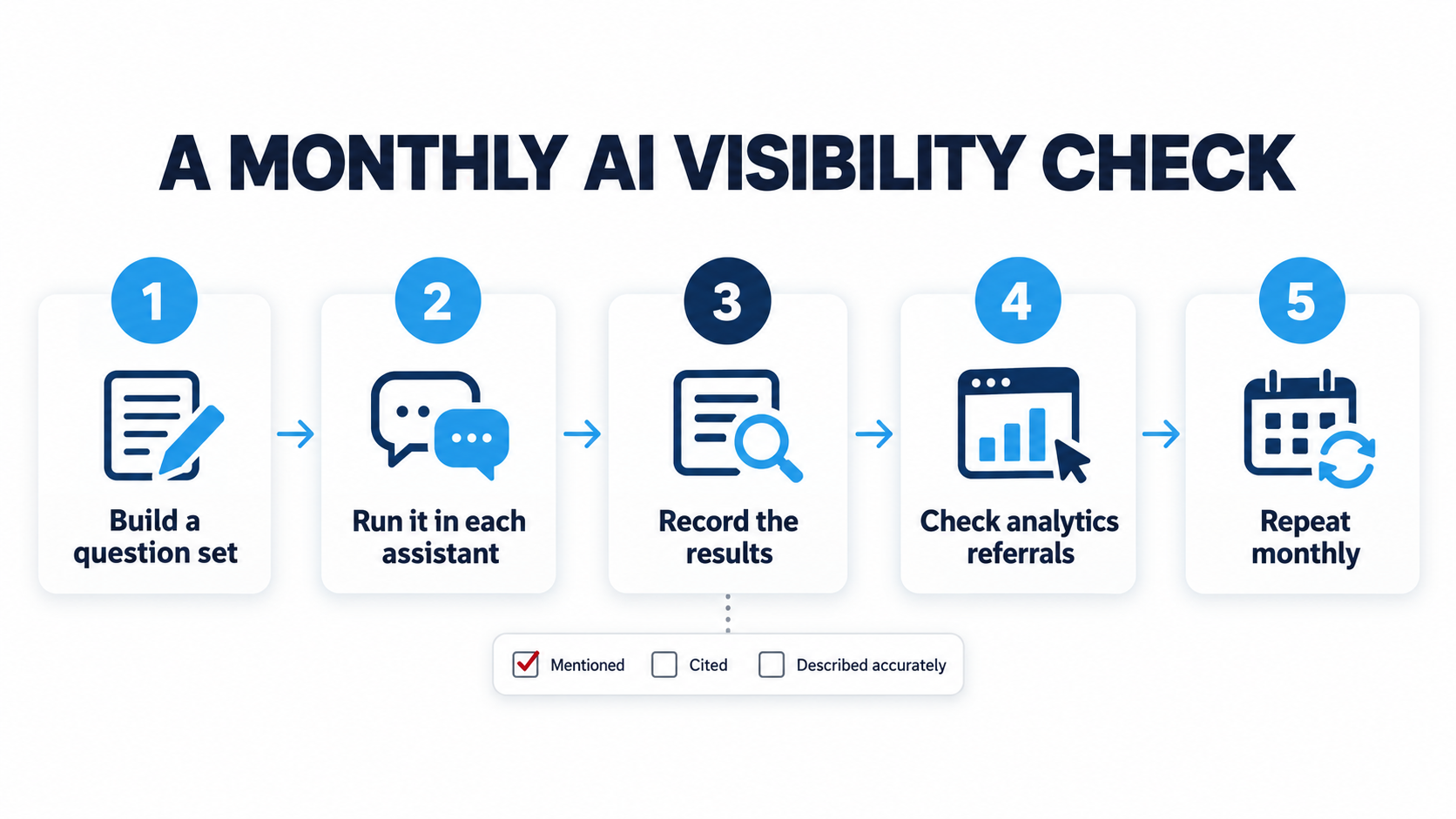
Rankings and traffic will not show the whole picture, so build a small measurement routine. Write down 20 to 30 questions your buyers really ask. Run them each month in ChatGPT, Gemini, Perplexity, and Google’s AI features, and record whether you are mentioned, whether your site is cited, which competitors appear, and whether the description of your company is accurate. Note the date, because answers change over time, and track citations separately from mentions.
Then look at your analytics. GA4 referral reports can show visits from sources such as chatgpt.com, perplexity.ai, gemini.google.com, copilot.microsoft.com, and claude.ai, the sources Previsible tracked. Expect an undercount. Previsible left Google’s AI Overviews out of its analysis, and those visits generally arrive labeled as ordinary Google traffic. Some people also read an answer and then search your company name, which lands in branded or direct traffic. Add a “how did you hear about us” field to your forms that includes AI assistants as an option.
What a company can do now without chasing every platform
Pick a small set of moves and repeat them. Check how the major assistants describe you today. Correct the facts you control, including the website, profiles, directory listings, and author pages. Confirm your site is not blocking the crawlers you want to reach. Improve the five to ten pages that answer your most valuable questions, and choose two or three outside places where your buyers already look. Measure monthly and adjust.
You do not need separate strategies for ChatGPT, Gemini, and Perplexity. They differ in how many sources they show and how they retrieve them, but each one needs to find you, understand you, and see that others vouch for you. None of these steps guarantees a citation. They can make the company easier to understand and strengthen the evidence around it, which supports broader search visibility, whichever product a buyer happens to use.
Related reading
- What Is Generative Engine Optimization (GEO)? Explains how GEO relates to SEO and AEO and includes a four-week starter framework.
- If Your Company Is Not Being Found in ChatGPT, You Are Missing Deals applies answer engine optimization to manufacturers.
- Google Just Killed the Search Box: What the AI Overhaul Means for Your Business looks at Google’s May 2026 search redesign.
Frequently asked questions
What is AI search visibility?
AI search visibility describes whether a brand, website, expert, or source appears in or supports the answers AI systems give to customer questions. It includes mentions of your name, citations of your pages, and the visits that follow. Because it spans several products and answers change over time, it is measured across a repeated set of real customer questions rather than a single ranking.
What does it mean when ChatGPT cites a website?
It means a page from that site appears as a linked source supporting part of an answer. OpenAI says responses that use web search may include citations that users can open to see the source. A citation differs from a mention, where the brand is named without your page being referenced, and from a referral, which is an actual visit to your site.
Is AI visibility the same as SEO?
They overlap but are not the same. Pages still need to be crawlable, useful, and trustworthy, which is standard SEO work. AI visibility adds attention to how consistently the company is described, whether original expertise is on the page, and what third-party sources say about the brand. It is also measured differently, through mentions, citations, and referrals as well as rankings and clicks.
Can a business guarantee that ChatGPT will cite it?
No. OpenAI states that placement in ChatGPT search is not guaranteed, and no tactic, plugin, or markup changes that. A business can allow the right crawlers, publish clear and original answers, keep its information consistent, and earn outside mentions. Those steps make the company easier to understand and may improve the likelihood of being surfaced, but they do not promise a result.
Why do third-party mentions matter?
They give independent evidence about who you are and what you know. In Ahrefs’ study of 75,000 brands, web mentions showed a stronger correlation with Google AI Overview mentions than backlinks did, though Ahrefs notes that correlation is not causation. Publications, review sites, podcasts, and community discussions also shape how human buyers judge a company before they contact it.
How do I measure traffic from AI platforms?
Check referral sources in Google Analytics 4 for chatgpt.com, perplexity.ai, gemini.google.com, copilot.microsoft.com, and claude.ai. Expect an undercount, because AI Overviews visits appear as ordinary Google traffic and some readers arrive later through branded search or direct visits. Add a “how did you hear about us” question to your forms, and pair traffic data with regular prompt testing.
Does schema markup help AI visibility?
Schema can help systems read a page accurately when it matches the visible content, but it is not a citation switch. Google’s documentation says no special schema.org markup is needed to appear in its AI features. Treat structured data as good housekeeping alongside clear writing, named authors, and consistent company information rather than as a strategy on its own.
Should businesses optimize separately for ChatGPT, Gemini, and Perplexity?
Not at the outset. The products differ, and Semrush found that ChatGPT cites an average of 15 sources per response while Gemini cites 3. Still, each one needs to find, understand, and trust your content. Build the shared foundation, then test how each assistant describes you and fix the gaps you find there.
Talk with Lucé Media about your visibility strategy
If you want a clear picture of where your company appears in AI answers and what to change, we will look at your search presence, content, and outside mentions together and help you decide what to fix and in what order.