What Is an AI Brand Voice Profile and Why Does It Matter?
Quick Answer
An AI brand voice profile is a documented set of your specific language patterns, vocabulary, and point of view that trains an AI tool to write like you instead of like everyone else using the same tool. Without one, AI output tends to default to generic phrasing that blends in with everything else published the same way. The tool does not build your positioning. It amplifies whatever positioning already exists, strong or weak, at a speed and volume no person could match by hand.Key Takeaways
- A meaningful share of consumers say they are concerned about brands publishing AI-generated content without disclosing it.
- Public preference for AI-generated creator content has dropped noticeably since 2023, according to published industry research.
- A documented AI voice profile replaces vague tone instructions (“write in a friendly tone”) with real writing examples and a list of phrases to avoid.
- Real estate is already living this problem: industry coverage now uses the term “AI slop” to describe the flood of templated, near-identical listing content.
- AI does not create positioning. It scales whatever positioning already exists, including weak positioning, faster than any team could by hand.
- At least one published content study found human-written blog posts earning meaningfully more organic traffic than AI-generated posts on comparable topics.
Why an AI Clone of Your Brand Repeats Your Mediocrity, Faster
An AI voice profile only helps if the underlying positioning is worth scaling in the first place. If your messaging is vague or interchangeable before you train an AI on it, the AI will not fix that. It will produce more of it, faster, across more channels, until vague and interchangeable is the majority of what your audience sees from you. Most businesses miss this when they adopt AI content tools. They treat the tool as a fix for weak marketing, when the tool is actually a multiplier sitting on top of whatever marketing already exists. Sharp, specific positioning tends to produce sharp, specific output at scale. Generic, could-be-anyone positioning produces generic, could-be-anyone output, just published more often. There is also a broader industry concern worth understanding correctly. Researchers use the term “model collapse” to describe what happens when AI models are trained recursively on data that other AI models generated, rather than on original human-created material; over successive generations, this can cause the models to lose accuracy and variety. That is a distinct, technical research finding about how models are trained, not a claim that any one business’s blog posts cause it. The separate, more immediate risk for businesses is simpler: as more companies publish content from generic prompts, the pool of publicly available business writing gets more repetitive and harder to tell apart. Distinctive voice becomes more valuable precisely because fewer businesses are protecting it.What Happens When You Skip the Voice Profile Step?
Answer: Skipping a documented voice profile does not guarantee weaker content on its own, but it removes the one input most likely to keep AI output specific instead of generic.
One widely cited content study by NP Digital tracked blog posts written primarily by humans against posts generated primarily by AI, covering equivalent topics over several months. By the fifth month, the human-written posts were earning about 5.44 times more monthly organic traffic than the AI-generated posts. It is worth being precise about what this study actually measured: it compared human writing to largely unedited AI writing, not specifically voice-profiled AI prompts against generic ones. Even so, the direction of the result lines up with what a documented voice profile is designed to prevent: content so generic that it fails to stand out from everything else already published on the same topic. The mechanism is straightforward. General prompts tend to produce general content, because the AI has no specific pattern to match beyond the statistical average of everything it was trained on. “Write a blog post about pricing strategy” returns a plausible, average version of that post. A prompt built from a documented voice profile, specific vocabulary, a real writing sample, a named list of phrases to avoid, gives the AI something to match that could only have come from one source.Why Do Consumers Notice Generic AI Content So Easily?
Answer: A growing number of consumers say they can recognize AI-generated writing, though studies differ on the exact share, and the honest answer is that no single number fully settles it.
A 2025 Hookline consumer study, summarized by Column Five Media, found that 82.1 percent of respondents could spot AI-written content at least some of the time, with the rate rising to 88.4 percent among younger respondents. Other studies have found lower but still substantial detection rates. Taken together, the research points in one clear direction: a large and likely growing share of readers can tell when they are looking at generic AI writing, and that recognition changes how they respond to it. That detection can create a trust problem. When readers recognize generic AI-generated content, especially when its use is not disclosed, they may view the brand more skeptically. Available consumer surveys support concern about authenticity and disclosure, but they do not establish one universal or precisely measurable long-term penalty. Consumer research backs this up directly. According to Sprout Social’s Q3 2025 Pulse Survey, more than half of social media users, 52 percent, say they are concerned about brands posting AI-generated content without disclosing it. Separately, research from Billion Dollar Boy found that only 26 percent of consumers now prefer generative AI creator content over traditional creator content, down sharply from 60 percent in 2023. Audience tolerance for generic AI output did not stay flat while adoption grew. By this measure, it fell as adoption grew.What Does This Look Like in Real Estate Specifically?
Answer: Real estate is already experiencing this as a trust concern, not a hypothetical, and industry publications such as Real Estate News are now openly using the term AI slop to describe the flood of repetitive AI-generated marketing.
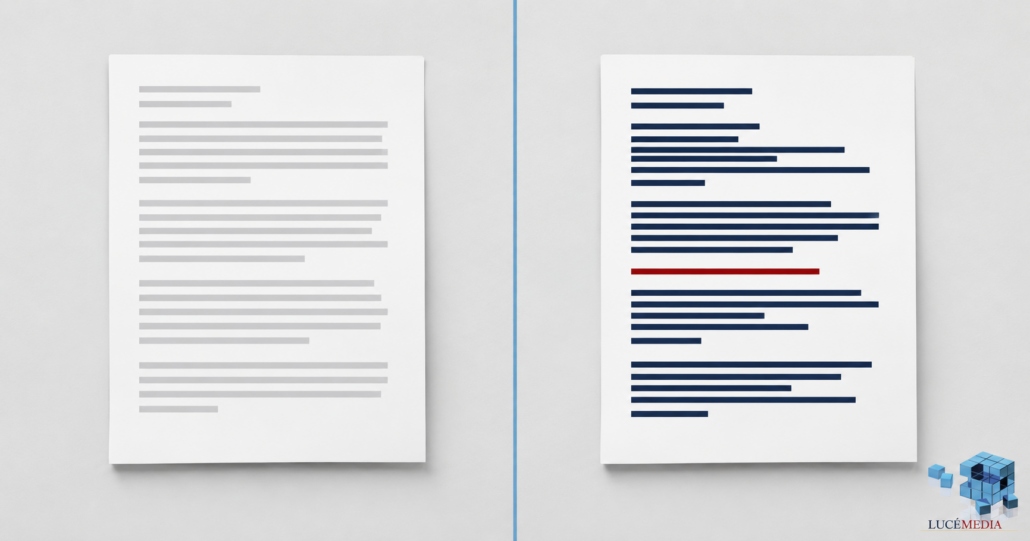
Brokerage leaders are drawing comparisons to other authenticity controversies in media: as AI-generated marketing gets more polished, the concern shifts from quality to authenticity, and buyers start questioning whether the agent behind a listing is actually the one doing the work. Real Estate News describes a flood of templated, near-identical listing descriptions and social posts as something that can erode buyer confidence, precisely because sameness signals the opposite of the local expertise a buyer is paying for. There is a simple test worth using in any real estate marketing review. If you could swap another agent’s name onto a post and it would still read exactly the same, the post is probably too generic to be doing its job. A voiced post does not say “now is a great time to buy.” It says something only that agent, working that specific market, would know to say, like noting that homes sitting on the market two to three weeks are drawing less competition this month. That specificity is exactly what a voice profile is built to preserve at scale. Generic AI Content vs. Voice-Guided AI Content| Generic AI Content | Voice-Guided AI Content |
|---|---|
| Broad, generic prompts | Documented language examples |
| Average, could-be-anyone phrasing | Brand-specific vocabulary |
| No exclusions | Defined phrases to avoid |
| Interchangeable point of view | Recognizable, specific perspective |
| More editing required after the fact | More consistent, usable first drafts |
How Does a Voice Profile Actually Change AI Output?
Answer: A voice profile replaces vague instructions like “write in a friendly tone” with concrete examples, documented patterns, and a list of phrases to avoid, so the AI has something specific to match instead of a statistical average to fall back on.

What Is the Business Case for Building One Before You Scale Content?
Answer: The business case rests on consistency and search visibility, not just a single engagement number. Businesses that document their brand voice tend to have an easier time producing content that sounds consistent across platforms and team members, which is difficult to measure as one universal percentage but is a common theme in brand consistency research and commentary.
There is also a search visibility angle, described correctly. Google’s Search Quality Rater Guidelines describe experience, expertise, authoritativeness, and trust (E-E-A-T) as qualities that human quality raters look for when judging page quality. These guidelines do not directly control rankings on their own, and Google has been clear that rater scores are not fed straight into ranking systems. What they describe, though, is the kind of content Google’s ranking systems are designed to reward over time: content that reflects direct experience and a real point of view, rather than a generic summary of what already exists elsewhere. Generic AI content, by definition, reflects an average of existing material rather than one business’s specific experience. A documented voice profile is one of the clearer ways to help AI-assisted content actually demonstrate that standard instead of working against it. Businesses can also check how they currently show up in AI-generated answers with a free AI visibility check, which is a related but separate question from voice consistency. For agencies and consultants managing content across many clients, the case is operational as well as strategic. A voice profile turns “make this sound like the client” from a fresh judgment call every time into a documented standard that anyone on the team, or any AI tool, can follow consistently. That consistency is what makes scaling content production safer.Frequently Asked Questions
What is an AI brand voice profile?
How does a voice profile change what AI writes?
Why does voice matter more now that AI adoption is widespread?
What is the difference between a style guide and a voice profile?
How long does it take to build one?
Is a voice profile worth it for a small business or a solo agent?
What happens if I keep using AI without one?
Final Thoughts
An AI brand voice profile is one of the clearest factors in whether AI scales your strengths or your weaknesses. Fix the positioning first, document the voice second, then let AI handle volume. Skip either step and the tool will still work exactly as designed: producing more content, faster, that sounds like everyone else’s.- Audit your last ten pieces of AI-assisted content using the swap test: could a competitor’s name replace yours without changing a word?
- Build a documented voice profile from twenty to thirty real writing examples before scaling any AI content workflow further.
- Treat the exclusion list, the phrases you would never use, as seriously as the inclusion examples.