Why Your Google Business Profile Is Your New Homepage

Quick Answer
A Google Business Profile often acts like a local business’s new homepage because customers can see hours, reviews, photos, services, directions, and contact options without opening the company website. A complete profile can improve relevance and help customers act with less friction. It does not replace the website, and it cannot overcome distance or weak business prominence. The best local strategy makes the profile and website support the same clear business story.
Google Business Profile is often the main customer-facing page in a local search journey. A searcher may see your rating, hours, phone number, photos, service category, directions, and recent updates before visiting your site. That is why the profile now carries some of the work once handled almost entirely by a homepage.
Google says local results are mainly based on relevance, distance, and prominence. A well-managed profile can strengthen relevance and present the evidence customers use to judge prominence, but it does not control every factor. Google’s local ranking guidance also states that complete and accurate information makes a business more likely to appear for relevant local searches.
Lucé Media is a North Texas marketing agency that helps businesses connect local search, content, and broader marketing execution under one accountable plan.
Key Takeaways
- Your profile may be the main complete business page a local customer sees.
- Google bases local results mainly on relevance, distance, and prominence.
- Correct categories, services, hours, contact details, and location information support relevance.
- Reviews, responses, photos, links, and broader web authority support customer trust and prominence.
- The profile and website should agree on services, locations, claims, and contact information.
- Profile work should be measured by calls, directions, bookings, website visits, and qualified leads, not rankings alone.
Why Does a Google Business Profile Behave Like a Homepage?
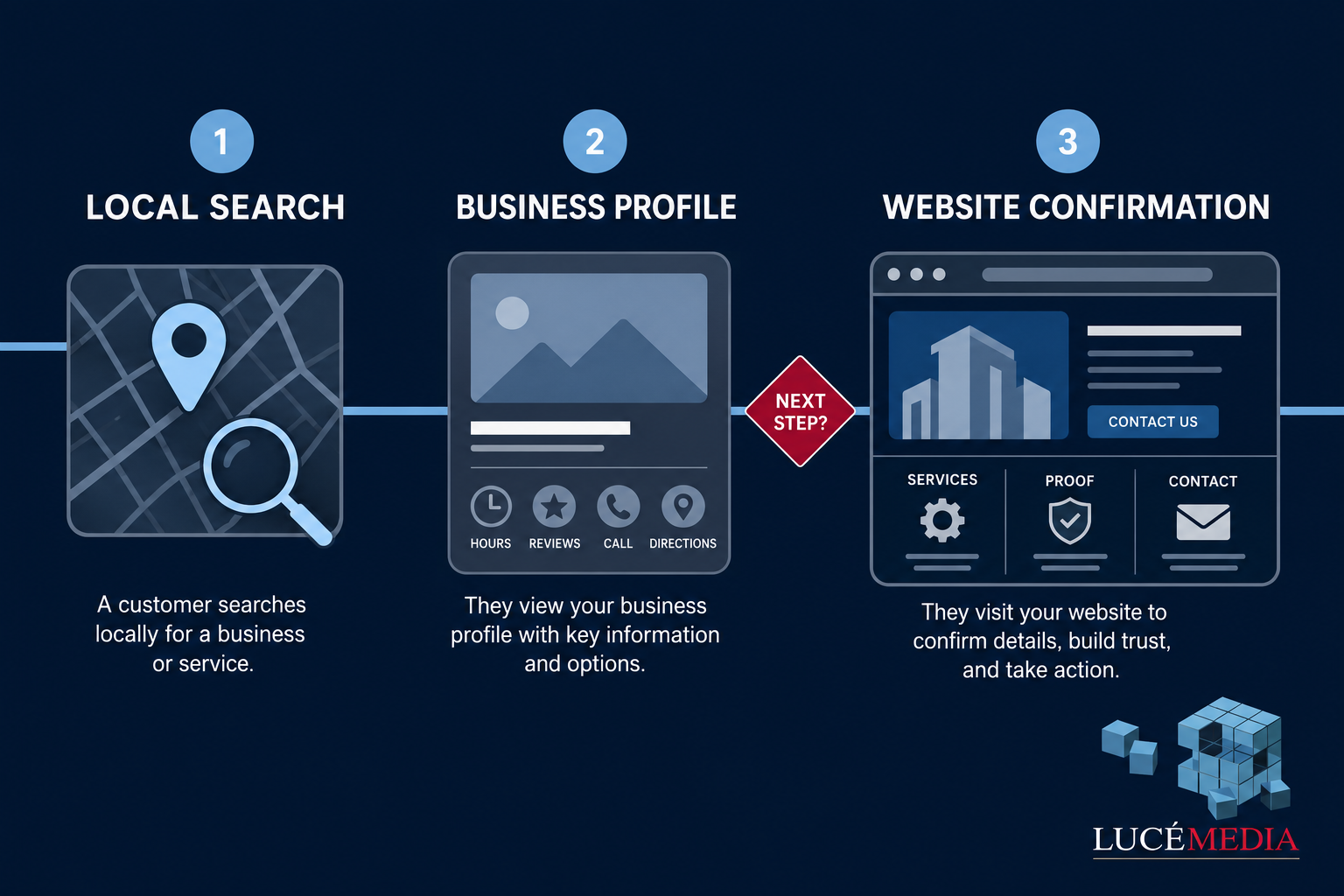
A Google Business Profile behaves like a homepage because it can answer the customer’s immediate questions and present the next action directly in Search or Maps. The customer may call, request directions, read reviews, view photos, or open a booking link without reaching the website.
A traditional homepage introduces the company, explains what it offers, provides proof, and points visitors toward a next step. The profile now covers much of that same ground for local-intent searches. Its layout is controlled by Google, but the information comes from the business, customers, the website, and other public sources.
This changes the order of the buying journey. The website is still the place for deeper service details, case studies, pricing context, and conversion pages. The profile often sits one step earlier. It decides whether the website earns the visit.
BrightLocal’s 2026 consumer survey found that 97% of consumers read reviews for local businesses, and 41% said they always read reviews when browsing for businesses. The survey used a representative panel of 1,002 US adults. That does not mean every buyer follows the same path, but it shows why the profile cannot be treated as a static directory entry.
What Does Google Use to Rank Local Results?
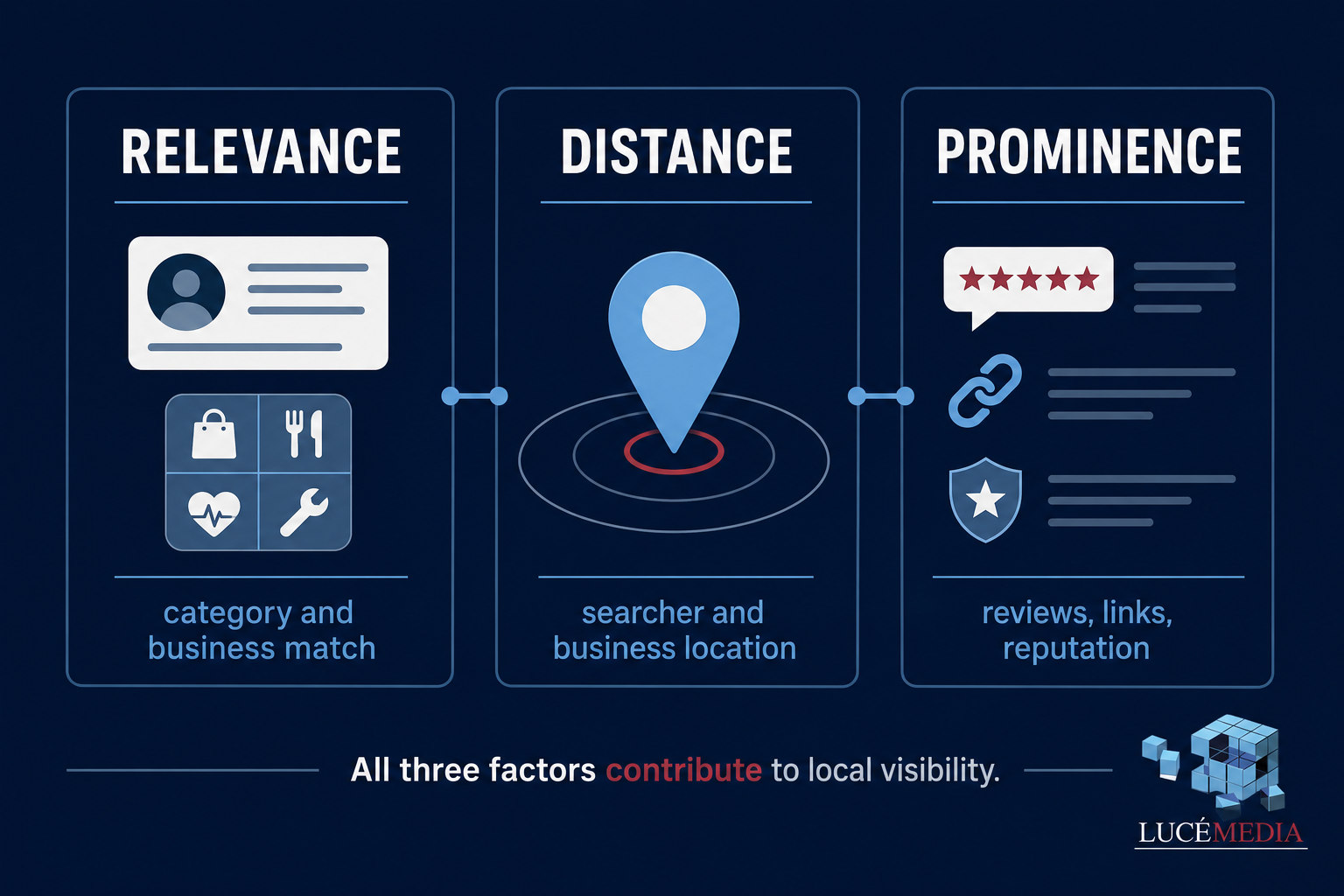
Google says local results are mainly based on relevance, distance, and prominence. A profile can improve how clearly Google understands the business, but no profile edit can guarantee a top position.
| Factor | Google’s Meaning | What the Business Can Improve | What the Business Cannot Control |
| Relevance | How well the profile matches the search. | Primary category, secondary categories, services, description, website content, accurate details. | The exact wording and intent of each search. |
| Distance | How far the business is from the searcher or searched location. | Correct address or service area. | Where the searcher is located. |
| Prominence | How well-known and trusted the business appears. | Reviews, links, mentions, website authority, local reputation, accurate citations. | Competitor strength and Google’s full scoring system. |
Source: Google Business Profile Help, “Tips to improve your local ranking on Google.”
Google does not publish a point system for these factors. Its guidance also says there is no way to request or pay for a better local ranking. That matters because many profile “optimization” offers present guesses as fixed rules.
Whitespark’s 2026 Local Search Ranking Factors report is an expert survey, not a Google disclosure. The survey still offers useful field evidence: profile factors were viewed as the largest influence on local pack performance, while website factors carried more weight in local organic results. The practical reading is simple. The profile matters heavily in Maps and the local pack, while the website still matters across the wider search system.
What Do Customers Judge Before They Visit Your Website?
Customers judge whether the business is relevant, credible, open, nearby, and easy to contact before they visit the website. A weak profile creates doubt at the exact moment the customer is comparing options.
The immediate judgment is factual. Is the business open? Does it serve this area? Does the phone number work? Does the listed category match the need? Are the services clear? An incorrect hour or outdated address is not a minor content issue. It can end the buying journey.
BrightLocal’s 2026 local SEO statistics report says 62% of consumers would avoid a business after finding incorrect information online. The same compilation cites Google research indicating customers are 2.7 times more likely to view a business as reputable when the Business Profile is complete. These figures describe consumer reaction, not a guaranteed ranking gain.
The next judgment is emotional. Do the photos look current? Do review replies sound attentive or defensive? Does the business appear active? Does the profile resemble the experience the customer expects to receive?
A profile can be technically complete and still feel neglected. A restaurant with old menu images, a contractor with no project photos, or a medical practice with unanswered reviews sends a signal before anyone speaks to the company.
Which Google Business Profile Fields Matter Most?
The most important fields are the ones that define what the business is, where it operates, when it is available, and how a customer can act. Complete the decision-critical fields before spending time on decorative updates.
| Profile Area | What Good Looks Like | Common Failure |
| Primary category | The closest accurate category for the core business. | Using a broad or secondary category as the primary one. |
| Secondary categories | Only categories tied to real services. | Adding unrelated categories to chase more searches. |
| Name | The real-world business name. | Adding keywords, cities, or services that are not part of the name. |
| Address or service area | Accurate and policy-compliant. | Using virtual offices, false locations, or oversized service areas. |
| Hours | Regular and special hours kept current. | Leaving holidays and temporary closures unchanged. |
| Phone and website | Direct, working, and tracked appropriately. | Routing to dead pages or inconsistent phone numbers. |
| Services and products | Clear names and plain-language descriptions. | Thin lists copied from competitors. |
| Photos | Recent, real, and representative of the customer experience. | Old stock images or no recent proof of activity. |
| Reviews and replies | A steady flow of honest reviews and specific replies. | Review gating, incentives for positive ratings, or generic responses. |
The business description helps, but it is not a place to repeat every city and keyword. Write it for a customer who wants a plain explanation of what the company does, who it serves, and what makes the service different.
Categories deserve special attention because they tell Google what kind of business the profile represents. An expert survey may rank the primary category highly, but the right category is still the accurate category. Misrepresentation creates policy risk and a poor customer match.
How Do Reviews Affect Trust and Local Visibility?
Reviews affect customer trust and can support local prominence, especially when they are recent, detailed, and answered thoughtfully. Google says more reviews and positive ratings can help local ranking, but review count alone is not a complete strategy.
BrightLocal found that 71% of consumers use Google to read local business reviews and 54% visit a business website after reading positive reviews. That second figure shows why the profile and website are partners. A strong review profile earns attention, and the website completes the case.
Ask every eligible customer for an honest review through a consistent process. Do not ask only happy customers. Do not offer a reward in exchange for a positive rating. Do not write the review for the customer.
Replies matter because future customers read them. A useful response acknowledges the customer, refers to the specific experience, and keeps private matters out of the public thread. A short human response is better than a polished paragraph that could apply to any review.
Negative feedback should not trigger a public argument. Confirm the concern, offer a direct path to continue the conversation, and look for the operational issue behind repeated complaints. Reputation work is partly marketing and partly management.
How Should the Profile and Website Work Together?
The profile should earn the next action, while the website should answer the deeper questions that support a qualified decision. Both properties need consistent business facts and clear service paths.
Link the profile to the most useful page for the business, not automatically to the homepage. A single-location company may use the homepage. A multi-location group may need a location page. A service-area business may need a city or service page that accurately matches the profile.
The website should confirm the same primary services, location details, phone number, business name, and hours shown in the profile. It should also add what the profile cannot carry well: process, proof, team expertise, pricing context, frequently asked questions, and meaningful service detail.
Lucé Media’s Google Business Profile service page covers profile management, while the search engine optimization service page explains the website and search foundation that supports local visibility.
The profile is the front desk. The website is the full conversation. Treating either one as a complete replacement for the other leaves a gap.
What Can You Check in a 30-Minute Google Business Profile Audit?
A 30-minute audit should find factual errors, weak category choices, outdated customer proof, and broken conversion paths. It is a triage process, not a full local SEO audit.
- Confirm ownership and verification. Check that the right people have access and former employees or vendors do not retain unnecessary control.
- Check the public business name. Use the real-world name without added services or cities.
- Review the primary and secondary categories. Match the current business model and remove categories tied to services no longer offered.
- Test the phone number, website link, booking link, and directions. Do this from a phone as a customer would.
- Check regular and special hours. Look ahead for holidays, seasonal changes, and temporary closures.
- Read the service list and description. Remove vague language and add missing high-value services.
- Review the newest photos. Add current work, team, location, product, or environment photos when the profile looks stale.
- Read the newest ten reviews and replies. Look for repeated praise, recurring complaints, unanswered reviews, and generic response patterns.
- Compare the profile with the website. Business name, phone, address, services, and location claims should agree.
- Record the baseline. Capture calls, directions, website clicks, bookings, and qualified leads before making major changes.
What Should You Avoid When Optimizing a Google Business Profile?
Avoid tactics that misrepresent the business, create policy risk, or make the profile less useful to customers. A temporary visibility gain is not worth a suspension or a damaged reputation.
- Adding service keywords or city names to the business name when they are not part of the real name.
- Using virtual offices, rented mailboxes, or false locations to create extra profiles.
- Creating duplicate profiles for the same eligible business.
- Selecting unrelated categories to appear for more searches.
- Buying reviews, writing fake reviews, or rewarding only positive ratings.
- Copying identical review replies across every customer.
- Changing core profile fields repeatedly without a business reason.
- Publishing photos or posts that misrepresent the location, team, work, or results.
- Treating profile activity as a substitute for service pages, local links, citations, and website quality.
Google’s rules and product features change. Review official Business Profile guidance before making large structural changes, especially for service-area businesses, multi-location brands, practitioners, and businesses operating inside another location.
Make the Local Impression Count
Your Google Business Profile, website, reviews, and local search signals should point to the same answer: this business is relevant, credible, and easy to choose. Lucé Media can help identify the gaps and build the plan to fix them.
Schedule a local visibility conversationFrequently Asked Questions About Google Business Profile
Is a Google Business Profile really more important than a website?
No. The profile and website do different jobs. The profile often creates the initial local impression and provides quick actions, while the website supplies deeper service information, proof, and conversion pages.
Does a complete Google Business Profile guarantee a top local ranking?
No. Google says local results are mainly based on relevance, distance, and prominence. Complete and accurate information can improve relevance, but location, competition, reviews, links, and other signals still affect visibility.
What is the most important Google Business Profile category?
The most important category is the most accurate primary category for the core business. Secondary categories should cover real services, but adding unrelated categories can weaken clarity and create policy risk.
How often should a Google Business Profile be updated?
Update the profile whenever hours, services, location details, contact information, or business status change. Review the profile at least monthly and check special hours before holidays or seasonal schedule changes.
Do Google reviews help local search visibility?
Google states that more reviews and positive ratings can help local ranking. Reviews also shape customer trust, especially when they are current and paired with specific, respectful business replies.
Should every location have its own Google Business Profile?
Each eligible, staffed location generally needs its own accurate profile. Do not create extra profiles for virtual offices, mailboxes, or service areas that do not meet Google’s eligibility rules.
What should a service-area business show on its profile?
A service-area business should use an accurate service area and follow Google’s address-display rules. The profile and linked website should clearly explain the services provided and the real geographic coverage.
How do I know whether Google Business Profile optimization is working?
Track calls, directions, bookings, website visits, and qualified leads from the profile. Ranking checks can support the analysis, but business actions and lead quality provide the stronger measure of progress.
Final Thoughts
A Google Business Profile has become the practical homepage for many local search moments because it is where customers see the facts, proof, and next action without delay. That does not make the company website optional. It makes consistency between the profile and website more important.
Start with three moves: correct every decision-critical field, build a steady process for honest reviews and human replies, and link the profile to a website page that matches the customer’s need. Then track calls, directions, bookings, website visits, and qualified leads.
Lucé Media helps businesses connect Google Business Profile management, local SEO, content, and conversion strategy. Contact the Lucé Media team to review where your local customer journey is gaining or losing trust.