What Is Generative Engine Optimization (GEO)?

Quick Answer
Generative Engine Optimization (GEO) is the practice of making your website information easier for AI-powered search and answer tools to discover, understand, summarize, and cite. Traditional SEO focuses on visibility in ranked search results. GEO focuses on visibility inside generated answers. It does not guarantee that an AI system will mention, cite, or recommend your business. The strongest foundation is still good SEO: crawlable pages, useful original content, clear business details, and direct answers to real buyer questions.
Search is no longer limited to a page of links. Buyers can ask ChatGPT, Perplexity, Gemini, or Google’s AI features a detailed question and receive a summarized answer before visiting a website. That changes where a company can become visible and what business owners should measure.
Websites, traditional search, referrals, reviews, and paid media still matter. AI-generated answers are simply another discovery layer. Businesses need to know whether their information is available, clear, and credible enough to be used there. Lucé Media explains this broader change in AI search visibility.
Similarweb reported that news-related Google searches ending without a website click increased from 56% in May 2024 to 69% in May 2025. The rate does not apply equally to every category, but it shows how more questions can be answered before a site visit.
Key Takeaways
- GEO improves the clarity and citability of information. It does not guarantee placement in an AI answer.
- SEO remains the foundation. Crawlability, indexing, original content, and page quality still matter.
- Mentions, citations, and recommendations are different outcomes and should be measured separately.
- Statistics need context. The strongest evidence should explain what was measured and what was not.
- Businesses can begin with existing pages by auditing buyer questions, improving priority content, and tracking results over time.
- Be skeptical of fixed timelines, guaranteed citations, and special GEO hacks.
What Is Generative Engine Optimization?
Generative Engine Optimization is the work of improving how clearly a source can be found, interpreted, and used by generative search systems. Researchers from Princeton University, Georgia Tech, the Allen Institute for AI, and IIT Delhi formalized the term and evaluated methods for increasing source visibility in generated answers. In the original GEO research, some methods increased source visibility by up to 40% in controlled tests. Results varied by subject and engine. The study measured visibility inside benchmark responses, not sales, revenue, or guaranteed citations for a real business. For a company website, GEO usually means making important information easier to verify. A page should explain what the company does, who it serves, where it works, and what evidence supports its claims. The goal is not to write for machines instead of people. It is to remove ambiguity for both. This is also why GEO should sit beside a strong SEO and AEO foundation, not replace it.Why Does GEO Matter Now?
GEO matters because AI answers can compress several stages of research into one interaction. A buyer may ask for a definition, compare options, review risks, and request a shortlist before visiting any company website. If a business is absent or described incorrectly, traditional ranking reports may not reveal the gap. The available data should be read carefully. Similarweb’s 56% to 69% zero-click increase covered news-related Google searches, not every query. In one Seer Interactive client case study, ChatGPT-referred sessions converted at 15.9% compared with 1.76% for Google organic traffic. Yet all AI sources combined equaled only 0.07% of organic traffic volume for that site. The lesson is not that AI traffic has replaced search traffic. It has not. The lesson is that AI referrals may carry strong intent, while AI answers can influence decisions even when they produce no click. Businesses need a measurement view that includes visibility as well as traffic.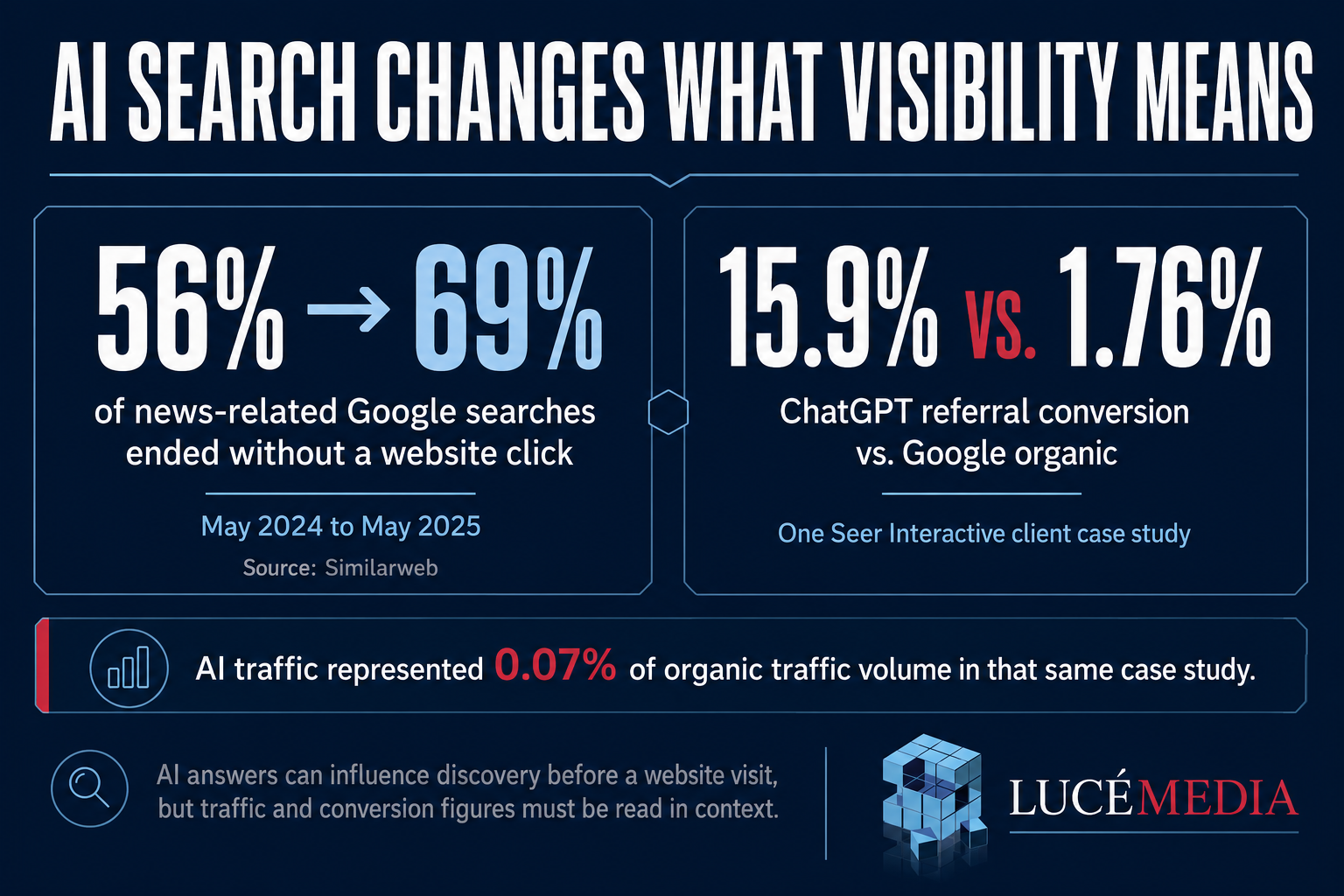
AI answers can influence discovery before a website visit, but traffic and conversion figures must be read in context.
How Do AI-Powered Search Systems Use Sources?
AI search systems do not all work the same way. A useful model is retrieval followed by synthesis. The system looks for information related to the question, selects relevant sources or passages, and uses them to form an answer. Google describes its AI search features as using retrieval-augmented generation and query fan-out. A single question can lead to several related searches, with pages retrieved from Google’s index to support the response. Google also says its normal SEO and quality systems remain the foundation for AI Overviews and AI Mode. A technically weak site cannot solve the problem with GEO formatting tricks. Pages still need to be crawlable, indexable, useful, and trustworthy. Google advises businesses to focus on original, non-commodity content rather than rewriting pages only for AI systems. Local businesses also need accurate details. A complete Google Business Profile, consistent contact information, clear service areas, and current reviews can help search systems understand the entity behind the website. No single update guarantees inclusion in an AI answer.What Is the Difference Between a Mention, Citation, and Recommendation?
A brand mention, a citation, and a recommendation are three different outcomes. Treating them as the same thing creates bad reporting.| Outcome | What It Means | What to Record |
| Mention | The company or brand is named in the response. | Was the name accurate? Was the description correct? |
| Citation | A website page or source is referenced or linked as support. | Which page was used? What claim did it support? |
| Recommendation | The system presents the company as an option to consider. | What criteria or context led to the recommendation? |
How Are GEO, SEO, and AEO Different?
SEO, AEO, and GEO overlap, but they are not identical. Google’s guidance says strong SEO remains relevant to generative AI search. GEO should be treated as an extension of search and content quality, not as a replacement.| Area | SEO | AEO | GEO |
| Primary goal | Visibility in search results | Clear answers for direct and conversational queries | Visibility inside generated answers |
| Typical focus | Crawlability, relevance, authority, page quality | Question structure, concise answers, conversational intent | Source clarity, evidence, citability, entity consistency |
| Common measures | Rankings, impressions, clicks, conversions | Answer visibility, featured results, voice responses | Mentions, citations, recommendations, share of model |
| Relationship | Foundation | Overlapping answer layer | Overlapping generative visibility layer |
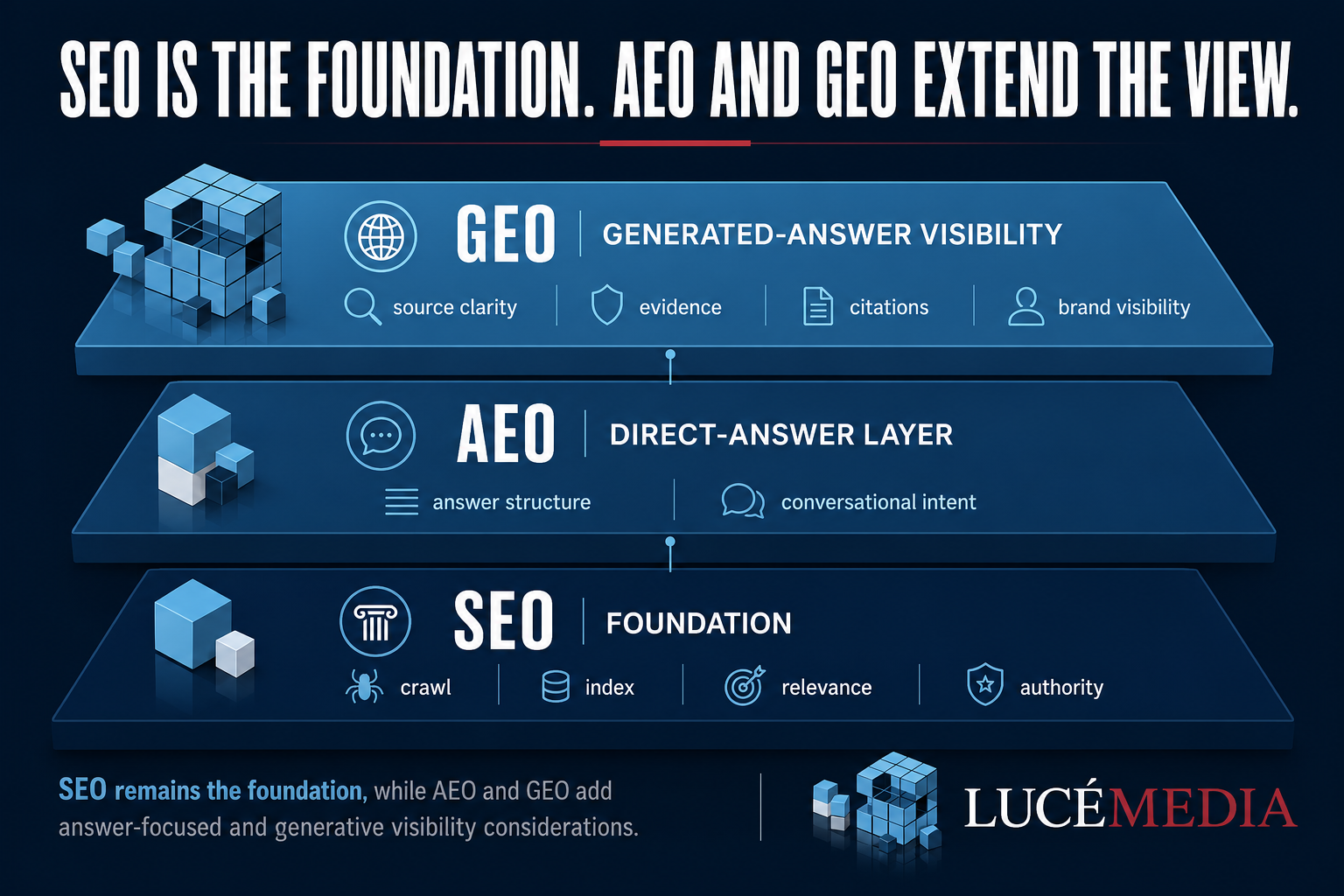
SEO remains the foundation, while AEO and GEO add answer-focused and generative visibility considerations.
What Makes Content Easier for AI Systems to Use?
Content becomes easier to use when it is clear, specific, useful, and supported. The following improvements help readers first and also make the information easier for search and answer systems to interpret.Answer the real question early.
Place a direct, complete answer near the beginning of the section.Use clear structure.
Organize the page around distinct questions or decisions, with headings that match the information below them.Add evidence with context.
Use current statistics, named sources, documented experience, or client evidence. Explain what the evidence did and did not prove.Make the business identity explicit.
State the company name, services, audience, location, and author clearly and consistently.Publish original expertise.
Real examples, methods, informed opinions, and first-hand observations are more useful than generic summaries.Maintain technical SEO.
Confirm important pages can be crawled and indexed, with accurate metadata, internal links, canonical URLs, and appropriate structured data. Structured data can support an overall SEO program, but Google says no special GEO schema is required for its generative AI features. It is better to use valid, appropriate markup than to add unsupported AI-specific code.What Can a Small Business Do This Month?
You do not need a new website or tool before you begin. Start with a controlled audit and improve the pages that already matter most.- Week 1: Build a question set. Write 10 to 20 questions a serious buyer asks before choosing a company like yours. Include definition, comparison, cost, risk, process, and local-intent questions.
- Week 2: Establish a baseline. Run the same questions across the AI tools your customers may use. Record mentions, citations, competitors, and factual errors. Repeat selected prompts because outputs can vary.
- Week 3: Improve the top three pages. Add direct answers, specific service details, named authors, reliable evidence, useful internal links, and visible update dates. Remove vague claims that could fit any competitor.
- Week 4: Check technical and entity signals. Confirm the pages are indexable, business information is consistent, and important structured data is valid. Review the Google Business Profile if local discovery matters.
What Can GEO Not Guarantee?
GEO cannot guarantee a citation, recommendation, ranking, traffic level, or revenue result. Platforms use different data sources, retrieval methods, and answer formats. Outputs can change between sessions and prompt variations. A strong page may be cited for one question but ignored for another. A company can also appear based on third-party information it does not control. Measure GEO as an ongoing visibility program, not a one-time switch. Be cautious with providers promising fixed timelines or guaranteed placement. Google states that meeting its requirements and best practices does not guarantee crawling, indexing, or display.Frequently Asked Questions About Generative Engine Optimization
What is Generative Engine Optimization in simple terms?
Generative Engine Optimization makes website information easier for AI-powered search and answer tools to discover, understand, summarize, and cite. It may improve visibility, but it does not guarantee a mention or recommendation.How is GEO different from SEO?
SEO focuses on visibility in traditional search results and provides the technical and content foundation that AI search also uses. GEO adds attention to how clearly information can be extracted, supported, and cited inside generated answers.What is the difference between GEO and AEO?
AEO focuses on content that can answer direct or conversational questions. GEO focuses more broadly on visibility inside generative answers that combine several sources. The work often overlaps.Does GEO guarantee that ChatGPT will cite my company?
No. Platforms use different sources and can produce different answers to similar prompts. No provider can guarantee a mention, citation, or recommendation.How long does GEO take?
There is no universal timeline. Results depend on the platform, query, competition, website authority, indexing status, content quality, and source refresh cycles. Track a consistent question set over time.What is share of model?
Share of model compares how often a brand appears in AI responses with how often selected competitors appear for the same prompt set. It is useful only when the testing method remains consistent.Final Thoughts
Generative Engine Optimization is a practical response to a new discovery environment. .Connect AI search visibility to your marketing system
The fundamentals remain familiar: useful content, sound SEO, clear business information, credible evidence, and consistent authority. The difference is what you now monitor. Ranking and traffic still matter, but businesses should also track whether they are mentioned, cited, accurately described, and compared favorably in AI-assisted search. Start with a fixed question set, improve the pages that answer those questions, and measure the same outcomes over time. That creates a clearer view of AI search visibility without pretending any platform can be controlled. Lucé Media helps businesses connect search visibility, content, and broader marketing execution under one accountable plan. To discuss where AI-assisted search fits into your current marketing system, Contact the Lucé Media teamSources and References
- Aggarwal et al., “GEO: Generative Engine Optimization,” KDD 2024.
- Google Search Central, “Optimizing Your Website for Generative AI Features on Google Search.”
- Similarweb, “Generative Engine Optimization: The Complete 2026 Guide.”
- Seer Interactive, “Case Study: 6 Learnings, 1 Site, How Traffic From ChatGPT Converts.”