Google AI Search Overhaul 2026

If your business relies on Google to drive traffic, leads, and revenue, the landscape changed permanently on May 19, 2026.
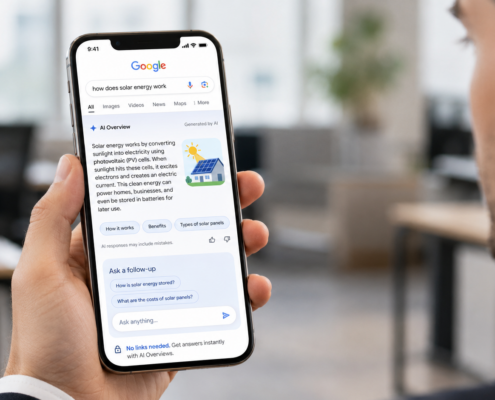
In its place, Google is deploying conversational AI and autonomous agents powered by its Gemini models — systems designed to answer questions, compare options, and complete transactions without ever sending a user to your website.
For established businesses doing $5M to $50M in revenue, this is a critical moment that demands strategic action, not a wait-and-see approach.
The End of the Click: What Google Actually Announced
Google’s announcement makes one thing clear: they no longer want users to leave Google. Here is what is changing right now:
Conversational Search: The search box is now built for full natural language queries. Users ask questions the way they would speak to a person, and Google’s AI responds in kind.
Follow-Up Conversations: Instead of clicking a link to find more information, users continue the conversation directly within Google. The AI refines, expands, and clarifies — all without a single outbound click.
Autonomous AI Agents: Google is introducing “information agents” that can browse the web, synthesize data from multiple sources, and deliver a complete answer — all on your behalf.
Agentic Booking: In select categories, Google’s AI can now complete transactions autonomously, including booking appointments and making purchases, without the user ever visiting a business’s website.
The implications for your business are profound. When an AI agent is doing the searching, comparing, and deciding — your traditional web presence may never even enter the equation.
The Data Is Already Brutal
You do not have to wait to see the impact of this shift. The bleeding has already begun.
Consider the reality of the current landscape:
- According to a February 2026 study by Ahrefs, Google’s AI Overviews now appear in a significant majority of search results, dramatically reducing click-through rates to organic listings.
- Data from SparkToro shows that 58.5% of all Google searches now end without a single click to any website.
- Half of the top 50 US news sites saw their traffic fall by 20% or more following the expanded rollout of AI Overviews.
- Digital Content Next reported that median referral traffic from Google to publisher sites has dropped sharply over the past 12 months.
These are not projections. These are current numbers. And with the I/O 2026 announcements now in effect, the acceleration will only continue.
Why Your Current Marketing Strategy Is Failing
Many established businesses have strong operations, proven offerings, and real customer value — but their marketing has not kept pace with how buyers now find and evaluate solutions.
Here is the uncomfortable truth: you do not have a traffic problem. You have a strategy problem.
Relying on an agency to “do SEO” or “run ads” without a broader strategic framework is no longer sufficient. Tactical execution without strategic direction produces activity, not results.
If your website and messaging do not clearly articulate your value proposition in a way that AI systems can surface, synthesize, and recommend — you are invisible in the new search ecosystem.
This is not about tactics anymore. It is about strategic clarity.
The Strategic Pivot: What You Must Do Now
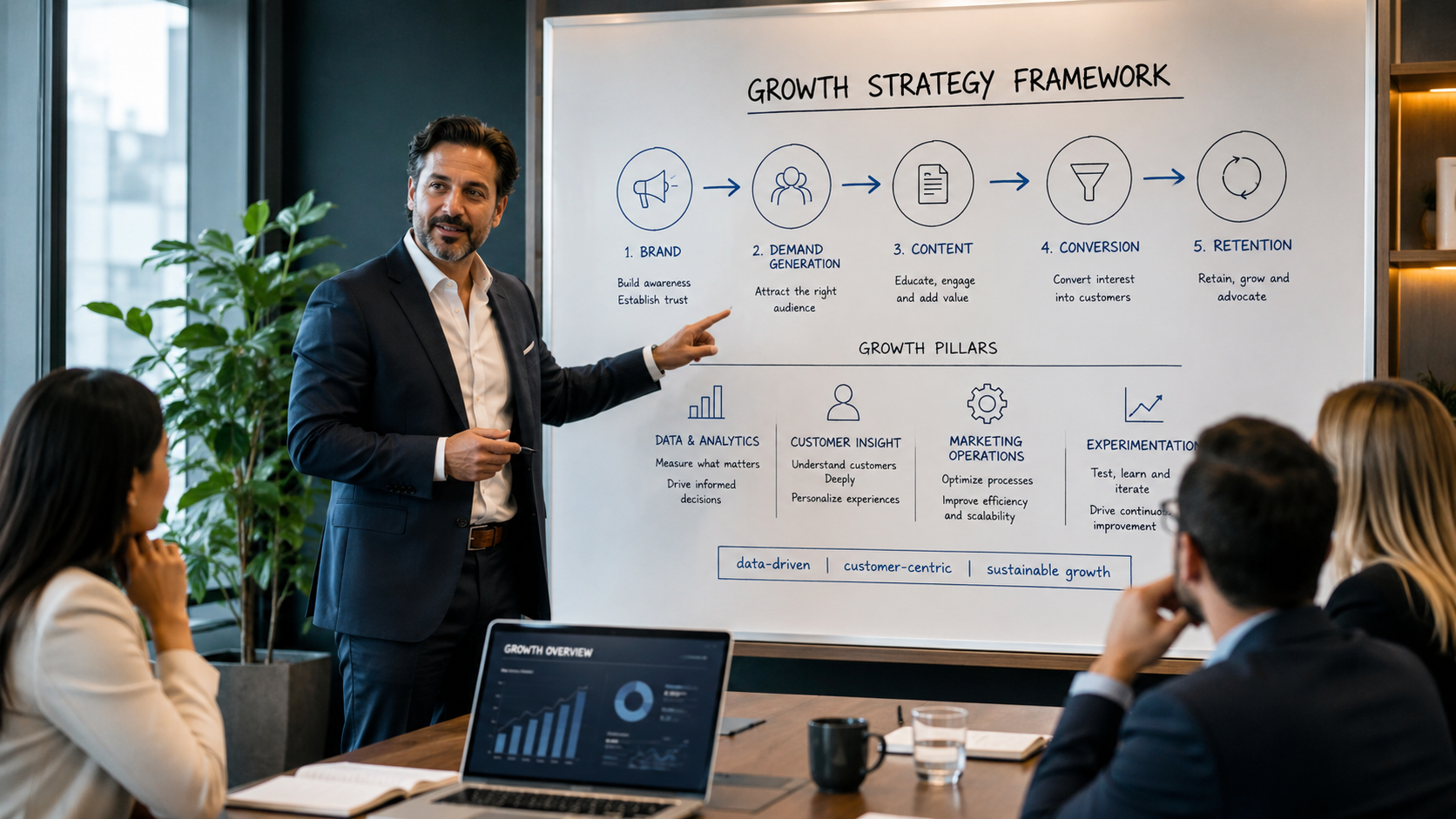
Hope is not a strategy, and waiting for Google to revert to the old way of doing things is not a plan. Here is how serious operators are adapting to the AI search era:
1. Optimize for Answers, Not Just Keywords. Answer Engine Optimization (AEO) is replacing traditional SEO as the primary discipline for search visibility. Your content must directly and authoritatively answer the questions your buyers are asking — in a format that AI can extract and surface.
2. Strengthen Your Positioning. Generic claims will be ignored by both AI systems and human buyers. You need clear, specific, differentiated messaging that speaks directly to your ideal customer’s problem and your unique ability to solve it.
3. Build Owned Audiences. You can no longer rent access to your market through Google. Email lists, communities, referral networks, and direct relationships are now strategic assets — not optional add-ons.
4. Install Marketing Leadership. Tactics without strategy are expensive and ineffective. Businesses at the $5M to $50M level need executive-level marketing thinking, not just execution-level vendors.
Stop Chasing Tactics. Start Building a Growth System.
The businesses that survive and thrive in this new era will be the ones that approach marketing as a system — not a set of disconnected tactics managed by disconnected vendors.
If you are a founder, president, or CEO of a $5M to $50M company, you do not need more marketing tools. You need a strategic growth partner who understands how to build visibility, authority, and pipeline in an AI-first world.
At Luce Media, we provide executive marketing leadership without the cost of a full-time CMO. We help established businesses clarify their positioning, align their marketing with their growth goals, and adapt to changes like this one before they become crises.
The search box is gone, but your buyers are still out there. It is time to change how you reach them.
Ready to evaluate your marketing strategy for the AI search era? Schedule a strategic conversation with Luce Media