Who Owns Marketing? You Don’t Need More, You Need an Owner

Who Owns Marketing? You Don’t Need More, You Need an Owner
Quick answer
Who owns marketing in your company should have a one-name answer: the person who answers for the result, not the person doing the most tasks. Most companies doing $5 million to $50 million in revenue have plenty of marketing activity and nobody accountable for the number. AI makes that gap more expensive, because it multiplies output without adding direction. The fix is to put one name on the result, whether that person is promoted from inside, hired full time or brought in as a fractional CMO.Key takeaways
- Marketing activity does not necessarily mean marketing leadership and ownership.
- AI removed the natural speed limit on marketing output. Without an owner, more output just means more noise.
- A marketing owner sets the target, chooses what not to do, connects marketing to sales, manages vendors, decides where AI fits and reports to the CEO in plain language.
- Companies at $5 million to $50 million often split the job up because a full-time CMO is hard to justify.
- You can promote from inside, hire full time or bring in a fractional leader. The rule stays the same: one name on the result.
Who owns marketing in a typical mid-market company?
In most mid-market companies, nobody owns marketing. The work is spread across several people and vendors, and nobody answers for the number. Walk into a company doing $15 million in revenue and ask who owns marketing. You will usually get a long pause. Here’s what I find when I look closer. There is an agency running ads. A freelancer writes blog posts. Someone in operations manages the website. Sales builds its own decks. The CEO approves things when asked. Everyone is busy. Nobody is accountable for the number. I call this random acts of marketing. Each piece might be done well on its own. But nobody connects the pieces to revenue, and nobody decides which pieces matter. Marketing activity does not necessarily mean marketing leadership and ownership. You have people executing plans, but nobody is really looking at the strategy, the governance or the growth.Why does AI make the marketing ownership problem worse?
AI makes the ownership problem worse because it removes the natural speed limit on marketing output. A team without an owner can now produce ten times more, with no more direction than before. Before AI, a weak marketing structure was held back by how long things took. A blog post took a week. A new outreach push took a month. The slow pace limited the damage. AI removed the brakes. Now a team can publish every day without anyone asking whether it helps the business. The adoption is already here. According to Outcomes Rocket’s State of AI in Marketing 2025 report, conducted by Prolific, 93.5% of marketers use generative AI at work every day, and 82.4% use it for content creation. A 2025 survey from 10Fold found that average B2B content volume tripled while budgets barely moved. So output went up. Direction did not. More output with no owner gives you noise. Your market already has plenty of that. Your buyers are getting more generic content than ever, and they are getting very good at ignoring it.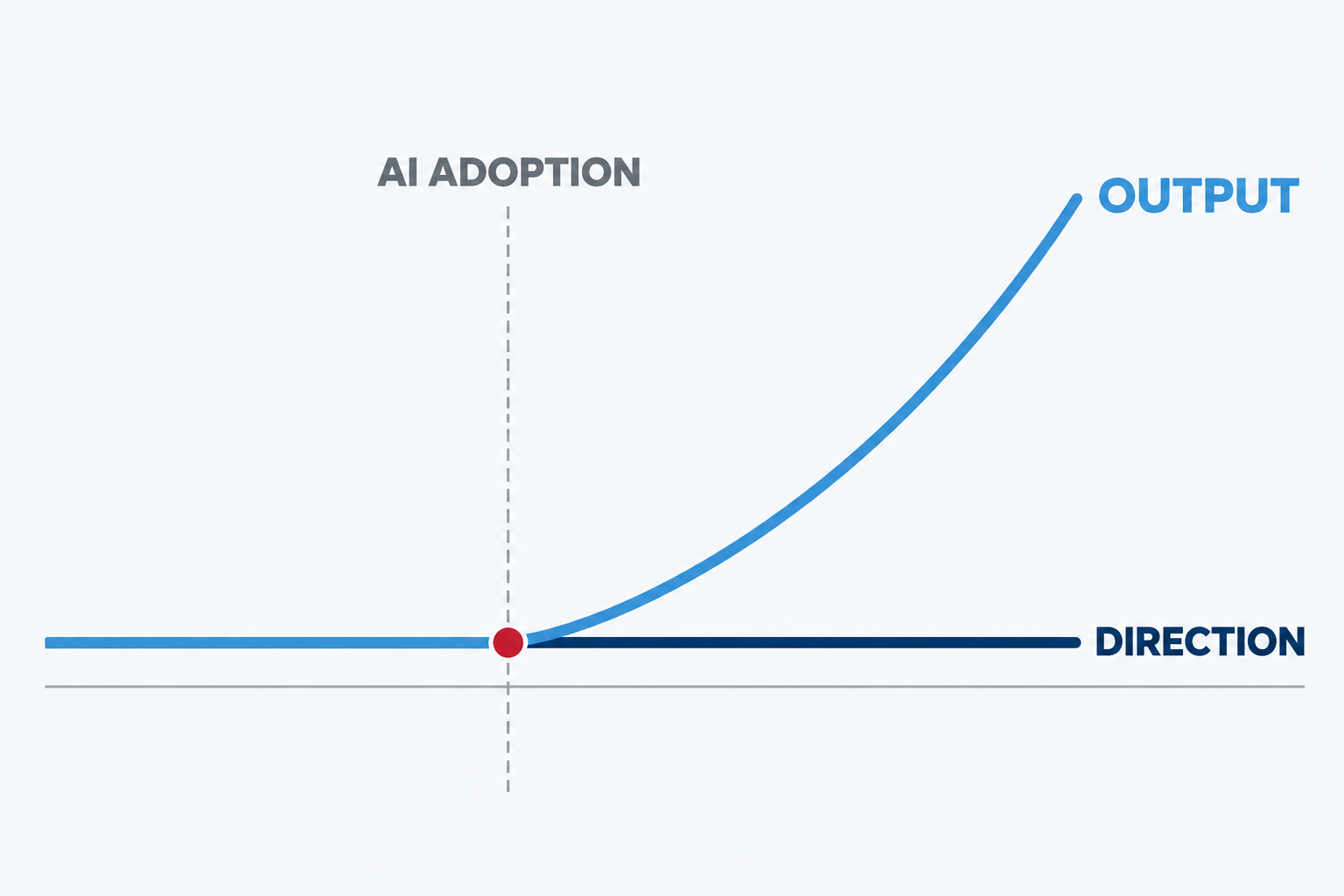
What does a marketing owner actually do?
A marketing owner is not a person who does everything. A marketing owner is the person who answers for the result. Here is what that looks like in practice.They set the target.
They decide, for example, how many qualified meetings marketing should create next quarter. Then they tie that number to the revenue goal.They choose what not to do.
This is the hardest part of the job. It means saying no to five good ideas so the team can do two great ones.They connect marketing to sales.
They sit in the pipeline review. They know why deals are won and why they are lost.They manage the vendors.
Agencies, freelancers and tools all report to one person, with clear goals and scorecards.They decide where AI fits.
Not everywhere. They put it in the places where it saves time or improves quality, with a human checking the work.They report to the CEO in plain language.
What worked, what did not, what we are changing, and what it means for revenue. I always lead with strategy. Every one of these duties is a strategic decision before it ever becomes a task.Why don’t most companies have a marketing leader who owns the result?
Most companies do not have a marketing owner because a full-time CMO is expensive. For a company at $5 million to $50 million, that cost is hard to justify when the need is more about direction than headcount. The numbers are real. According to Built In (2026), the average total compensation for a U.S. CMO is $293,575. That is before recruiting fees and before the team a new CMO usually wants to build. So the job gets split up. The head of sales takes part of it. The operations lead takes another part. The CEO fills the gaps at night. What happens is the CEO gets handed that plate and has to juggle it with all the other plates already in the air. It works for a while. Then it stalls. And when it stalls, sales have usually plateaued or even declined, and nobody is quite sure where the wall is.Which marketing leadership option fits: promote, hire or go fractional?
There are three ways to put a marketing owner in place: promote someone from inside, hire a full-time leader or bring in a fractional CMO. The right choice depends on your revenue, your complexity and how much direction you need.Promote someone from inside.
This works if the person has real strategic experience. A great marketing coordinator is not always a great marketing leader. Be honest about the gap.Hire a full-time leader.
This is the right move when revenue and complexity justify it. Expect a long search and a real investment.Bring in a fractional leader.
A fractional CMO is a senior operator who works with you part time, owns the plan and the scoreboard, and manages the moving parts. This fits many companies in the $5 million to $50 million range, because you get the experience without the full-time cost. RankedCMO’s 2026 pricing guide, as reported by Web Tonic, puts typical fractional CMO retainers at $5,000 to $25,000 per month.| Option | When it fits | What to watch for | Typical investment |
|---|---|---|---|
| Promote from inside | The person already has real strategic experience | Execution skill is not the same as leadership skill | Raise plus training |
| Hire a full-time CMO | Revenue and complexity justify a full executive seat | Long search, high fixed cost | $293,575 average total compensation (Built In, 2026) |
| Bring in a fractional CMO | Companies at $5M to $50M that need direction more than headcount | Make sure they own the result, not just advise | $5,000 to $25,000 per month (RankedCMO via Web Tonic, 2026) |
Three ways to put one name on the marketing result.
Whichever path you choose, the rule stays the same. One name on the result.How can you tell if your company has a marketing ownership gap?
You can spot a marketing ownership gap with three questions. If you hesitate on any of them, you have a gap worth closing. Ask yourself these today.- If revenue from marketing dropped 20 percent next quarter, who would I call first?
- Who can tell me, without looking it up, our cost per qualified opportunity?
- Who decides which new AI tool we try and which one we skip?
What should you do next to fix marketing accountability?
Start by listing every person and vendor who touches marketing, then write down the result each one is responsible for. Not the task. The result. If there are gaps or overlaps, that is where your money is leaking. Then decide who will own the whole picture. Put their name at the top of the page.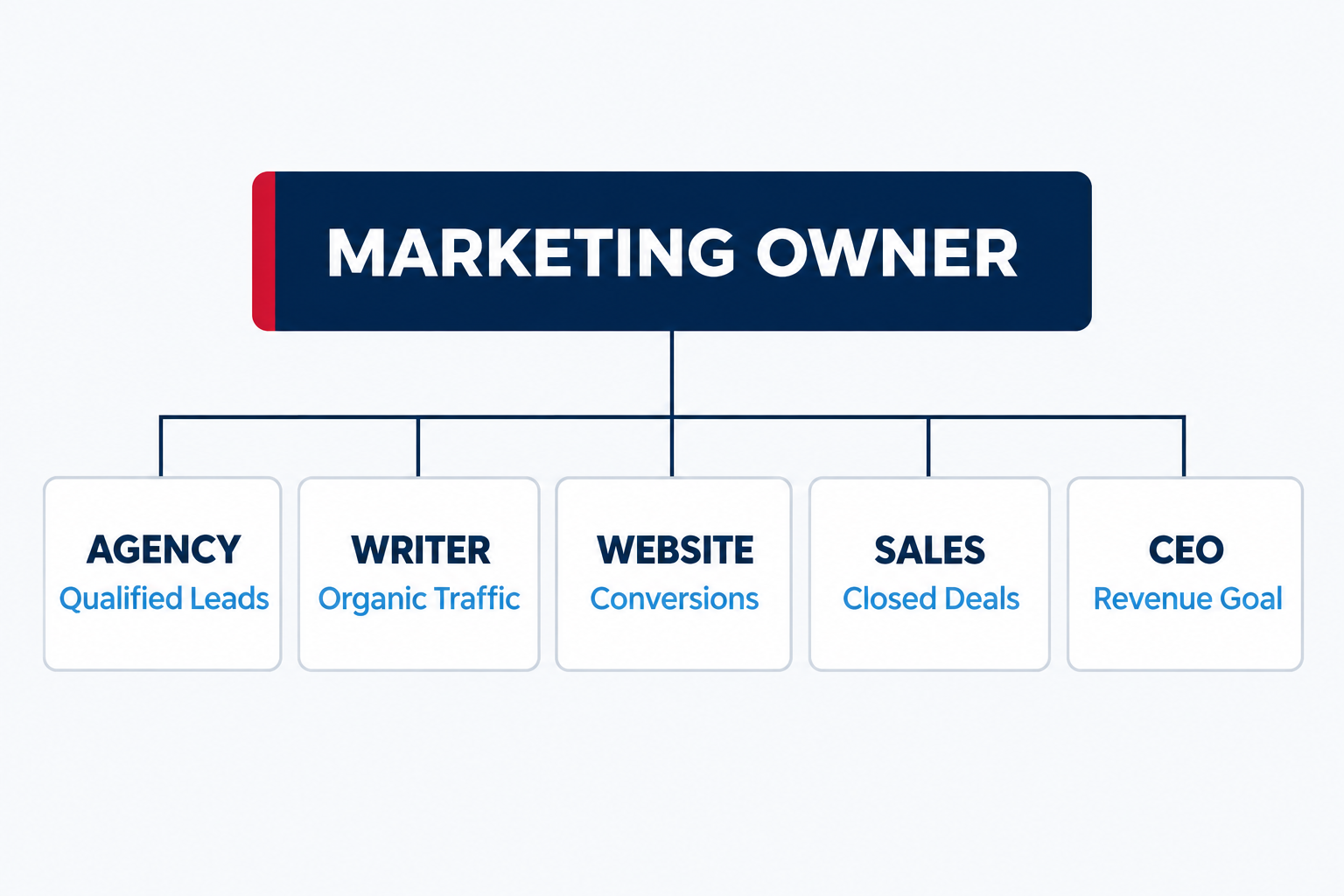
What changes when one person owns marketing?
When one person owns marketing, things get simpler fast. Meetings get shorter, decisions get quicker, and AI gets used where it helps and ignored where it does not. The agency knows who it answers to. Sales knows who to call when the pipeline looks thin. The team knows which two things matter this quarter and which five they are not doing. And you stop being the person who has to hold it all together. The CEO doesn’t have to do it by himself.Related reading
- Quality over quantity in blogging makes the case for publishing less and saying more, which matters even more when AI makes volume cheap.
- What Is Generative Engine Optimization (GEO)? explains how GEO relates to SEO and AEO and includes a four-week starter framework.
- Google Just Killed the Search Box: What the AI Overhaul Means for Your Business looks at Google’s May 2026 search redesign.
Frequently asked questions
Who owns marketing in a mid-sized company?
In a well-run company, one person owns marketing and answers for the result. That is usually a CMO, a VP of Marketing or a fractional CMO. In many mid-sized companies, nobody does. The work is split across agencies, freelancers, sales and the CEO, and no one is accountable for the number.
What does it actually mean to own marketing?
Owning marketing means answering for the result, not doing every task. The owner sets the target, decides what not to do, connects marketing to sales, manages the vendors, decides where AI fits and reports to the CEO in plain language.
Why does marketing ownership matter more now that everyone uses AI?
AI lets a team produce far more content and outreach than before. Without an owner, that extra output turns into noise that buyers learn to ignore. An owner makes sure AI is used where it helps the business and skipped where it does not.
What is the difference between a fractional CMO and a full-time CMO?
A full-time CMO works only for your company and carries full executive pay, which averages $293,575 in total compensation in the U.S. according to Built In. A fractional CMO is a senior leader who works with you part time, owns the plan and the scoreboard, and costs a fraction of that. Both should own the result.
Is a fractional CMO right for a company doing $5 million to $50 million in revenue?
Often, yes. Companies in that range usually need direction more than headcount, and a fractional CMO brings senior experience without the full-time cost. If your revenue and complexity already justify a full executive team, a full-time hire is the better fit.
How do I find out who owns marketing in my company?
Ask three questions. Who would you call first if marketing revenue dropped 20 percent? Who can tell you your cost per qualified opportunity without looking it up? Who decides which AI tools you try? If you hesitated on any of them, you have a gap.
Can I promote someone from inside to own marketing?
Yes, if that person has real strategic experience. A strong marketing coordinator is not automatically a strong marketing leader. Be honest about the gap before you hand someone the result.
Final thoughts
Your company does not need more marketing. It needs one person who owns the result. Here is where to start this week.- List every person and vendor touching marketing, and write the result each one owns next to their name.
- Run the three-question test above and notice where you hesitate.
- Decide whose name goes at the top of the page, whether that person comes from inside, from a full-time search or from a fractional engagement.